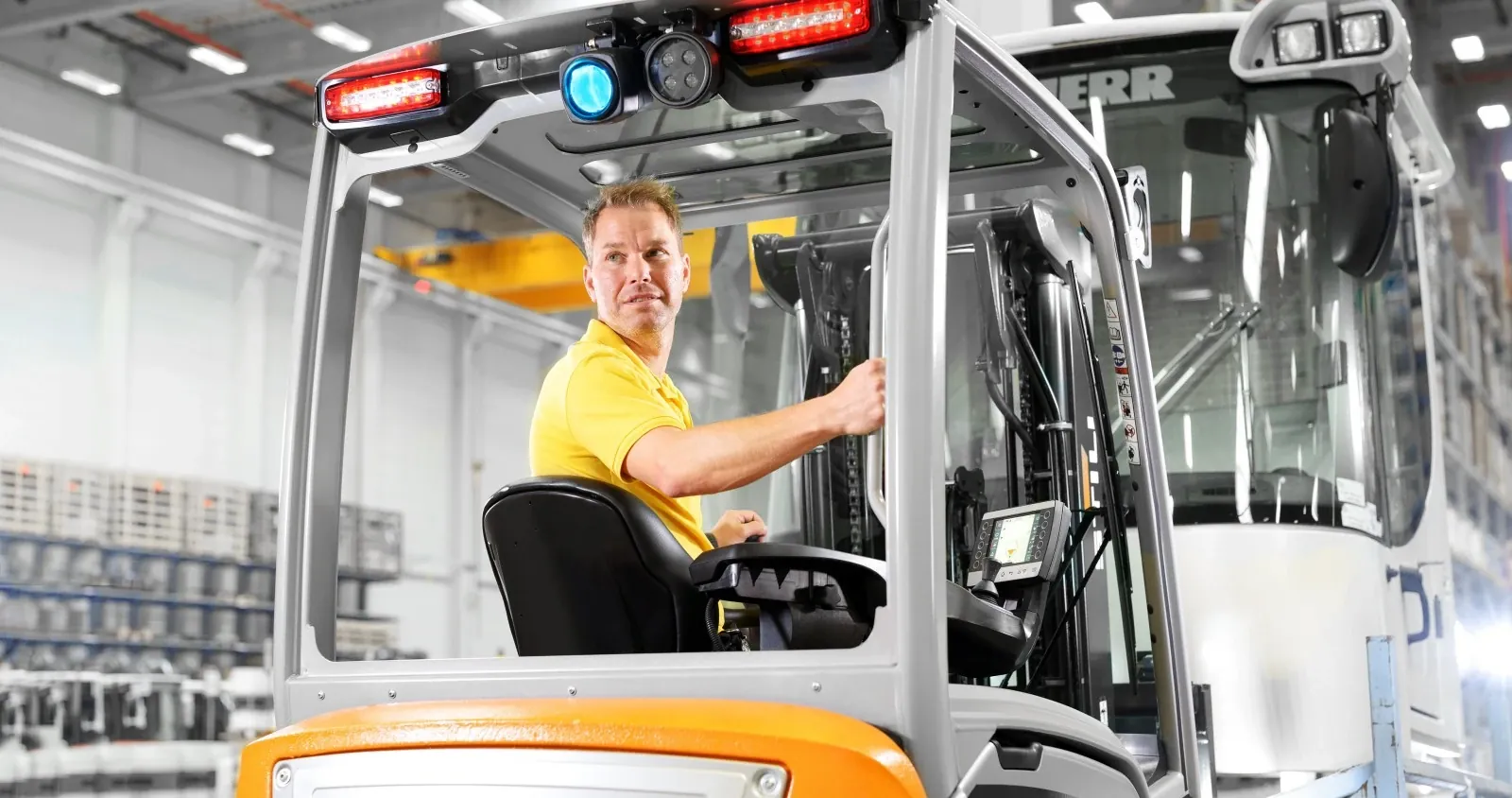
In a food processing plant or a beverage bottling site, forklifts work right next to packing areas, finished goods storage and the dispatch dock. An electric forklift for the food industry therefore has to be more than strong: it must produce no exhaust, keep oil off the floor and carry enough energy for production schedules that run around the clock.
Why electric counterbalance trucks are the default in food plants
Most food plants are enclosed spaces where odours and fumes must be controlled. Combustion trucks release exhaust exactly where goods may not yet be sealed, so they are usually kept to outdoor yards. Electric counterbalance trucks produce no exhaust and run quietly. Lines also often run two or three shifts, and peak seasons such as Tet or summer for soft drinks can mean almost no stop, so trucks must support opportunity charging or fast battery changes.
Where electric counterbalance trucks work in the plant
- Receiving raw materials and packaging: unloading pallets of flour, sugar, additives, film reels and flat cartons from trucks or containers.
- End-of-line pick-up: taking stretch-wrapped finished pallets from the palletiser to finished goods storage or the quality hold area.
- Moving goods into chillers and cold stores: taking pallets through the cold store door, where batteries and drivers face low temperatures.
- Dispatch to distributors: loading full pallets onto trucks by order, usually bunched in the early morning and late afternoon.
STILL models suited to food and beverage plants
STILL RX 20: the multi-shift workhorse with a cold-store-ready Li-Ion battery
The STILL RX 20 covers 1.4 to 2 tonnes, reaches 20 km/h and offers a lift height of up to 7930 mm according to the manufacturer. STILL says the RX 20 shows its strength in two- or three-shift operation in narrow aisles, including drinks stores. The Li-Ion version uses batteries described as suitable for cold storage, the electronics monitor every cell in real time, and just 30 minutes of charging extend usage by several operating hours.
STILL RXE 10 – 16C: compact enough for containers and narrow aisles
The STILL RXE 10 – 16C is a three-wheeler for 1.0 to 1.6 tonnes, just under 2 metres high and 1 metre wide, with a top speed of 12.5 km/h. STILL names the food industry as a typical application, alongside loading trucks and containers. In small plants, cramped packing areas or narrow cold store doors, its compact size and standard Curve Speed Control keep it safe in tight turns.
STILL RX 60: when beverage pallets are heavy and tall
Pallets of bottled water, canned beer or crates of empties are heavier than dry food pallets. The STILL RX 60 2.5 – 3.5 t handles up to 3.5 tonnes and offers lateral battery change for multi-shift work. STILL describes the RX 60 6.0 – 8.0 t as usable indoors and outdoors, even in damp and dusty environments.
Selection table by stage
| Stage | Type/model | Reason |
|---|---|---|
| End-of-line pick-up, multi-shift | STILL RX 20 Li-Ion | 30-minute opportunity charging, no exhaust indoors |
| In and out of chillers and cold stores | STILL RX 20 Li-Ion | Li-Ion battery described as suitable for cold storage |
| Unloading containers, tight plants | STILL RXE 10 – 16C | Compact three-wheeler, works inside trucks and containers |
| Heavy beverage pallets, dispatch | STILL RX 60 2.5 – 3.5 t | Up to 3.5 tonnes, lateral battery change |
The full counterbalance range is in the electric forklifts category.
Operating points specific to food plants
- Wet floors after cleaning: processing areas are often washed every shift. Set speed limits per zone; Curve Speed Control slows the truck automatically in bends.
- Heavy pedestrian traffic: Safety Light 4Plus projects blue spots about 5 m in front of and behind the truck to warn people at blind corners.
- Temperature changes: trucks moving between cold stores and ambient areas are prone to condensation. Read cold storage forklifts before finalising the specification.
Other truck types for each stage are summarised on the forklift solutions for food & beverage page.
Frequently asked questions
Must a food plant use electric forklifts?
There is no single rule for every case, but in production and enclosed storage electric trucks make sense because they produce no exhaust. Check against the food safety management system you apply.
Can a Li-Ion electric forklift work in and out of cold stores?
For the RX 20 Li-Ion, STILL states that its batteries are suitable for cold storage. Time spent in deep-freeze areas and door frequency should be surveyed case by case.
3-wheel or 4-wheel for a beverage plant?
In tight plants with lots of container work, a three-wheeler such as the RXE 10 – 16C is more agile. For heavy pallets, long runs and ramps, choose a four-wheeler such as the RX 20 or RX 60. See also 3-wheel vs 4-wheel electric forklift.
Need to size the fleet and battery set-up for your plant? Send a request on the quote page or call 0902 63 79 70 for a site survey.