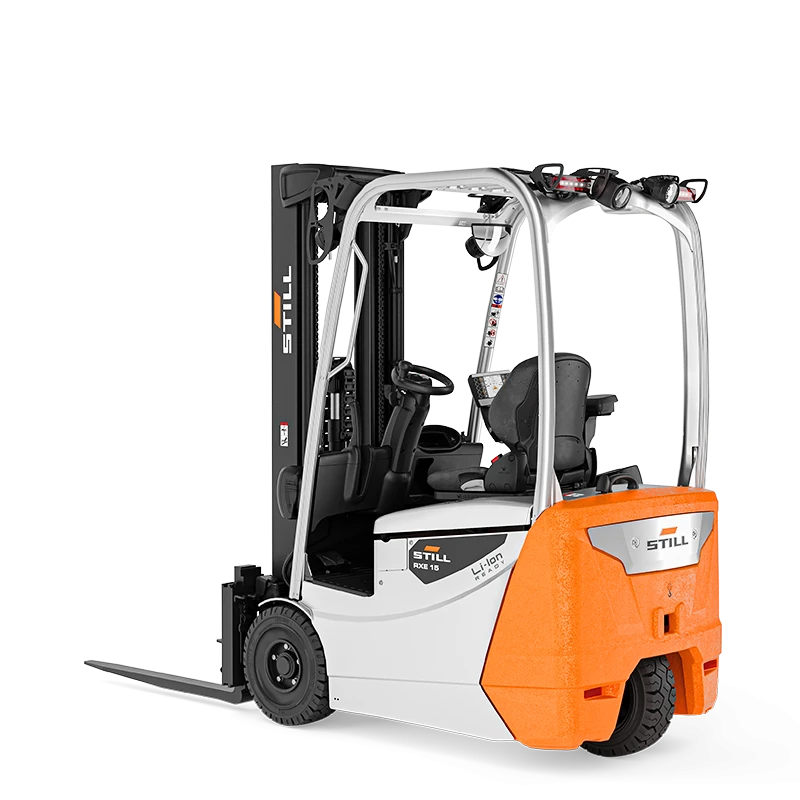
When choosing between a 3-wheel and 4-wheel electric forklift, many companies look only at price and capacity. In practice, the number of wheels determines how the truck turns, how stable it is on uneven ground and which aisles it can enter. This article compares the two chassis principles and then looks at four small-to-medium STILL electric series: RCE 15–20, RCE 25–35, RXE 10–16C and SXV-CB 10.
How do 3-wheel and 4-wheel forklifts differ?
Both are counterbalance trucks: the load sits on the forks at the front, while the truck’s weight and counterweight at the rear keep it balanced. The difference is the rear axle.
- 3-wheel trucks: one steered wheel (or a closely paired set) sits in the centre at the rear. The truck turns almost around the centre of the front axle, giving a small turning radius that suits narrow aisles, lorries, containers and areas with many corners.
- 4-wheel trucks: two rear wheels sit on either side. The wider stability base makes the truck steadier in bends, on uneven floors, gentle ramps or outdoor yards. In return, the turning radius is usually larger than a 3-wheel truck of the same capacity.
STILL’s source sums this up for the RCE 15–20: the three-wheel forklift truck “moves safely even in the tightest of spaces”, while the four-wheel forklift truck “impresses with stability and safety, even on uneven ground”.
Four STILL electric series to consider
| Series | Capacity (kg) | Max. lift height (mm) | Speed (km/h) | Voltage (V) | Truck type per source |
|---|---|---|---|---|---|
| STILL RXE 10 – 16C | 1,000 – 1,600 | 5,610 – 6,810 | 12 | 24 | 3-wheel counterbalance, sit-down |
| STILL RCE 15 – 20 | 1,500 – 2,000 | 6,500 | 15 – 16 | 80 | 3-wheel and 4-wheel versions, sit-down |
| STILL RCE 25 – 35 | 2,500 – 3,500 | 6,500 | 15 | 80 | Sit-down counterbalance |
| STILL SXV-CB 10 | 1,000 | 5,380 | 12 | 24 | Stand-on counterbalance, central tiller |
Figures are from the manufacturer’s model tables.
STILL RXE 10 – 16C: the most compact 3-wheel truck
The RXE 10–16C is the smallest member of STILL’s electric forklift family and the successor to the RX 50. It is just under 2 metres high and about 1 metre wide, fits through doorways and can enter lorries and containers. According to STILL:
- Capacity up to 1.6 tonnes at a 500 mm load centre; maximum lift height of almost 7 metres.
- Top speed of 12.5 km/h (12 km/h laden), with a maintenance-free 24 V three-phase AC drive.
- Curve Speed Control fitted as standard; options include lift height display, overload detection and lift height preselection.
- A lateral quick-charging port for the optional Li-Ion battery.
- The same operating concept as the RX 20 and RX 60, so operators can switch trucks without retraining.
Best for: the food industry, logistics service providers, production supply, and loading lorries and containers. STILL also positions the RXE as an attractive upgrade from a stacker truck.
STILL RCE 15 – 20: choose 3-wheel or 4-wheel
The RCE 15–20 is available in both three-wheel and four-wheel versions, with a width of just under 110 cm (a minimum of 1,120 mm in the detailed specifications). It lifts up to 2.0 tonnes at a 500 mm load centre to a height of 6.5 m. The RCE 15, RCE 16 and RCE 20 travel at 16 km/h; the RCE 16P and RCE 20P at 15 km/h.
- A 4.3-inch display shows the drive programme and battery status.
- Front-wheel drive with an encapsulated, maintenance-free 80 V AC motor.
- High ground clearance and an optional fully enclosed cab for outdoor work.
- Side charging; the Li-Ion version has a quick-charging port for opportunity charging at many points.
Best for: online retailers, wholesalers, DIY stores and production workshops with occasional transport and stacking tasks.
STILL RCE 25 – 35: higher capacity, simple configuration
The RCE 25–35 lifts up to 3.5 tonnes at a 500 mm load centre to 6.5 m, with a top speed of 15 km/h and an encapsulated 80 V AC motor. Operators select Economy, Efficiency or Performance on the 4.3-inch display and can see the remaining operating time. The truck comes in three pre-configured equipment packages, with an optional enclosed cab for outdoor use. The source does not state the wheel configuration of the RCE 25–35, so our engineers will confirm it for the specific model.
In the F+H test of the RCE 25, the real operating time with maximum battery capacity was 7:26 h (Performance) to 8:00 h (Economy). F+H called it “a solid basic model for everyday work”.
STILL SXV-CB 10: stand-on and ultra-compact
The SXV-CB 10 is a stand-on electric counterbalance truck that lifts 1,000 kg on cantilever forks up to 5,380 mm. Thanks to its self-supporting forks, it can even lift closed load carriers. Highlights according to STILL:
- A centrally positioned OptiSpeed tiller automatically adjusts speed according to the distance between the operator and the truck.
- A low step height of only 120 mm on each side, a spacious platform and an upholstered backrest.
- Li-Ion batteries from 300 Ah to 500 Ah, with lateral battery change.
- ECO, BOOST or Blue-Q modes; Curve Speed Control in bends.
Best for small warehouses, shops and workshops with narrow aisles where the operator gets on and off many times per shift.
How to choose: a quick guide
- Very narrow aisles, lorries, containers, loads up to 1.6 tonnes: RXE 10–16C (3-wheel).
- Loads up to 2 tonnes, moving between indoors and the yard: RCE 15–20; choose the 3-wheel version for manoeuvrability, the 4-wheel version for uneven floors.
- Loads of 2.5–3.5 tonnes at moderate intensity: RCE 25–35.
- Loads up to 1 tonne, stand-on, frequent getting on and off: SXV-CB 10.
- High intensity, two to three shifts: consider a high-performance series such as the STILL RX 20 (available as a four-wheel version with the Combi floating axle).
Whichever series you choose, check the load chart against your real rack height. See how to choose forklift capacity.
Frequently asked questions
Is a 3-wheel forklift less safe than a 4-wheel one?
No, when used in the right environment. A 3-wheel truck is optimised for level floors and narrow aisles. On uneven floors or outdoor yards, a 4-wheel truck is more stable. Features such as Curve Speed Control reduce speed in bends on both types.
Can the RXE 10–16C replace a stacker?
According to STILL, the RXE is an attractive upgrade from a stacker, offering more comfort and safety, especially for longer runs and lorry loading.
Should a small truck have a Li-Ion battery?
If the truck runs several shifts or needs opportunity charging, Li-Ion is well worth considering. See lithium-ion vs lead-acid forklift battery.
Not sure whether to choose 3 or 4 wheels? Send your aisle layout, load and rack height via the request a quote form or call our hotline 0902 63 79 70.