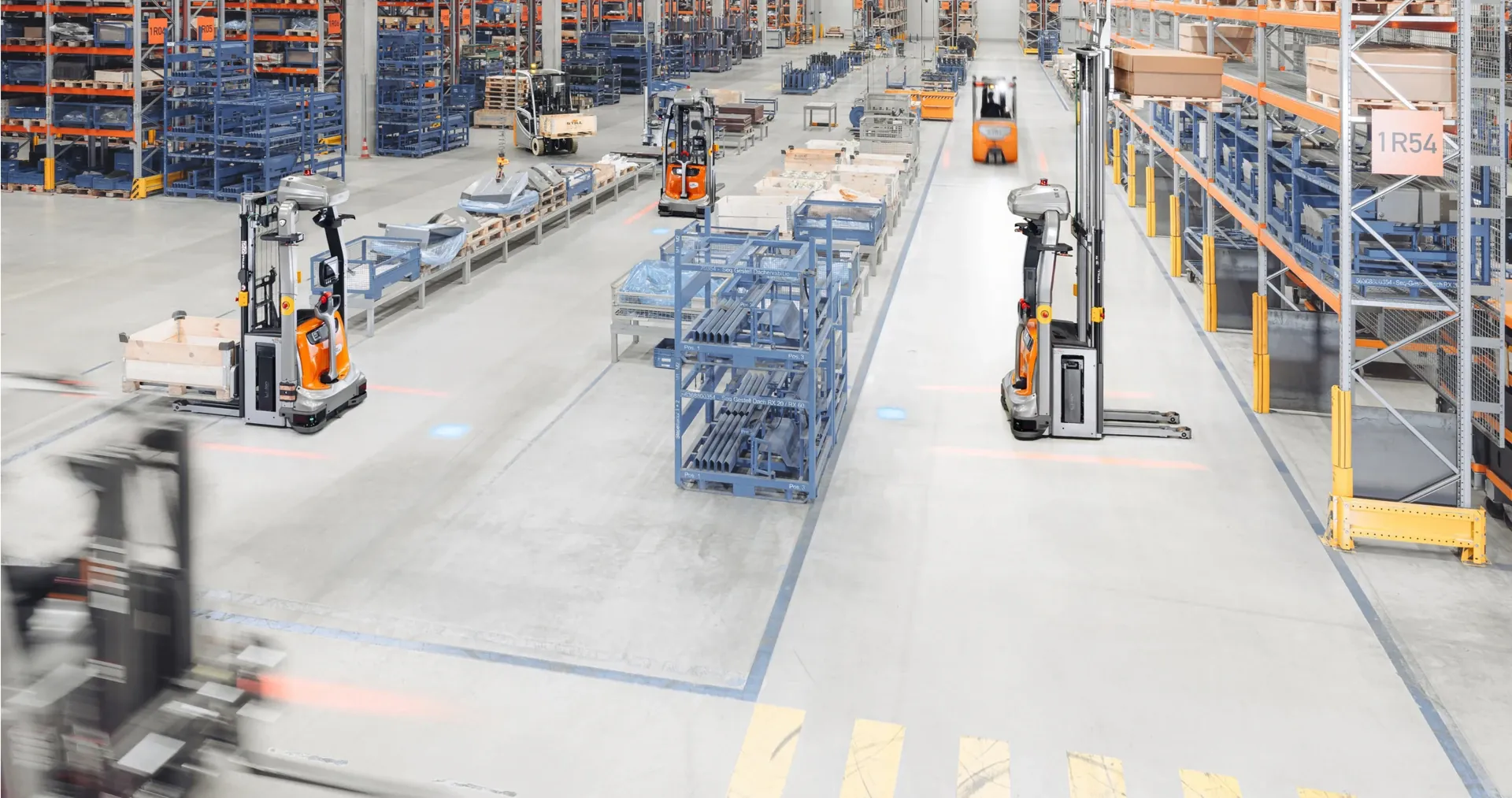
Warehouse automation
Warehouse automation with STILL iGo automated trucks: start with one repetitive transport route, expand step by step and run alongside manual trucks.
When should a warehouse automate?
Operator shortages, fluctuating volumes and demand for fast delivery are leading many companies to automate their warehouses. Every warehouse has its own material flow, so the effective approach is to start with one specific process. A suitable process usually shows these signs:
- A transport route repeated many times per shift, such as end-of-line to storage or replenishment of picking zones.
- The site runs 2–3 shifts and struggles to staff enough drivers for simple runs.
- Fairly uniform pallets and load carriers with fixed pick-up and drop-off points.
- The truck loading area is regularly congested at peak times.
The difference between AGVs and AMRs is covered in Autonomous forklifts (AGV/AMR): when should a warehouse automate?. This page focuses on the STILL iGo solutions that TCID advises on and implements.
STILL iGo: one system, several levels of automation
STILL iGo includes both automated trucks and software, sharing one open platform across all levels and adapting to existing processes. You do not have to decide at the outset how far you will automate.
iGo easy – a plug-and-play start
iGo easy is for individual transport tasks, needs no software integration, has an intuitive interface and lets you start with just a few trucks. Transport orders are triggered by push buttons, light barriers on a conveyor or a touchscreen; a connection to the warehouse management system (WMS) remains possible when needed. STILL cites an example from plastic injection moulding: EXV iGo trucks take pallets of finished goods to the conveyor heading to the warehouse and bring empty pallets back to the machines, with no WMS connection.
iGo systems – complex processes, mixed fleets
The iGo systems software coordinates multiple trucks and truck types in sync, not as a “taxi” taking isolated orders but according to defined storage and retrieval parameters. In an example published by STILL, in a warehouse with around 20,000 pallet positions, the EXV iGo picks up pallets at goods-in, checks their weight and shape and places them on transfer stations, from where the MX-X iGo very narrow aisle truck stores them; orders come from the WMS.
iGo cube – high-density automated storage
iGo cube is a compact automated storage system with 4-way pallet shuttles, comprising a warehouse control system (WCS), a conveyor pre-zone with contour and weight checks, lifts and storage lanes; shuttles are added as throughput grows. According to STILL, iGo cube operates in ambient, chilled and deep-freeze warehouses down to -28 °C with loads of up to 1,500 kg per pallet. For warehouses with conventional racking, see racking systems.
The STILL iGo automated truck range
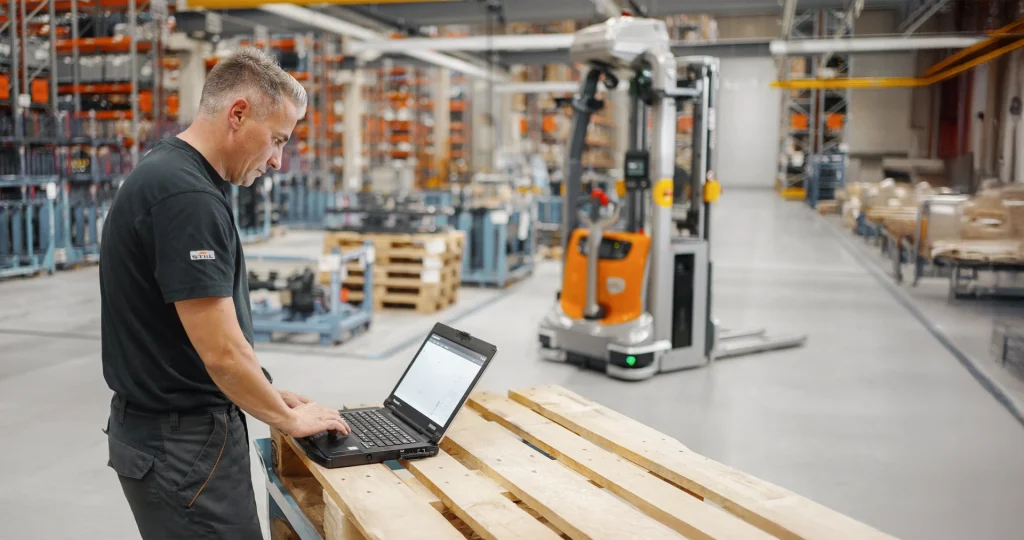
iGo trucks are built on standard STILL trucks, so maintenance and parts stay close to manual trucks. The table summarises key data from STILL documentation; see the full range under automated trucks.
| Model | Truck type | Load capacity | Lift height | Typical application |
|---|---|---|---|---|
| AXL iGo | Autonomous low-lift pallet truck | 1,500 kg | 125 mm | Loading and unloading lorries |
| AXV 12 iGo | Compact automated high-lift pallet truck | 1,200 kg | 1,844 mm | Production supply and removal, goods-in/out |
| EXV iGo | Automated high-lift pallet truck | 1,600 kg | 3,744 mm | Staging areas, transfer stations, horizontal transport |
| EXV-CB iGo | Automated counterbalance high-lift truck | 1,400 kg | 3,800 mm | Varied transfer points, special load carriers |
| FM-X iGo | Automated reach truck | up to 2,330 kg | up to 10,474 mm | High racking, flow racks, conveyors, VNA transfer stations |
All models above travel at 7.2 km/h. The STILL AXL iGo automates lorry loading: it navigates inside the trailer without stationary safety infrastructure at the dock; according to STILL, two trucks in double play can load 30 pallets in about 35 minutes. The AXV 12 iGo is the easiest entry point, working in 2,480 mm aisles. The STILL EXV iGo can fully automate charging via charging contacts, for both lithium-ion and lead-acid batteries. The FM-X iGo features the PPS pallet positioning system and a safety system meeting ISO 3691-4.
Running alongside manual trucks
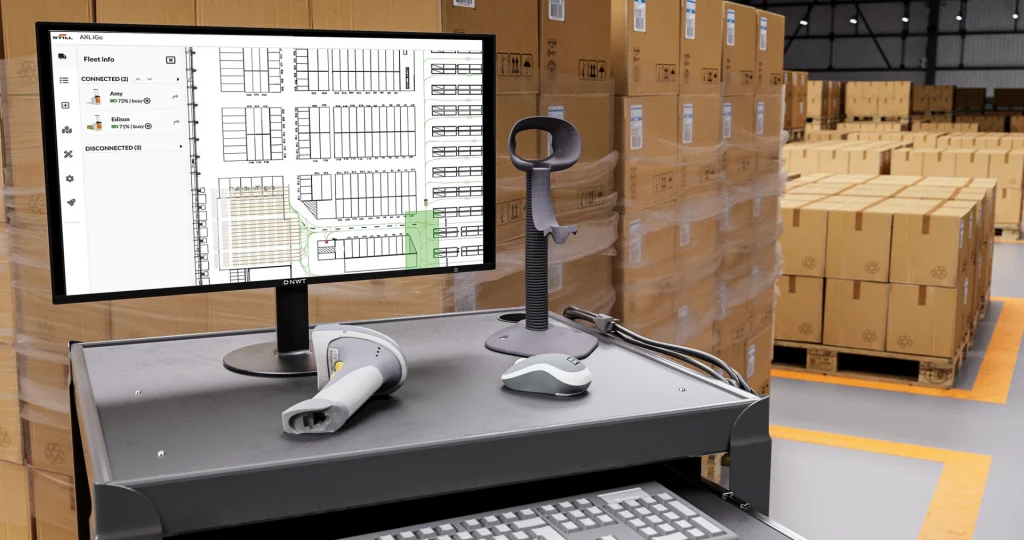
iGo trucks are designed for mixed operation, where pedestrians, manual trucks and automated trucks share the same aisles: 360° safety laser scanners, dynamic safety fields adjust speed to the route and cornering radius, and the STILL Warning Zone Light and optional STILL Safety Light improve visibility. Give repetitive routes to automated trucks, while non-standard pallets, damaged goods and rush orders stay with manual trucks. When both groups run together, tracking operating hours and truck allocation matters more; see our fleet management solution.
A step-by-step automation roadmap
| Stage | STILL solution | Connection |
|---|---|---|
| Automate one route | iGo easy with AXV 12 iGo or EXV iGo | Push buttons, sensors; WMS optional |
| Automate lorry loading | AXL iGo, MAS fleet manager | WMS or existing storage system |
| Multiple processes | iGo systems, mixed fleet | WMS interface |
| High-density automated storage | iGo cube with AGVs | WCS connected to the WMS |
How TCID implements it
TCID works with STILL automation specialists, supporting customers from our Hanoi office, Ho Chi Minh City office and the Long Binh Service Center in Bien Hoa, Dong Nai:
- Survey the layout, aisles, material flow, shifts and IT systems.
- Choose a pilot route, the right iGo level and truck models.
- Propose the configuration, safety concept and quotation.
- Install, map the site, set up safety fields and connections.
- Instruct staff on working safely alongside automated trucks.
- Maintain to STILL standards and expand when ready.
Frequently asked questions
Do STILL iGo trucks have to be connected to a WMS?
No. With iGo easy, trucks run standalone, with orders triggered by push buttons, sensors or the touchscreen. A WMS connection is only needed as processes become more complex.
Does the warehouse need major changes to use automated trucks?
Usually not, as the trucks navigate by laser. Even so, the floor, aisle widths and pick-up and drop-off points should be surveyed before choosing a model.
Is it safe for automated and manual trucks to share an area?
iGo trucks have 360° sensors, dynamic safety fields and warning lights. Companies should still separate traffic flows, mark floor lanes and train staff on traffic rules; see also warehouse safety.
Send us your floor plan and a description of your material flow, and TCID will recommend the right STILL iGo level.