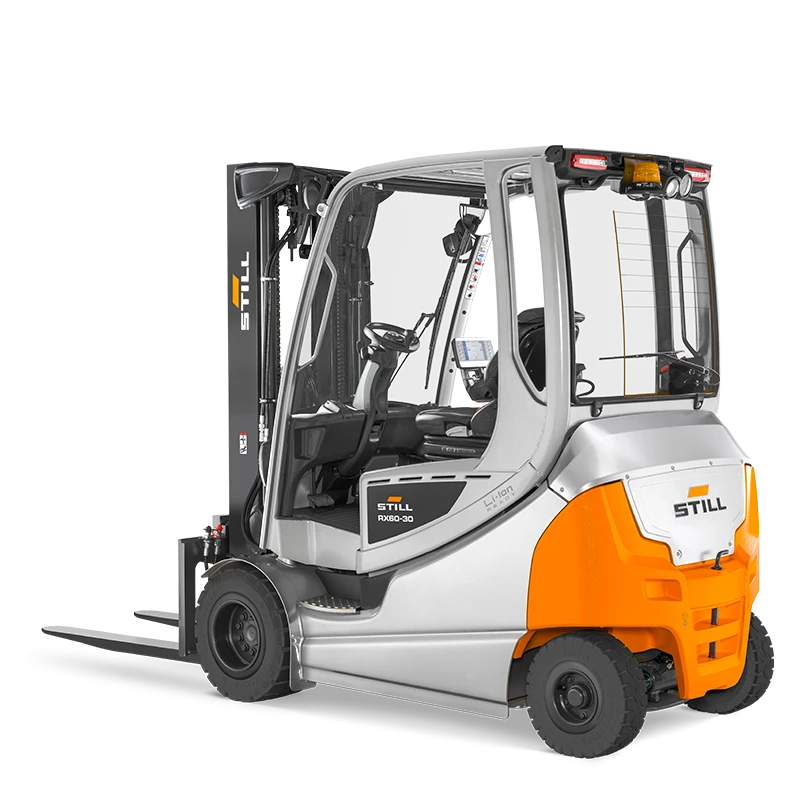
Many businesses choose a forklift based only on the weight of their heaviest pallet. This easily leads to an under-sized truck – with a risk of tipping over or damaging the mast – or an over-sized truck that costs more and is bulky. To choose the right forklift capacity, you need to understand three concepts: rated capacity, load centre and residual capacity at lift height.
1. What is rated capacity?
This is the figure in the model name, for example a 2.0 t or 3.5 t truck. It tells you how much the truck can lift at a standard load centre and at the standard lift height. Outside those conditions, the actual lifting capacity changes.
2. Load centre
The load centre is the distance from the front face of the forks to the centre of gravity of the load. For counterbalance trucks in the common capacity range, the standard load centre is usually 500 mm – corresponding to a pallet about 1,000 mm deep with evenly distributed goods. When the load is longer, or the goods sit towards the fork tips, the centre of gravity moves further out and the truck can lift less than its rated capacity.
A simple way to picture it: holding a water container close to your body feels light, but holding it at arm’s length feels much heavier, even though the weight is the same. A forklift works the same way.
3. Capacity decreases with lift height
The higher the mast, the less stable the truck, so manufacturers publish the residual capacity at each height. For example, the STILL FM-X reach truck stores goods up to 14 m and can still lift 1,000 kg at 13 m. When choosing a truck, compare the weight of your heaviest pallet with the residual capacity at the highest rack level, not with the rated capacity.
How to read a load chart
The load chart (found in the technical data sheet and on the truck’s capacity plate) shows the relationship between three values: lift height, load centre and maximum permitted weight. To read it, find the height at which you need to place goods, follow the actual load centre of the load, and read off the permitted weight. If the load is heavier than this figure, you need a higher-capacity truck or a different mast configuration.
On the STILL FM-X, the residual capacity is 1,000 kg at a height of 13 m but only 850 kg at the maximum height of 14 m. On the same truck, lifting just one rack level higher already reduces the permitted weight. This is why you cannot rely on rated capacity alone.
4. Attachments reduce capacity
Side shifters, paper roll clamps, carton clamps, rotators and similar attachments all add weight and push the centre of gravity further out. When an attachment is fitted, the permitted capacity must be recalculated and shown on the truck’s capacity plate.
5. A 5-step process to choose capacity
- Weigh the heaviest load (not the average).
- Measure the load dimensions to estimate the load centre.
- Determine the height of the highest rack level where goods are placed.
- List the attachments to be fitted.
- Choose a truck whose residual capacity at that height, with that load centre and with the attachments fitted, is still greater than the heaviest load – with a reasonable safety margin.
Besides capacity, also check: the load-bearing capacity of the floor and any mezzanine, ramp gradients, door heights and the height of the mast when fully lowered. Higher-capacity trucks are usually longer and heavier and need wider aisles, so choosing far too much capacity can mean the truck no longer fits your current warehouse layout.
Capacity ranges of STILL trucks
| Series | Capacity | Notes |
|---|---|---|
| RXE 10–16C | 1.0–1.6 t | Electric, compact |
| RX 20 | 1.4–2.0 t | Electric, compact for narrow aisles |
| RX 60 | 2.5–8.0 t | Electric, many versions |
| RX 70 | 2.0–8.0 t | Diesel / LPG |
| RCD | 10–18 t | Heavy-duty diesel |
| FM-X | 1.0–2.5 t | Reach truck, up to 14 m |
Loads with a long load centre
Some truck series are designed for load centres beyond the standard. For instance, the STILL RX 60 6.0–8.0 t can lift up to 8 tonnes at a load centre of 600 or 900 mm, suitable for long and bulky goods. Among smaller counterbalance trucks, the STILL RCE 15–20 lifts up to 2.0 tonnes at a load centre of 500 mm. When comparing models, always compare them at the same load centre.
Frequently asked questions
Can a 3-tonne truck lift a 3-tonne pallet onto a 6 m rack?
Not necessarily. You must check the load chart for that exact mast configuration. At greater heights, the residual capacity is usually lower than the rated capacity.
Should we choose extra capacity to be safe?
A safety margin is advisable, but too much extra capacity makes the truck larger and heavier, uses more energy and requires wider aisles. It is best to let an engineer calculate based on your real data.
Where is the permitted capacity shown on the truck?
The permitted capacity by lift height and load centre is shown on the capacity plate fitted to the truck. When the mast is changed or an attachment is fitted, the capacity plate must be updated accordingly. Operators should be shown how to read the capacity plate before using the truck.
How do we calculate the load centre for loads of varying size?
Calculate for the worst case: the longest load, or the load whose centre of gravity is furthest towards the fork tips. If your goods vary a lot, send a list of typical load types so our engineers can check them against the load chart of each configuration.
Send your load weight, pallet dimensions and rack height via the quote request form or call our hotline 0902 63 79 70 – we will propose a suitable configuration together with its load chart.