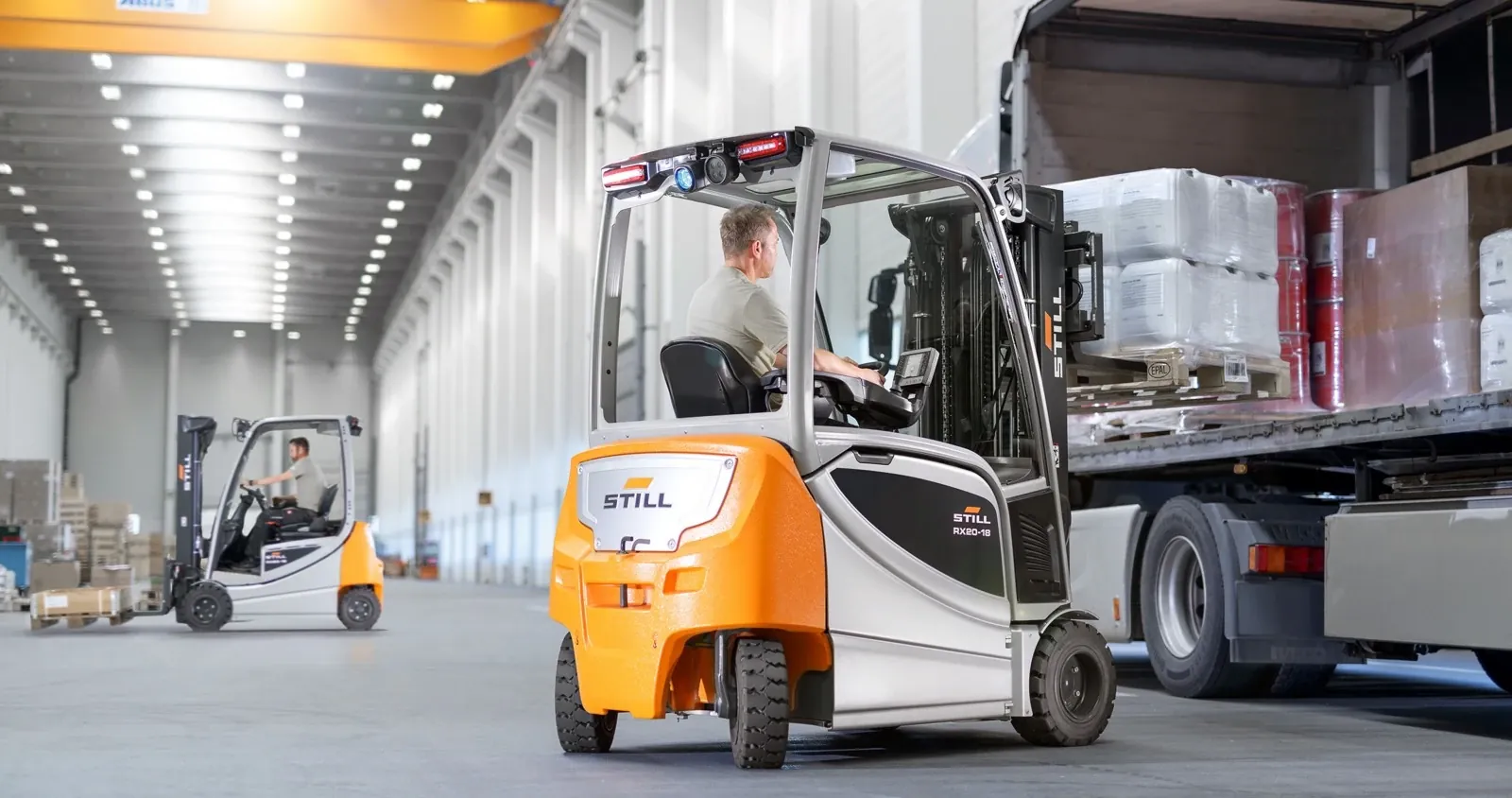
In automotive plants and engineering workshops, the electric counterbalance forklift is usually the truck that runs the most hours: receiving blanks and components at goods-in, bringing material to machining areas and collecting finished parts for the finished goods store. This article explains which steps suit electric forklifts and how to choose between the STILL RX 20, RX 60 and RXE.
Why automotive and engineering shops prefer electric trucks indoors
Assembly and machining areas are enclosed spaces with many pedestrians, machine tools and hand carts. Electric forklifts produce no local emissions and are quieter than combustion trucks, so they suit routes running close to the line. The key requirement is availability across every shift.
Goods are specific: metal mesh boxes of bolts and gears; racks carrying sub-assemblies; pallets of steel blanks that are heavy but compact. Concentrated loads and offset centres of gravity mean capacity and load centre need careful checks, see how to choose forklift capacity.
STILL RX 20: electric truck for multi-shift production supply
According to STILL, the STILL RX 20 really shows its strengths in narrow aisles in heavy-duty two- or three-shift operations, including production supply in the mechanical engineering and automotive industries. The 1.4 to 2 tonne capacity range suits component boxes and medium parts pallets.
- Top speed of 20 km/h, with Performance-Boost when handling rate needs to rise.
- Li-Ion version: just 30 minutes of charging extends usage time by several operating hours, ideal for opportunity charging during breaks.
- Combi floating axle for a small turning radius between workstations.
STILL RX 60: heavier capacity for dies, blanks and large assemblies
When pallets of blanks, sub-assemblies or special carriers exceed 2 tonnes, the STILL RX 60 3.5 – 5.0 t is the electric option for heavy loads. STILL describes it as productive both in production supply and in outdoor storage, accelerating to 20 km/h, and with lithium-ion it can run three shifts without a battery change. For even heavier loads, the RX 60 6.0 – 8.0 t has a model lifting eight tonnes at a 900 mm load centre.
See also: heavy-duty electric forklift STILL RX 60.
STILL RXE: compact 3-wheel truck for tight assembly areas
In small machining shops, sub-assembly areas or tier-2 and tier-3 component suppliers, aisles are often narrow and loads around one tonne. The STILL RXE 10 – 16C is a three-wheel counterbalanced truck that STILL presents for both production supply and lorry loading, with a top speed of 12.5 km/h.
Assigning electric forklifts by process step
| Plant process | Suggested type / model | Reason |
|---|---|---|
| Receiving blanks and components from trucks | STILL RX 20, RXE | Fast unloading, agile at goods-in |
| Line feeding, machining cells | STILL RX 20 Li-Ion | STILL names automotive production supply; opportunity charging |
| Moving dies, blanks, heavy assemblies | STILL RX 60 3.5 – 5.0 t / 6.0 – 8.0 t | Heavy loads, zero emissions, indoor and outdoor use |
| Finished goods store, loading dispatch trucks | STILL RX 20, RX 60 | High handling performance, several drive programmes |
Safety and configuration when working next to the line
Automotive production areas have heavy pedestrian traffic, so consider options such as Safety Light, Curve Speed Control, the STILL Sentry rear-area warning system, plus access control and collision detection via Smart Portal. Floors with oil or metal chips call for suitable tyres. With attachments fitted, re-check the load chart.
On energy, lithium-ion vs lead-acid compares both options against shift count and charging infrastructure. The automotive & engineering forklift solutions hub covers the other truck types in the same chain, and the electric forklifts category lists every model.
Frequently asked questions
Are electric forklifts strong enough for steel blanks and dies?
For medium loads the RX 20 covers 1.4 to 2 tonnes. For heavy dies and blanks, the RX 60 range has models up to 5 tonnes and up to 8 tonnes. Determine the real weight and load centre of each load type before choosing.
Which battery suits continuous three-shift operation?
STILL states the RX 60 with lithium-ion can run three shifts without a battery change, while the RX 20 Li-Ion can be charged briefly to extend usage time. The right option depends on the shift plan and where chargers can be placed in the plant.
Should one truck type serve both warehouse and production?
It can, if capacities and aisles are similar. Many plants still add tow tractors to separate line-feeding routes from warehouse routes.
For a survey of your line-feeding routes and a proposed RX 20, RX 60 or RXE configuration, send a request via the quote page or call 0902 63 79 70.