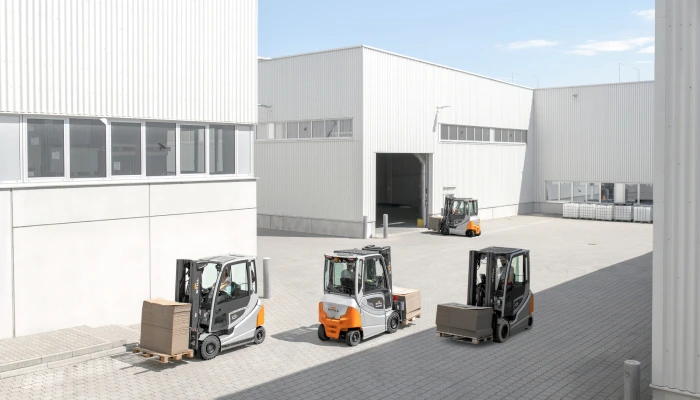
Many companies still assume that anything from 3 tonnes upward needs a diesel truck. The STILL RX 60 heavy-duty electric forklift challenges that assumption: this electric counterbalance series covers 2.5 to 8 tonnes, works both indoors and outdoors and was judged in an independent test to accelerate and lift like a diesel truck. This article looks at the three RX 60 groups and how to plan the replacement of diesel trucks.
Why switch from diesel to heavy-duty electric trucks?
Diesel trucks have familiar strengths: quick refuelling and power in outdoor yards. But exhaust and noise make them hard to use in enclosed production halls, areas where workers stand close by, food warehouses or shared warehouses. Electric trucks produce no local emissions, have fewer engine maintenance items and are quieter for the operator.
The obstacles used to be power and operating time. The RX 60 targets both. The independent F+H test noted that the high-performance RX 60 model “accelerates, lifts and drives as powerfully as a diesel counterbalance truck, but without the loud noise and exhaust typical of combustion engines”. For a general comparison of the two drive types, read electric vs diesel forklift.
The three capacity groups of the STILL RX 60
| Series | Max. capacity (kg) | Max. lift height (mm) | Travel speed (km/h) | Voltage (V) |
|---|---|---|---|---|
| STILL RX 60 2.5 – 3.5 t | 2,500 – 3,500 | 7,390 | 20 | 80 |
| STILL RX 60 3.5 – 5.0 t | 3,500 – 4,990 | 6,880 – 7,180 | 19 – 20 | 80 |
| STILL RX 60 6.0 – 8.0 t | 6,000 – 8,000 | 7,705 – 8,670 | 20 | 80 |
Figures are taken from the manufacturer’s model tables. All models in the tables use an 80 V system; the two smaller groups are available as Li-Ion versions.
RX 60 2.5 – 3.5 t: replacing mainstream diesel trucks
This is the class where 2.5–3.5 tonne diesel trucks dominate in Vietnam. According to STILL, the RX 60-25/35 achieves optimum handling performance in the class up to 3.5 tonnes and the longest range per battery charge in its class. Some figures published by the manufacturer:
- Moving 258 tonnes of goods over 200 m in 3,600 seconds.
- Lifting 3.5 tonnes to 7.4 m in 11 seconds.
- With a 2,500 kg load on a 10% gradient, covering a 610 m route ten times in one hour.
- Ready to operate 0.5 seconds after start-up.
F+H test results for the high-performance model:
| Test item (F+H) | Sprint mode | Efficiency mode |
|---|---|---|
| Pallet throughput (8 hours) | 363 | 318 |
| Travel speed with 1700 kg load | 22.8 km/h | 19.5 km/h |
| Operating time | 12.8 h | 19.8 h |
F+H reported that the test truck ran for almost 1.5 working days on a single battery charge, and that operating time is theoretically unlimited if the lithium-ion battery is quick-charged during breaks.
RX 60 3.5 – 5.0 t: heavy loads indoors and outdoors
This group includes the models from RX 60-35/600 to RX 60-50/600. STILL describes them as built for both indoor and outdoor use, from production supply to outdoor storage. Published figures:
- Starting off and covering the first 15 m with a load in 5.7 seconds.
- Moving 324 tonnes in 3,600 seconds.
- Up to 12 hours of operation before the next charge with the largest battery.
- Compact dimensions and a small turning radius allow narrow working aisles and a denser warehouse layout.
A configuration note: the RX 60-50 lifts 4,990 kg to 7,180 mm, while the RX 60-50/600 lifts 4,990 kg to 6,880 mm at a travel speed of 19 km/h. The suffix in the model name directly affects lift height and speed, so read the data sheet carefully. See how to choose forklift capacity to understand the role of the load centre.
RX 60 6.0 – 8.0 t: the flagship series
This group directly replaces 6–8 tonne diesel trucks in material yards, factories and freight companies. According to STILL:
- The flagship RX 60-80/900 lifts up to eight tonnes at a 900 mm load centre in a working aisle only 4,999 mm wide.
- Standard maximum speed is 17 km/h, rising to 20 km/h with the optional sprint mode.
- It can be used indoors and outdoors, even in wet and dusty environments.
- The battery is changed from the side in just a few minutes.
- Smart Portal brings fleet data together: operator management, impact detection and access control.
Typical applications: freight forwarding, manufacturing, heavy goods handling and fast loading and unloading of lorries.
Roadmap for replacing diesel trucks with the RX 60
- Site survey: record the heaviest load, load centre, lift height, ramp gradients, ground conditions and hours per shift for every existing diesel truck.
- Choose the capacity group and configuration: match against the three RX 60 groups above; check the load chart rather than just the rated capacity.
- Design the energy concept: choose Li-Ion for intermediate charging between shifts, or lead-acid with lateral battery change. See lithium-ion vs lead-acid forklift battery and STILL’s energy solutions.
- Prepare charging infrastructure: charger locations, power supply and a safe charging area.
- Run a parallel trial: let one electric truck work alongside the diesel fleet to measure real productivity before converting the whole fleet. You can start with forklift rental.
- Train operators: electric trucks respond quickly, so operators need to learn the drive modes and charging routine. T&C offers operator training alongside the trucks.
When should you keep a diesel truck?
The RX 60 is not the answer for every yard. If a truck must run continuously on very rough ground, at a site without a stable power supply for charging, or with loads above 8 tonnes, diesel trucks such as the STILL RX 70 or RCD remain the better choice. Our engineers assess each position in your fleet to decide which trucks should switch to electric first.
Frequently asked questions
Can the RX 60 electric forklift work outdoors in the rain?
According to STILL, the RX 60 6.0–8.0 t can be used indoors and outdoors, even in wet and dusty environments, and the RX 60 3.5–5.0 t is built for both indoor and outdoor use. Ground conditions and gradients should be surveyed before choosing a configuration.
Can the RX 60 cover two shifts without a battery change?
That depends on the duty cycle. The manufacturer states that the RX 60 3.5–5.0 t runs up to 12 hours with the largest battery. With Li-Ion, short intermediate charges between shifts extend operating time.
How much does switching to electric cost?
Cost depends on configuration, battery type and charging infrastructure. Send us your current operating data to receive a quotation and a suitable analysis.
Want to assess replacing diesel trucks with the STILL RX 60? Send details of your current fleet via the request a quote form or call our hotline 0902 63 79 70.