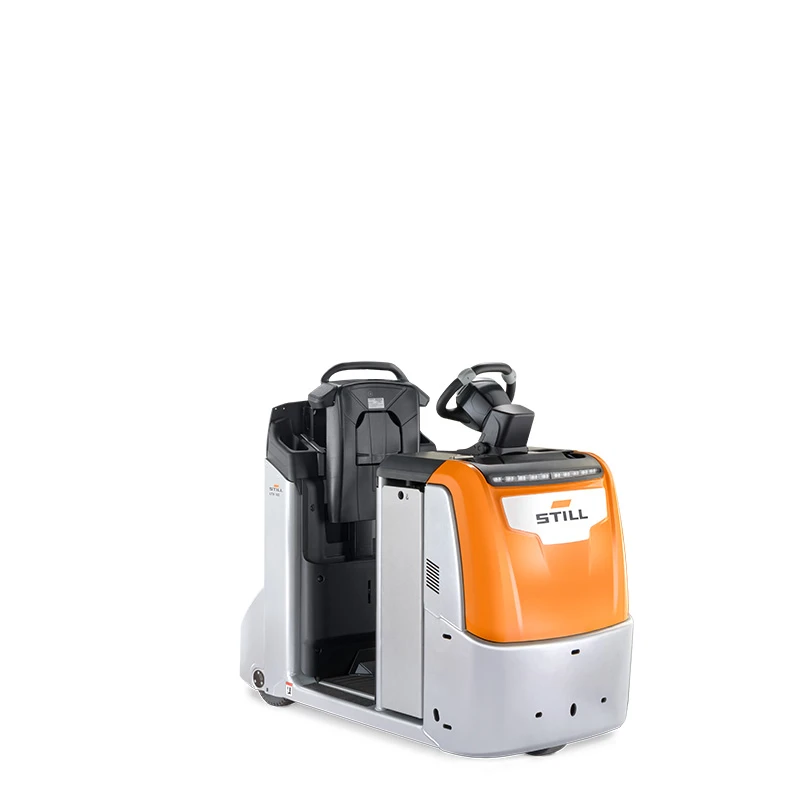
In lean production, components reach the line on fixed routes at a steady rhythm instead of pallet by pallet on forklifts. The core tool for this is the electric tow tractor pulling a train of trailers, known as a tugger train. In automotive & engineering, this is often the truck type that changes internal traffic the most. This article explains how to choose between the STILL LTX 20, LTX 50, LTX 70 and LXW.
Why automotive plants move to tugger trains
When each assembly station needs many part types in small quantities, carrying single pallets by forklift crowds aisles and creates many crossings with workers. A tugger train collects many boxes per trip, loops past stations on schedule and brings empties back. In the LTX 50 documentation, STILL notes that this makes production efficient and lean while reducing internal traffic.
Principles and configurations are covered in more detail in electric tow tractor and tugger train.
STILL LTX 20: narrow routes in assembly halls
STILL presents the STILL LTX 20 as ideal for tugger trains in lean production. It is only 600 mm wide, tows up to 2,000 kg and reaches 8 km/h. Pedestrian mode spares the driver from constantly getting on and off when delivering boxes to closely spaced stations. It is the choice for short routes and narrow aisles between machine cells.
STILL LTX 50: the main line-feeding route
The STILL LTX 50 pulls trailers with a total weight of up to 5,000 kg through narrow aisles in production facilities, at up to 14 km/h. According to STILL:
- STILL Easy Drive steering wheel with integrated display, one-hand operation.
- Pedestrian mode avoids frequent getting on and off; full view of the trailer coupling when hitching.
- Optional side battery change and Li-Ion for fast charging and round-the-clock availability.
- An LTX 50 iGo systems version is available for automated transport.
STILL LTX 70 and LXW: heavy towing between halls
When a plant has several halls, routes go outdoors and over ramps. The STILL LTX 70 tows up to eight tonnes indoors or outdoors, and STILL names production supply and tugger trains as applications. The automatic parking brake engages when the truck stops, the STILL Ramp Indicator shows the current gradient, and a reversing aid helps approach trailers.
For longer routes and heavier loads, the STILL LXW 20 / 30 offers 6,000 kg towing capacity, a load platform up to 3,000 kg and speeds up to 23 km/h. Descent Speed Regulation (DSR) adjusts speed to gradient and load automatically.
Tow tractor selection by process step
| Step | Type / model | Reason |
|---|---|---|
| Short-route parts delivery, narrow aisles | STILL LTX 20 | 600 mm wide, tows up to 2,000 kg |
| Main tugger train route in the hall | STILL LTX 50 | Tows up to 5,000 kg, 14 km/h, iGo version |
| Links between halls with ramps | STILL LTX 70 | Tows up to 8 tonnes, Ramp Indicator, auto brake |
| Large assemblies, long outdoor routes | STILL LXW 20 / 30 | 6,000 kg towing, load platform, DSR |
Designing the line-feeding route
Trailers and containers
Trailers must match the component boxes and how they are unloaded at stations (pushed by hand, pulled out sideways or lifted). Choose trailers first, then the tractor for the total load.
Turning space and intersections
Longer trains need wider bends. Simulate the real route, mark intersections and give pedestrians priority.
Route rhythm and fleet size
Trips per hour and dwell time per station determine the number of tractors. Fleet management helps track operating hours for fine-tuning.
The tow tractors category also lists the LXT with up to 35 tonnes towing capacity. Other trucks in the chain are on automotive & engineering solutions.
Frequently asked questions
Does a tugger train replace forklifts entirely?
No. Forklifts are still needed to pick pallets in the store and load trailers; the tugger train replaces the horizontal transport from store to line.
LTX 50 or LTX 70?
The LTX 50 suits in-hall routes and narrow aisles, towing up to 5,000 kg. The LTX 70 is a seated tractor towing up to eight tonnes indoors and outdoors, suitable for links between halls.
Can a tugger train route be automated?
Yes. STILL offers the LTX 50 iGo systems version; the level of automation should be assessed per route and plant infrastructure.
Want to design a tugger train route for line feeding? Send a request via request a quote or call 0902 63 79 70.