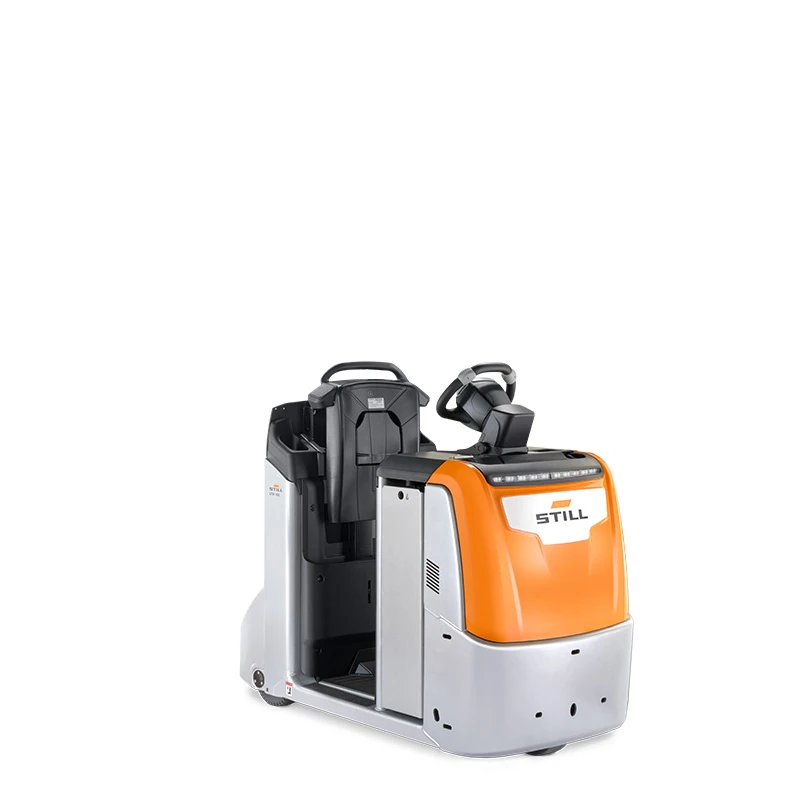
Electric tow tractors are an efficient horizontal transport solution when large quantities of goods must travel long distances in a factory, warehouse or airport. Instead of many forklifts shuttling back and forth with single pallets, one tractor can pull a whole train of trailers – an in-plant tugger train – along a fixed route. This article explains when to use tow tractors, how to organise a tugger train and how the STILL tractor ranges compare.
Why are companies switching to tow tractors and tugger trains?
In many plants, forklifts are doing horizontal transport that requires no lifting: carrying pallets from the warehouse to the line and returning empty. Each trip carries only one or two pallets, aisles are congested and the risk of collisions with pedestrians rises. Tow tractors tackle the problem differently:
- Bundled transport: one tractor carries several trailers per trip, reducing the number of vehicle movements in the plant.
- Fixed routes and cycles: a tugger train runs on a route and stops at supply stations in cycles, which suits lean production and just-in-time supply.
- Less internal traffic: fewer vehicles in the aisles make the workplace safer and more orderly.
- Forklifts focus on lifting: forklifts work in loading areas and the warehouse, while long-distance transport is handled by tractors.
How does a tugger train work?
A tugger train consists of a tractor and trailers carrying pallets, containers or trolleys. It is loaded in a preparation area (parts supermarket), then runs along a designed route, stopping at each station to deliver goods and collect empty containers. The design must consider the turning radius of the whole train, aisle widths, gradients on the route and the coupling type between trailers. STILL tractors offer various towing couplings and connection options for tugger train cars and trailers.
On routes with many closely spaced stops, pedestrian mode is very useful: the operator walks alongside and the truck follows, without constant getting on and off.
STILL electric tow tractor ranges
STILL LTX 20 – compact stand-on tractor
The STILL LTX 20 tows up to 2,000 kg at 8 km/h on a 24 V battery. Its strength is a vehicle width of only 600 mm, so it manoeuvres in the narrowest aisles. It suits tugger trains in lean production, airport baggage handling, hospital laundry transport and maintenance materials. It has a low step, folding seat, height-adjustable steering and coupling release from the driving position.
STILL LTX 50 – stand-on tractor for longer routes
The STILL LTX 50 pulls trailers with a total weight of up to 5,000 kg through narrow aisles at up to 14 km/h. It uses the STILL Easy Drive steering wheel with integrated display, self-centring electric steering, the Blue-Q energy saving mode and Curve Speed Control for bends. Options include an air-cushioned platform, lateral battery change and Li-Ion batteries for multi-shift work. The LTX 50 iGo systems version is an automated tugger train coordinated by transport control software.
STILL LTX 70 – seated tractor for indoor and outdoor use
The STILL LTX 70 offers towing capacity up to 8,000 kg, a top speed of 20 km/h and a 48 V system, for indoor and outdoor use. It has three braking systems (electric, hydraulic and an automatic parking brake that engages when the truck stops), the STILL Ramp Indicator showing gradients, a reversing aid for approaching trailers, pedestrian mode and lateral battery change. According to the manufacturer, service intervals extend up to 1,000 operating hours.
STILL LXT 120/350 – heavy-duty tractors
The STILL LXT 120/350 range is 80 V electric, with drawbar pull from 12,000 kg (LXT 120) to 35,000 kg (LXT 350) and speeds of 22–25 km/h depending on model, all available with Li-Ion. Twin-motor drive, robust protection for tough environments, a configurable cab and a reversing camera are part of the concept. Descent Speed Regulation (DSR) automatically adjusts downhill speed to load and gradient. It suits airports, railway stations and tough working environments.
STILL LXW 20/30 – platform truck and tractor in one
The STILL LXW 20/30 carries goods on its platform (2,000 kg for the LXW 20, 3,000 kg for the LXW 30) and tows trailers with a towing capacity of 6,000 kg, at 20–23 km/h on 80 V. Like the LXT range, it has a modular, configurable design and DSR, and suits applications that need to carry goods on the truck and tow extra trailers when required, at airports, railway stations or in tough environments.
STILL tow tractor comparison table
| Model | Driving position | Max. towing capacity | Max. speed | Voltage | Typical application |
|---|---|---|---|---|---|
| STILL LTX 20 | Stand-on | 2,000 kg | 8 km/h | 24 V | Narrow aisles, hospitals, small tugger trains |
| STILL LTX 50 | Stand-on | 5,000 kg | 14 km/h | 24 V | Tugger trains for production supply |
| STILL LTX 70 | Seated | 8,000 kg | 20 km/h | 48 V | Indoor and outdoor, routes with ramps |
| STILL LXT 120–350 | Seated, cab | 12,000–35,000 kg | 22–25 km/h | 80 V | Airports, stations, very heavy loads |
| STILL LXW 20/30 | Seated, load platform | 6,000 kg | 20–23 km/h | 80 V | Platform transport combined with towing |
How to choose the right tow tractor
- Total weight of the train: add goods and trailer weights, and choose a tractor with reserve towing capacity for routes with ramps.
- Route length and number of stops: short routes with many stops favour stand-on trucks and pedestrian mode; long routes favour speed and a seat.
- Indoor or outdoor: routes between buildings with outdoor sections and ramps call for trucks such as the LTX 70 or the LXT/LXW ranges.
- Aisle width: narrow aisles need compact trucks such as the LTX 20 and trailers with suitable tracking.
- Shift pattern: for multiple shifts choose Li-Ion or lateral battery change; see our energy solutions.
- Automation roadmap: to automate supply routes, consider LTX 50 iGo systems and our warehouse automation solutions.
Frequently asked questions
Can an electric tow tractor replace a forklift?
Tow tractors replace forklifts for long-distance horizontal transport. Lifting, putting away into racking and loading lorries still require forklifts or pallet trucks.
How many trailers can one tractor pull?
It depends on the tractor’s towing capacity, trailer weights, gradients and turning radius on the route. The actual route must be surveyed to calculate this.
Can tow tractors be used outdoors?
Yes, with the right model. The STILL LTX 70 works indoors and outdoors; the LXT and LXW ranges are designed for harsh environments too.
Stand-on or seated – which is better?
Stand-on is convenient when the driver gets on and off frequently on short routes; seated is more comfortable on long routes at higher speeds.
Browse our STILL tow tractors or send us your plant layout to receive a recommended tractor and route configuration via the quote page. Hotline 0902 63 79 70.
Real delivered projects
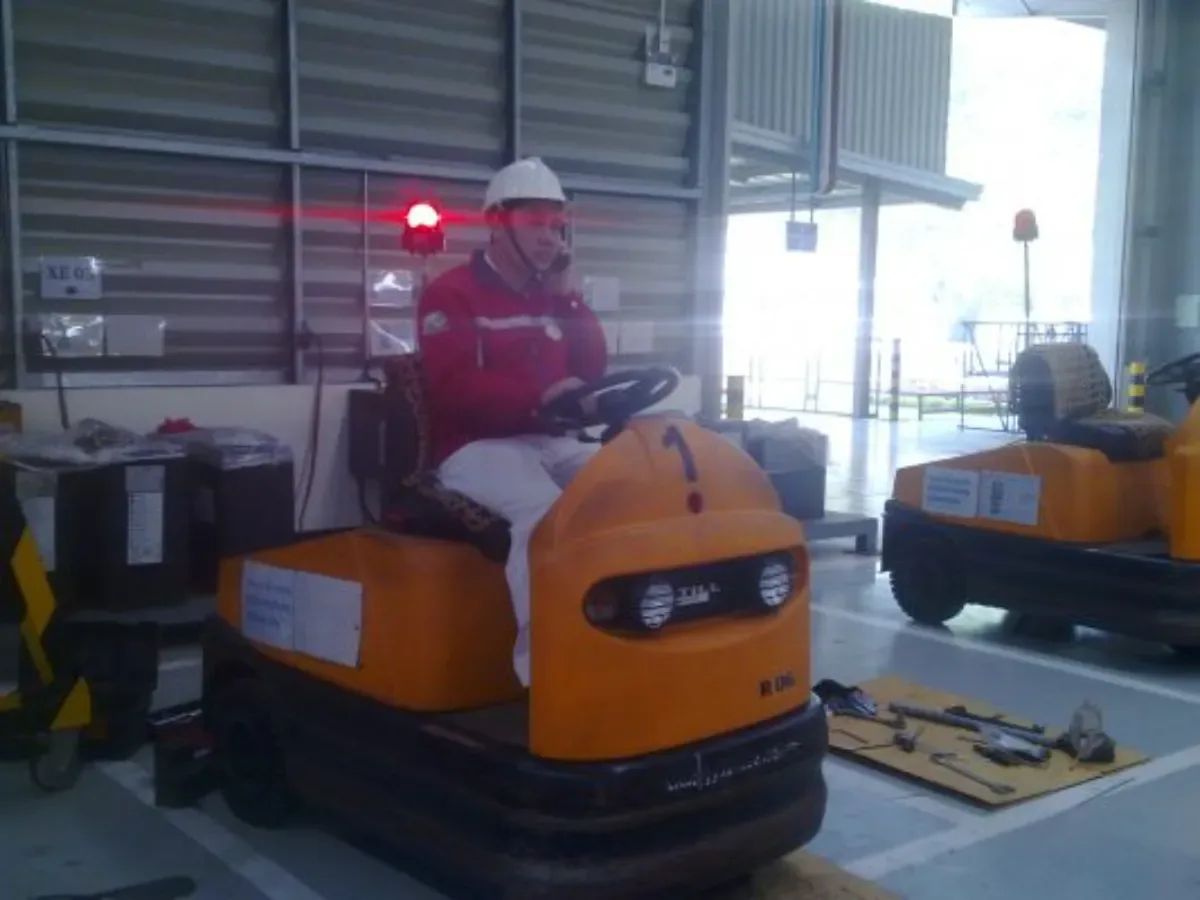

Honda Vinh Phuc plant
- 4 R06 tow tractors
- Handover: 2013
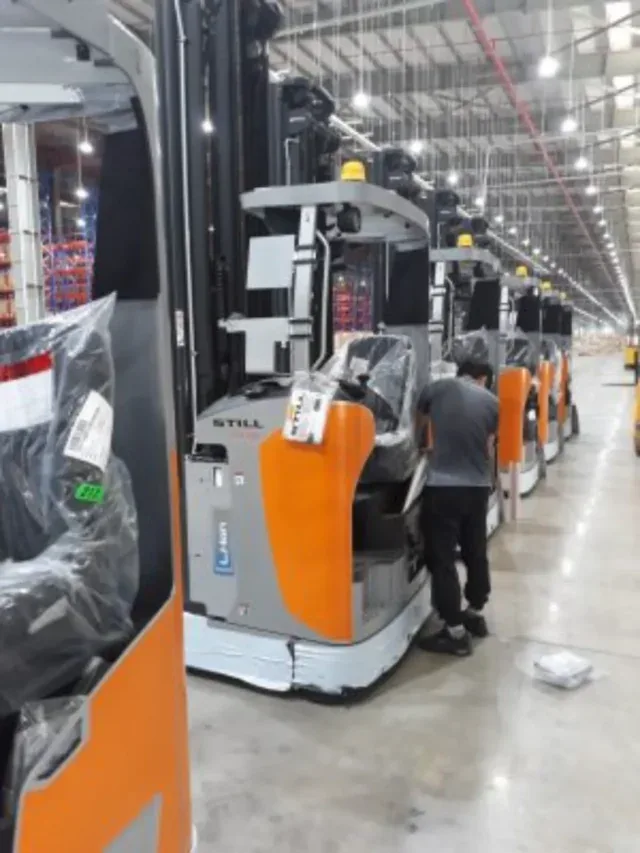

VinFast Hai Phong plant
- FM-X 20 reach truck, EXU 20S pallet mover, R08-20 tow tractor