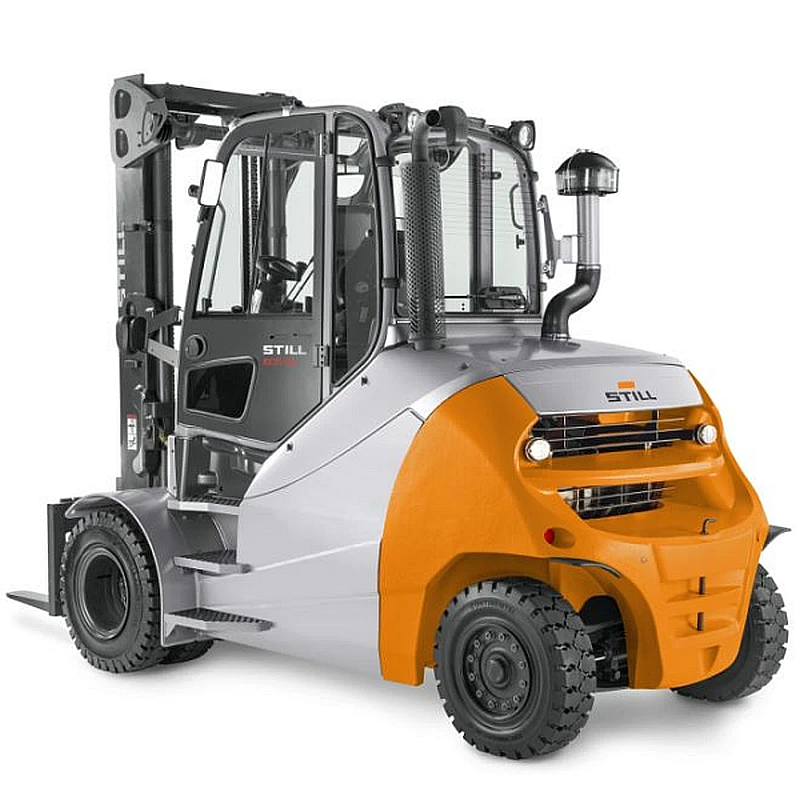
Building materials yards, timber mills, metal plants and container depots all need trucks that withstand dust, rain, poor ground and heavy loads over long shifts. For these environments, the STILL RX 70 diesel and LPG forklift (2.0–8.0 tonnes) and the STILL RCD 10–18 t heavy-duty truck are the two main options. This article compares the two series, explains their drive technology and shows how to pick the right truck for heavy outdoor work.
When is an IC engine forklift still the right choice?
Electric forklifts are getting more powerful, but diesel and LPG trucks still have a clear place:
- Outdoor yards with rough surfaces and many ramps, where trucks run continuously for long hours.
- Construction sites or temporary yards without charging infrastructure.
- Very heavy or bulky loads: steel, timber, moulds, containers, concrete elements.
- Operations that need fast refuelling and cannot depend on a charging schedule.
If the truck works mainly indoors or can be charged between shifts, consider a heavy-duty electric truck too. Both options are analysed in electric vs diesel forklift.
STILL RX 70: a distinctive diesel-electric drive
The biggest difference in the RX 70 series is its diesel-electric drive. The combustion engine produces the energy, while the truck’s movement is controlled by an electric drive. According to STILL, this combination delivers high availability, a longer service life and lower operating costs. All drive components are encapsulated against dust and water, making the trucks suitable for indoor and outdoor work.
Notable common features:
- Five drive programmes: choose maximum productivity or maximum efficiency; speed, acceleration and braking are adjustable.
- Blue-Q mode: according to the manufacturer, reduces energy consumption by 10% without reducing performance.
- Bending- and torsion-resistant mast: safe handling of heavy loads.
- Visibility: slim mast profiles and large windows on all sides.
- Connectivity: optional interface to the STILL neXXt fleet management software; MMS-ready for connection to material flow management systems.
RX 70 2.0 – 3.5 t: diesel or LPG
The smallest RX 70 group is available in both diesel and LPG versions. STILL states that the industrial engine is more than 20% more powerful than before, combined with the STILL Performance System and an electrically controlled hydraulic pump. Travel speed reaches up to 21 km/h, and parallel operation lets the truck travel while lifting or tilting. It suits yards with reversing in tight spaces and frequent ramps.
RX 70 4.0 – 5.0 t: medium to heavy loads
It lifts up to 5 tonnes at a 600 mm load centre and travels at up to 21 km/h. An asymmetrically offset driver’s seat gives a good view past the load and the fork carriage. STILL lists suitable industries: construction, building materials, timber processing, metalworking, food and beverages, and logistics.
RX 70 6.0 – 8.0 t: the heaviest RX 70 group
It lifts up to 8 tonnes at a 600 or 900 mm load centre and travels at up to 20 km/h. According to STILL, its exhaust treatment technology keeps emissions significantly below the EU Stage V limits. Applications include construction, building materials, timber processing, metalworking, paper, beverages, logistics and freight.
STILL RCD 10 – 18 t: heavy-duty forklifts
When loads exceed 8 tonnes, you need the STILL RCD 10 – 18 t. The RCD 100-180 series uses a turbo common-rail engine combined with a gearbox and hydrodynamic drive. According to STILL:
- Comparative work cycles show that the RCD 100-180 consumes less fuel than other trucks with torque converters.
- Emissions are well below the current EU exhaust limits.
- When bulky loads block the forward view, the entire operator workplace, including the controls, can rotate 180 degrees.
- A damped cab on rubber mounts is decoupled from the chassis; a sloped counterweight and an impact-resistant safety-glass roof window improve visibility.
- Automatic parking brake; the exhaust and rear-facing parts are integrated into the chassis for a clear view when reversing.
- A narrow track width on the RCD 100 and 120 allows heavy loads to be moved in confined areas.
RX 70 vs RCD comparison table
| Series | Max. capacity (kg) | Max. lift height (mm) | Travel speed (km/h) | Drive |
|---|---|---|---|---|
| STILL RX 70 2.0 – 3.5 t | 2,000 – 3,500 | 7,390 | 21 | Diesel-electric / LPG |
| STILL RX 70 4.0 – 5.0 t | 4,000 – 5,000 | 6,880 – 7,180 | 21 | Diesel-electric |
| STILL RX 70 6.0 – 8.0 t | 6,000 – 8,000 | 7,705 – 8,670 | 20 | Diesel-electric |
| STILL RCD 10 – 18 t | 10,000 – 18,000 | 6,500 – 7,000 | 25 – 28.8 | Diesel, hydrodynamic drive |
Figures are from the manufacturer’s model tables. On the RCD, speed varies by model; for example, the RCD 100/1200 reaches 28.8 km/h and the RCD 180/900 reaches 25 km/h.
RX 70 or RCD for outdoor yards?
- Define the real load and load centre: long goods such as steel and timber often have a larger load centre than a standard pallet, which reduces the residual capacity. See how to choose forklift capacity.
- Up to 8 tonnes: the RX 70 is a compact, flexible choice with three capacity groups. Choose the LPG version of the RX 70 2.0–3.5 t if it must also work in well-ventilated halls.
- Above 8 tonnes or very bulky goods: choose the RCD with a suitable fork carriage and specialised attachments.
- Ground and aisles: the RCD 100 and 120 have a narrow track width; the RX 70 has a compact design and good manoeuvrability.
- Service: outdoor trucks need a strict maintenance schedule and available parts. See maintenance and repair and genuine parts.
Frequently asked questions
How does the RX 70 differ from a conventional diesel forklift?
The RX 70 uses a diesel-electric drive: the combustion engine produces energy and an electric drive controls movement. Conventional diesel trucks typically use a torque converter or hydrodynamic drive. According to STILL, this approach delivers high availability, a long service life and lower operating costs.
Which RX 70 models are available with LPG?
According to the manufacturer’s source, the RX 70 2.0–3.5 t group comes in both diesel and LPG versions. The 4.0–5.0 t and 6.0–8.0 t groups are diesel trucks.
Can the RCD work in confined areas?
The RCD 100 and 120 have a narrow track width for moving heavy loads in confined areas. Even so, aisles and turning space should be surveyed before choosing a model.
Do diesel forklifts need periodic inspection?
Yes. Forklifts must undergo safety inspection in accordance with current regulations. T&C supports safety inspection services for forklifts.
Need a heavy-duty truck for an outdoor yard? Send the type of goods, weight, dimensions and ground conditions via the request a quote form or call our hotline 0902 63 79 70.