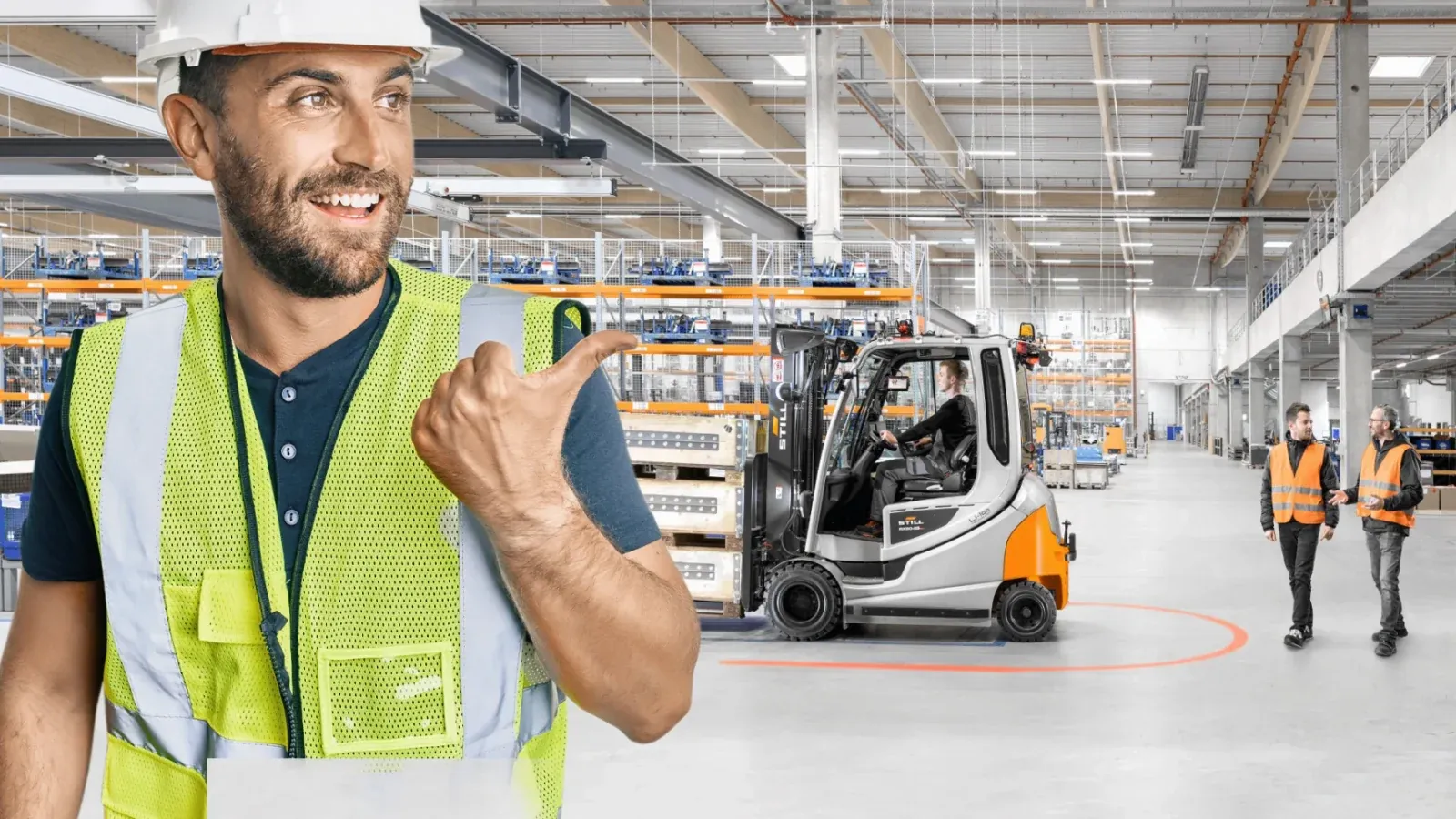
Forklift operating safety starts with a few minutes of checks before every shift, not after an incident. Most forklift accidents can be prevented through regular checks, properly trained drivers and suitable assistance systems on the truck. This article provides a practical checklist and introduces the safety features available on STILL forklifts.
Why check the forklift before every shift?
Forklifts work continuously with heavy loads, on varied floors, in areas with pedestrians. A worn tyre, a leaking hydraulic hose or a horn that does not sound can all cause an accident. Pre-shift checks help to:
- Detect damage early, before it causes an incident or longer downtime.
- Assign clear responsibility: which shift has the truck and in what condition.
- Build safe habits among drivers, especially new ones.
- Provide data for the maintenance team to plan repairs.
Besides daily checks, forklifts must also undergo periodic safety inspections according to current regulations. See our forklift safety inspection service.
Pre-shift forklift checklist
The list below is a general reference; add items from each truck’s operating manual and your on-site risk assessment.
| Item | What to check | Applies to |
|---|---|---|
| General inspection | Oil or water leaks under the truck; body, overhead guard and load backrest free of cracks or deformation | All trucks |
| Forks and mast | Forks free of cracks, bending or abnormal wear; fork locking pins; lift chains not slack or badly rusted | All trucks |
| Wheels | Wear, cuts, embedded objects; pressure for pneumatic tyres | All trucks |
| Hydraulics | Oil level, hoses not bulging or leaking; smooth lifting, lowering and tilting | All trucks |
| Brakes and steering | Service brake and parking brake working; no play in steering wheel or tiller | All trucks |
| Horn, lights, signals | Horn, work lights, warning lights and reversing signal working | All trucks |
| Seat belt | Belt not frayed, buckle latches securely | Sit-on trucks |
| Battery | Charge level, connectors and cables undamaged; battery retention secure | Electric trucks |
| Engine | Engine oil, coolant and fuel levels; LPG cylinder correctly fitted, no leaks | Diesel and LPG trucks |
| Display | No error warnings at start-up | Trucks with displays |
If a safety-related fault is found, such as brakes, steering, lift chains or fuel leaks, the driver must report it immediately and not operate the truck until it is fixed.
Safety rules during operation
- Never exceed the permitted capacity on the load chart at the actual lift height. See how to choose forklift capacity.
- Travel with forks lowered and the mast tilted back when loaded.
- Slow down at bends, intersections, doorways and pedestrian areas.
- When the load blocks the view, drive in reverse or use a banksman.
- Never carry people on the forks or on pallets.
- When leaving the truck: lower forks to the floor, apply the parking brake, switch off or remove the key.
Safety assistance systems on STILL forklifts
People make mistakes, so on-board assistance systems act as a second layer of protection. Depending on the model, the features below are available as standard or as options.
Speed and stability control
- Curve Speed Control: automatically adjusts speed according to steering angle when cornering, reducing the risk of tipping or losing the load.
- Speed reduction with raised forks: the higher the forks, the more travel speed is limited.
- Dynamic Load Control: detects load weight and lift height and adjusts the hydraulics for smooth, safe lifting and lowering.
- Overload detection: monitors the weight of the load and any attachments.
- Automatic parking brake: engages when the truck stops, preventing roll-away.
See and be seen
- STILL Safety Light: projects a blue light spot on the floor in the direction of travel, warning pedestrians that a truck is approaching. Warning Zone Light marks the danger zone around the truck.
- Reversing light, acoustic reversing signal, broadband alarm: help people nearby notice the truck, even with their back turned.
- Panoramic mirror, fork camera: reduce blind spots and improve visibility of loads at height.
- Reversing Assistant Plus (camera) and STILL Sentry (radar): monitor the area behind the truck and warn the driver when reversing.
Driver protection and access control
- Seat belt monitoring: if the driver has not fastened the belt, travel speed is automatically reduced.
- Protective roof grid and driver restraint bar system: protect against falling goods and impacts.
- PIN-code access authorisation: only authorised people can start the truck.
- STILL FleetManager 4.x: driver management, shock detection and access control, so managers know which truck, which driver and where impacts occur. Learn more about fleet management.
Warehouse area safety
- Zone recognition: automatically reduces speed in defined areas.
- Ceiling sensor: detects low ceilings and prompts the driver to slow down.
- Wireless anti-collision system: warns of danger between trucks and pedestrians even without line of sight.
For example, the STILL RX 60 range offers a very comprehensive list of safety options and assistance systems. See complete solutions under warehouse safety.
People remain the deciding factor
Assistance systems cannot replace a skilled driver. Make sure operators are trained and certified according to regulations, and retrained when moving to a new truck type. T&C offers forklift operator training. In parallel, separate pedestrians from trucks, mark aisles, install convex mirrors at blind corners and provide fire extinguishers according to your risk assessment.
Frequently asked questions
Who is responsible for the pre-shift check?
Usually the driver taking over the truck for that shift, recording the results on a checklist. The shift supervisor or maintenance team confirms and handles reported faults.
Can safety systems be retrofitted to existing trucks?
Many systems can be retrofitted, depending on model and configuration. An on-site assessment of the truck is needed.
If a truck has a Safety Light, do pedestrians still need to pay attention?
Yes. Warning lights help people notice the truck earlier but do not replace traffic separation rules and everyone’s attention in the warehouse.
How often must forklifts be inspected?
Inspection intervals follow current regulations. Contact T&C for advice specific to each truck type.
Need a safety assessment of your fleet or additional assistance systems? Request a quote or call our hotline 0902 63 79 70 for advice from T&C.