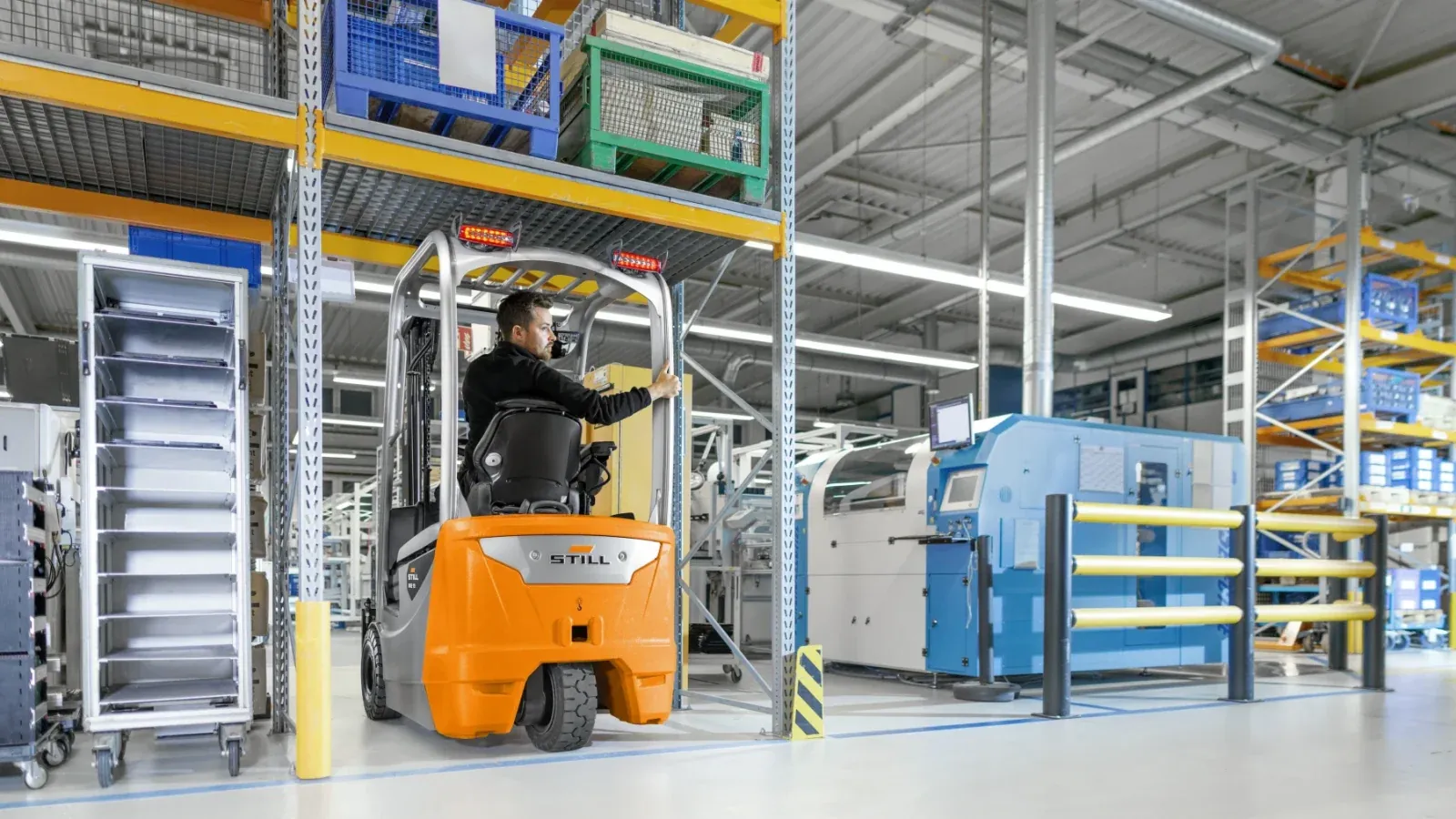
An electronics plant usually receives imported components by container and ships finished goods in cartons every day. An electric forklift for the electronics industry works on the boundary between the yard, the raw-material store and the assembly hall, so it must be compact, emission-free on site and gentle with high-value goods.
Where does a counterbalance truck work in an electronics plant?
In a plant assembling boards or electronic devices, the counterbalance truck works at four points:
- Component receiving: unloading pallets of component reels, trays, plastic housings and sheet metal from containers or lorries to incoming quality control (IQC).
- Raw-material store to production: moving inspected pallets to the line-side staging area.
- Finished goods collection: picking up packed pallets at the end of the line and taking them to the warehouse.
- Shipping: loading finished goods into containers, often against a fixed vessel schedule.
Goods and environment in the electronics industry
Electronics are light for their volume but valuable; even minor impacts are costly. Packaging is stacked cartons, plastic trays and component reels in moisture barrier bags, so forks must enter the pallet precisely and set loads down smoothly.
Many electronics plants have dust-controlled production, electrostatic protected areas (EPA) or cleanrooms. STILL’s published specifications do not state anti-static functions or cleanroom ratings for these trucks, so this is a requirement to discuss in detail during the site survey: which areas trucks may enter and what tyres, grounding or materials your internal rules require.
Suitable STILL models for electronics plants
STILL RXE 10-16C: a small truck for tight workshops
The STILL RXE 10-16C is STILL’s smallest three-wheel electric forklift. According to the manufacturer it is just under 2 metres high and 1 metre wide, so it fits through workshop doors and the tight staging areas between lines. It lifts up to 1.6 tonnes at a 500 mm load centre, travels at up to 12 km/h laden and uses a maintenance-free three-phase AC drive with 24 V technology. It suits feeding material into the assembly hall.
STILL RCE 15/20: moderate loads, moderate frequency
The STILL RCE 15/20 comes in three-wheel and four-wheel versions, is just under 110 cm wide and lifts up to 2.0 tonnes to 6.5 m. A 4.3” display shows the drive programme and battery time, and the battery is charged from the side. It fits mid-sized plants on day shifts.
STILL RX 20: the workhorse for multi-shift plants
When an electronics plant runs two or three shifts, the dock truck hardly rests. The STILL RX 20 covers 1.4 to 2 tonnes; the manufacturer says the Li-Ion version gains several more hours of operation from 30 minutes of charging, while an intelligent electronics system monitors every battery cell in real time. The STILL Easy Control safety and communication centre shows the driver all key safety information at a glance.
Recommendation table: process – model – reason
| Process in the electronics plant | Suggested type/model | Reason |
|---|---|---|
| Component container receiving | STILL RX 20 | Multi-shift, fast intermediate charging on Li-Ion |
| Material into the workshop | STILL RXE 10-16C | Under 2 metres high, 1 metre wide, fits workshop doors |
| End-of-line finished goods | STILL RCE 15/20 | Compact, three-wheel version turns easily |
| Export container loading | STILL RX 20 | Easy Control, capacity up to 2 tonnes |
Points to check when choosing an electric forklift for an electronics workshop
- Measure workshop doors, container doors and the mast’s lowered height before choosing a model.
- Define the EPA/cleanroom boundaries and internal vehicle rules; raise them during the survey so the adviser can check the options.
- Place chargers near the dock so Li-Ion trucks can top up between containers.
Three-wheel and four-wheel trucks are compared in 3-wheel vs 4-wheel electric forklift; other truck types for the sector are on the forklift solutions for electronics page. Full range: STILL electric forklifts.
Frequently asked questions
Can a counterbalance truck drive into the board production area?
That depends on each plant’s rules. EPA and cleanroom areas usually restrict vehicles; anti-static or cleanliness requirements for the truck must be discussed during the survey because STILL’s published specifications do not state these features.
Should an electronics plant choose a three-wheel or four-wheel truck?
If the truck works mostly in the workshop and tight staging areas, a three-wheeler such as the RXE 10-16C turns more easily. If it works at the dock and container yard across shifts, the RX 20 is the better fit.
Electronics are light. Is a 2-tonne truck needed?
Not necessarily. Pallet size, load centre and lift height all matter; bulky pallets move the load centre outward and reduce the real capacity.
Need to size the trucks for your plant’s receiving and shipping areas? Send a request on the quote page or call 0902 63 79 70 for a site survey.