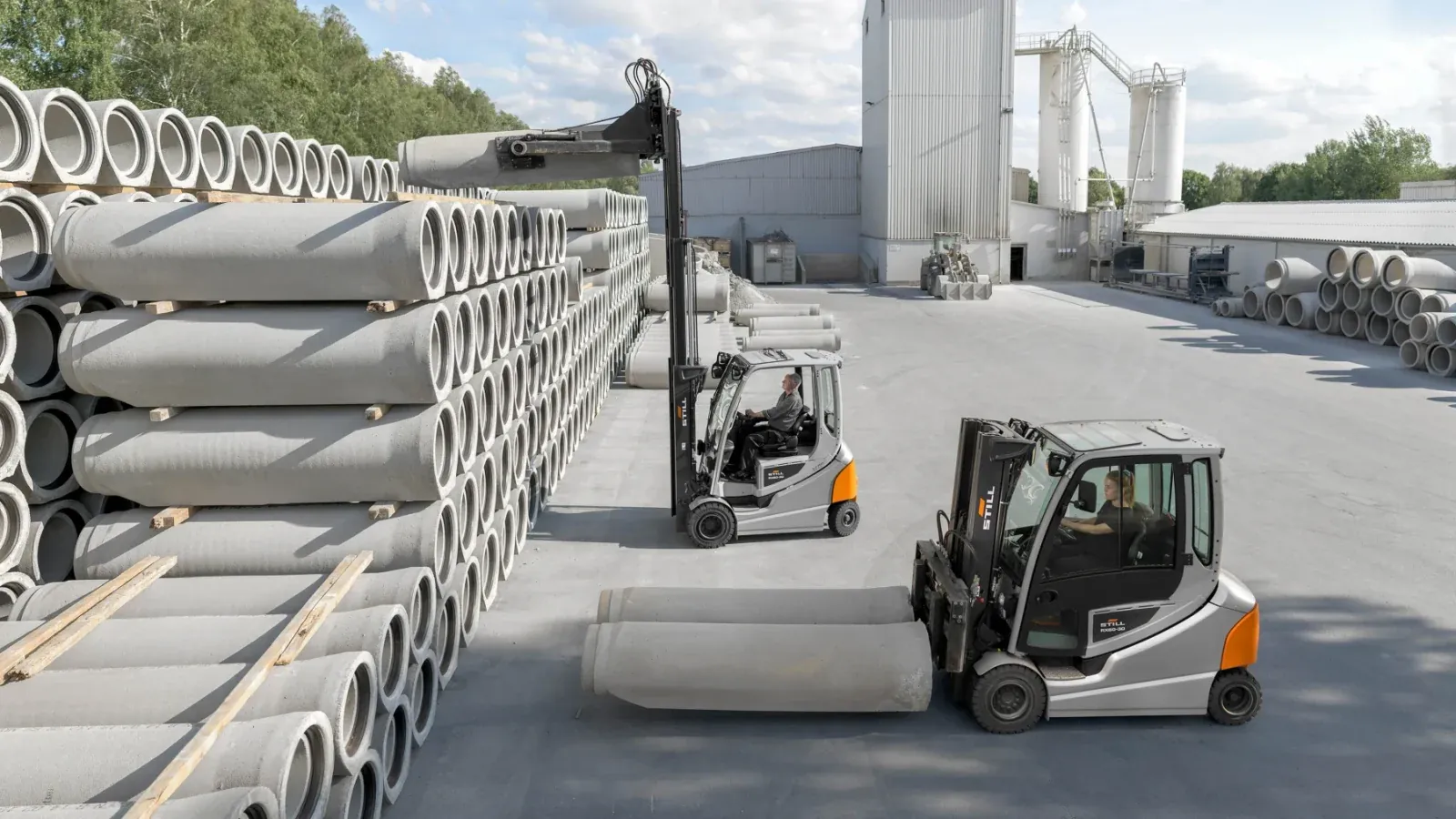
In a chemical plant, the electric forklift is usually the busiest truck on site: unloading drums and IBCs from trucks, feeding raw materials to the mixing area, moving finished pallets into storage and loading containers. This article looks at each step, how to choose a suitable STILL model and the limits of standard trucks in areas with an explosion risk.
Why chemical warehouses favour electric counterbalance trucks
Chemical warehouses are usually enclosed, with dedicated ventilation and many product groups segregated by compatibility. Electric trucks produce no local emissions, so they do not add to an atmosphere already controlled for solvent vapours. Quiet running lets drivers hear warnings in the receiving and dispatch area. Sensitive hydraulics matter as well: a liquid-filled drum set down too hard can dent and leak, causing spill clean-up costs. Counterbalance trucks work both indoors and in covered yards and handle bulky pallets without special racking. For a comparison of power sources, see electric vs diesel forklift.
Areas with an explosion risk: assess first, choose the truck second
Solvent filling stations, flammable goods stores or places where combustible dust is generated may be classified as hazardous areas. Standard forklifts must not enter them unless a suitable explosion-protected version is used. In the STILL source documents available to us, the STILL RX 60 2.5 – 3.5 t and RX 60 3.5 – 5.0 t have operating instructions for an explosion-protected version. The protection level, scope and configuration must be confirmed with the supplier based on the area assessment.
Companies should survey and classify areas in line with applicable regulations first. A common approach: standard trucks in safe areas, transfer points at the zone boundary, and only trucks confirmed as suitable inside.
STILL models for each step
STILL RX 60: heavy loads, multiple shifts
The STILL RX 60 2.5 – 3.5 t offers up to 3,500 kg capacity, up to 7390 mm lift height and 20 km/h; the RX 60 3.5 – 5.0 t lifts up to 5,000 kg, with an operating range per charge the manufacturer rates highly in its class. With lithium-ion, the manufacturer states the truck can run three shifts without a battery change, suiting continuously operating plants. The STILL Easy Control on-board computer shows truck information in the cab.
STILL RX 20: finished goods, narrow aisles
The STILL RX 20 covers 1.4 – 2 t with a top speed of 20 km/h. According to the source, 30 minutes of charging can add several hours of operation, helping it keep pace with two- or three-shift dispatch of canisters, cartons or bags.
STILL RCE and RXE: low frequency, tight spaces
The RCE 25 – 35 is for occasional transport and stacking at 2,500 – 3,500 kg, with a fast-charging port on the lithium-ion version; it suits empty packaging and maintenance stores. The RXE 10 – 16C is a compact three-wheel truck for 1.0 – 1.6 t, well suited to trucks, containers and cramped additive stores.
Guide table: step – model – reason
| Process step | STILL type/model | Reason |
|---|---|---|
| Unloading drums and IBCs from trucks | RX 60 2.5 – 3.5 t | Up to 3,500 kg, sensitive hydraulics |
| Areas assessed as having an explosion risk | RX 20 / RX 60 explosion-protected version (per source documents) | Only after zoning and confirming the configuration |
| Finished goods, container loading | RX 20 | Compact, fast charging between shifts |
| Packaging and materials store | RCE 25 – 35 | Simple configuration, opportunity charging |
| Sample and additive store | RXE 10 – 16C | Manoeuvres in small spaces |
Notes on handling chemical goods
- Actual load centre: liquids in drums and IBCs surge forward when braking; choose from the load chart, see how to choose forklift capacity.
- Drum clamps: reduce residual capacity and must be recalculated before fitting.
- Charging area: keep it away from flammable and corrosive goods according to the risk assessment.
See more models in the electric forklift category and other truck types under forklift solutions for the chemical industry.
Frequently asked questions
Which STILL electric forklifts have an explosion-protected version?
In our source documents, the RX 20 1.4–2.0 t, RX 60 2.5 – 3.5 t and RX 60 3.5 – 5.0 t have operating instructions for an explosion-protected version. Other models need to be checked with us; we make no claim without documentation.
Should diesel trucks be used in an enclosed chemical warehouse?
Enclosed warehouses should favour electric trucks because they produce no local emissions. Diesel and LPG trucks suit outdoor yards and must not enter hazardous areas without a suitable version either.
Where should lithium-ion chargers be placed?
Chargers should be outside hazardous areas and covered by the plant’s overall safety assessment; our technical team can survey this with you.
Need truck configurations for each area of your plant? Send a request via the quote page or call 0902 63 79 70.