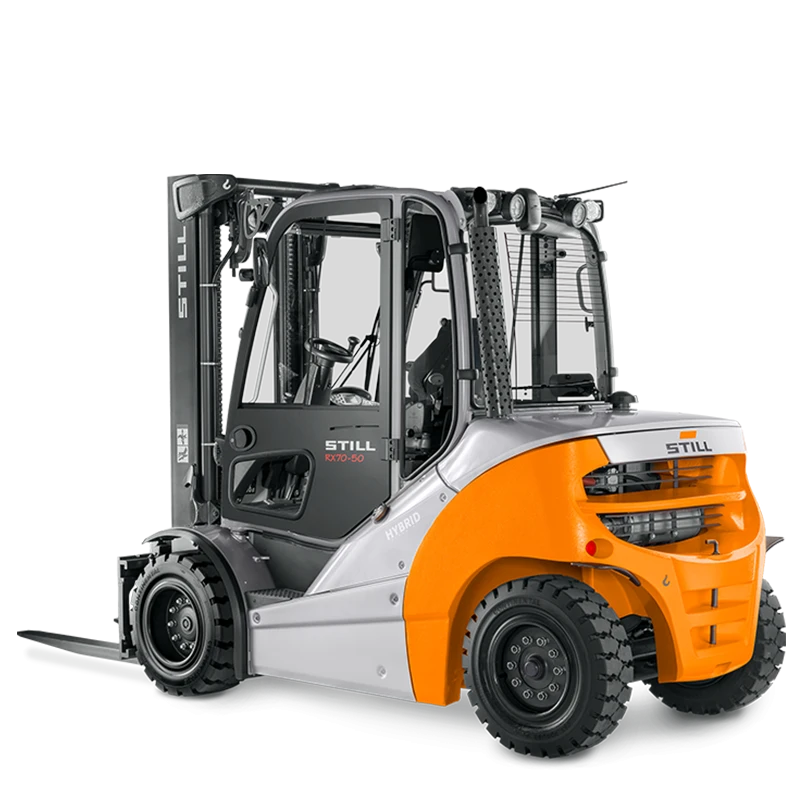
Most work inside a plastics plant should go to electric trucks, but the yard is different. A diesel forklift in the rubber industry and plastics still has a place in container yards, recycling yards and heavy mould stores, where the truck works outdoors, over ramps and on uneven surfaces. This article explains when to use the STILL RX 70 and RCD, and when not to.
Which areas of a plastics or rubber plant need IC trucks?
Yards for rubber bales and imported raw material
Natural rubber bales, synthetic rubber and imported resin usually arrive by container and are set down in the yard before entering the store. The area is open, has ramps to the dock and is exposed to rain and sun. A truck with an enclosed drive train that withstands dust and water lasts longer in these conditions.
Scrap, recycled plastic and by-product yards
Plants with recycling lines collect purgings, rejects and regrind in bulk bags or steel cages stored outdoors. The surface is rarely as finished as the hall floor, travel distances are long and the truck must work in the rain.
Mould and heavy equipment stores
Large injection moulds, calender rolls and extruder assemblies removed for maintenance need high-capacity trucks. The job is occasional but needs a high safety margin, especially when bulky loads block the forward view.
Specific points to watch
IC trucks produce exhaust, so as a rule they should be kept out of enclosed production areas, finished-goods packing and storage. The boundary between diesel/LPG zones and electric zones should be marked clearly on the floor plan. If the plant has only a little outdoor work, consider an electric truck suited to outdoor use instead of running two fuel types; see electric vs diesel forklift.
Do not take IC trucks into areas holding solvents, adhesives or flammable materials before a hazardous-zone assessment under current regulations.
Suitable STILL models
STILL RX 70 2.0–3.5 t has an industrial engine that STILL describes as more than 20 percent more powerful and a speed of 21 km/h. STILL highlights control when reversing in tight spaces, frequent ramp travel and changing conditions, which matches container yards and docks.
STILL RX 70 4.0–5.0 t and 6.0–8.0 t use a diesel-electric drive that combines an IC engine with the precision of an electric drive. All drive components are enclosed against dust and water. There are five driving programmes, and Blue-Q efficiency mode cuts energy consumption by 10% without reducing performance. On the RX 70 6.0–8.0 t, the high seat and offset cab give a panoramic view, useful when lifting bulky moulds.
STILL RCD 10–18 t handles loads up to 18 tonnes: very large moulds, machine assemblies, heavy containers. When large loads block the forward view, the entire driver’s workplace, including controls, can rotate 180 degrees. A wide range of fork carriages and attachments adapts the truck to many loads.
| Step | Type / model | Reason |
|---|---|---|
| Unloading rubber bales and resin from containers | STILL RX 70 2.0–3.5 t | Good control on ramps and when reversing in tight spaces |
| Outdoor scrap and recycling yard | STILL RX 70 4.0–5.0 t | Drive enclosed against dust and water |
| Removing and moving large moulds | STILL RX 70 6.0–8.0 t | Panoramic view, bending- and torsion-resistant mast |
| Very heavy moulds and equipment | STILL RCD 10–18 t | Up to 18 tonnes, driver’s area rotates 180 degrees |
Choosing capacity for moulds and rubber bales
Rated capacity applies only at the standard load centre. Moulds have offset, deep load centres, so the actual capacity drops. Measure the size and weight of your largest mould, determine the required lift height and check the load chart; see how to choose forklift capacity. Rubber bales can deform, so forks must be long enough and clamps or other attachments may be needed for stacking.
The full range is in STILL diesel & LPG forklifts; other truck types for the industry are on the forklift solutions for plastics & rubber page.
Frequently asked questions
Should a diesel forklift be used inside a moulding hall?
Not in enclosed production areas or finished-goods stores because of exhaust. Diesel and LPG trucks suit outdoor yards, container yards and heavy mould stores better.
RX 70 or RCD for moving moulds?
It depends on the actual weight and load centre of the mould. Within RX 70 range, the RX 70 is more agile; very heavy, bulky moulds call for the RCD. A technician should check the load chart first.
Can a diesel forklift work in a dusty scrap yard?
The RX 70 4.0–5.0 t and 6.0–8.0 t have drive components enclosed against dust and water, suiting this environment. Regular maintenance of air filters and radiators is still needed.
To choose the right truck for your yard and mould store, send your load details via our quote page or call 0902 63 79 70.