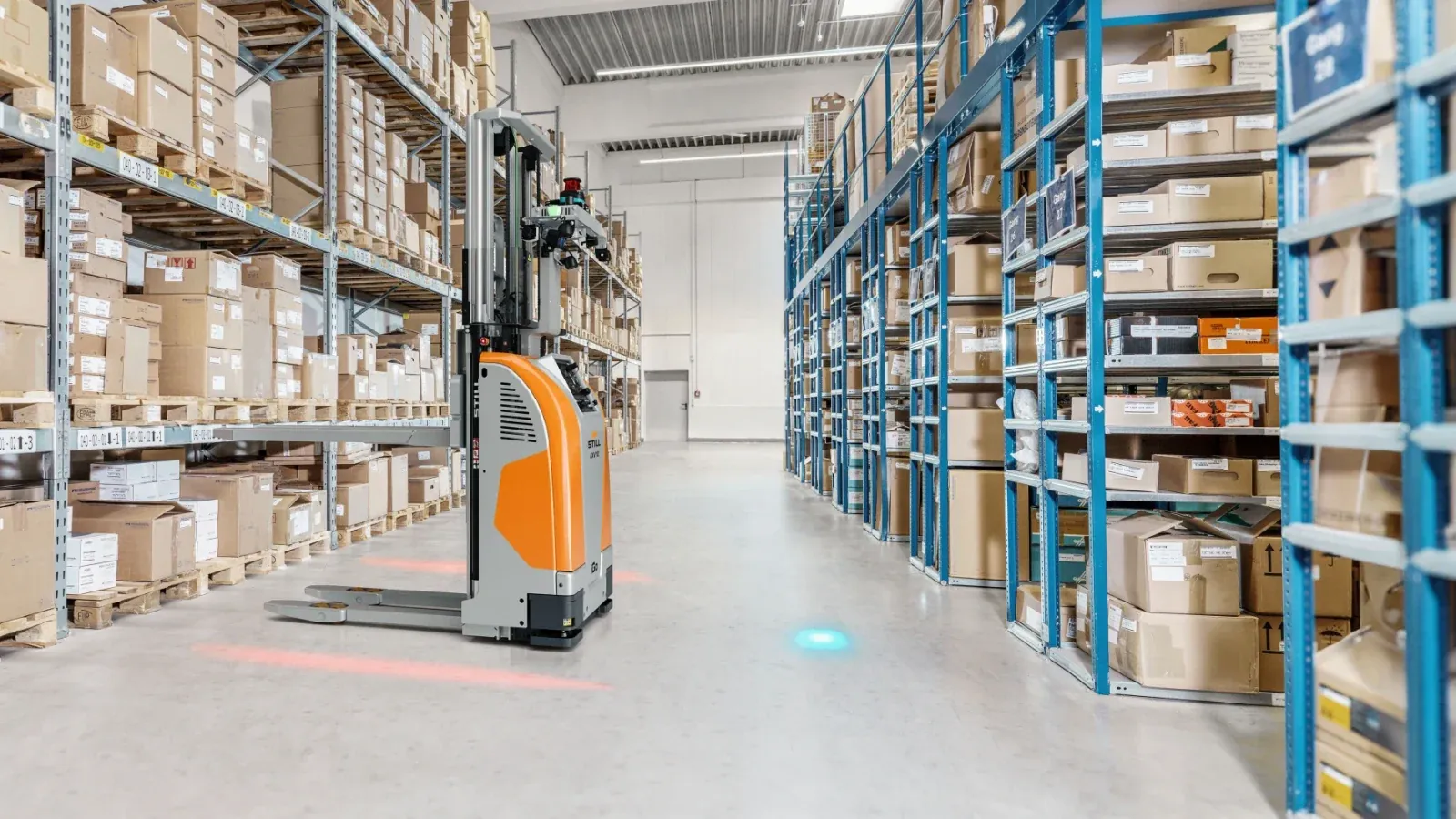
Electronics plants run multiple shifts with repetitive transport: store to line, line to packing, packing to dock. These are the first tasks worth automating. An automated forklift for the electronics industry keeps line supply steady across every shift and frees workers for value-adding work.
Which electronics processes should be automated first?
- Supplying and removing line materials: fixed routes repeated many times per shift.
- Pallets between store and staging: long distances at steady frequency.
- Finished goods put-away: from the end-of-packing conveyor to the rack.
- Loading outbound lorries: large volumes of uniform pallets.
The general rule: automate processes that are stable, with defined routes and standardised containers. Autonomous forklifts AGV/AMR: when to automate covers these criteria.
Line feeding: STILL AXV 12 iGo, EXV iGo, EXV-CB iGo
The STILL AXV 12 iGo is designed for simple horizontal transport such as supplying and removing production materials, stacking 1200 kg to 1780 mm. It is compact, with a working aisle width of only 2480 mm, suiting aisles between lines. iGo easy allows standalone operation or a link to the warehouse management system (WMS).
For longer distances, the STILL EXV iGo lifts up to 1,600 kg to 3.8 metres at up to 7.2 km/h, described by the source as a choice for production logistics and staging areas. If component containers are special, the STILL EXV-CB iGo handles both standard pallets and special load carriers, with 1,400 kg capacity and storage up to 3.8 metres.
Storage and shipping: STILL FM-X iGo, AXL iGo
In the finished goods store, the STILL FM-X iGo lifts up to 2,300 kg on cantilever forks to storage heights up to 10 metres, with a working aisle under 3 metres. The PPS pallet positioning system lets it work with wide-aisle storage, flow racking, conveyors and VNA transfer stations.
At the shipping dock, the STILL AXL iGo loads and unloads pallets on lorries automatically, handling standardised goods up to 1,500 kg. The source states it can load up to 30 pallets in about 35 minutes (with two AGVs in parallel) without fixed safety infrastructure at the ramp.
Safety in mixed operation
Electronics workshops are busy with workers, so safety comes first. iGo trucks use laser scanners and sensors to create 360-degree protective fields; the EXV iGo, EXV-CB iGo and FM-X iGo are stated to meet ISO 3691-4. The specifications do not state anti-static or cleanroom features for these trucks; if a route crosses such areas, discuss it during the survey.
Recommendation table: process – model – reason
| Process | Suggested model | Reason |
|---|---|---|
| Supplying and removing line materials | STILL AXV 12 iGo | 2480 mm working aisle, iGo easy |
| Store to staging, long distance | STILL EXV iGo | 7.2 km/h, lifts 1,600 kg |
| Special component containers | STILL EXV-CB iGo | Cantilever forks, special load carriers |
| Finished goods put-away | STILL FM-X iGo | Up to 10 metres, PPS |
| Lorry loading | STILL AXL iGo | 30 pallets in about 35 minutes |
See the STILL automated trucks category, warehouse automation and forklift solutions for electronics.
Frequently asked questions
Should a small electronics plant use automated trucks?
It can start with one truck on one fixed route. iGo easy allows standalone operation without WMS integration at first.
Can automated trucks share space with workers?
Yes, iGo trucks have scanners and sensors to protect pedestrians. A risk assessment and workshop traffic rules are still needed.
What should be prepared before deployment?
Standardise containers and handover points, stabilise routes, check floors and network coverage, and define which systems need integrating.
Need to assess which process to automate first? Send a request on the quote page or call 0902 63 79 70.