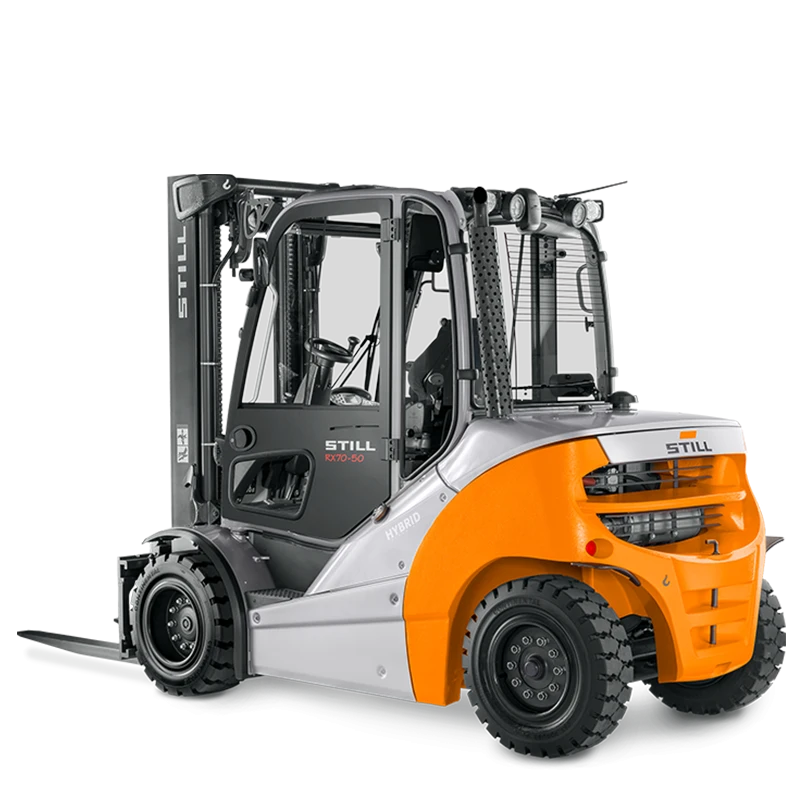
Many breweries, soft drink plants and agri-food processors have a large yard: a store for crates of empties, a raw material receiving area for sacks, a container marshalling area. A diesel forklift for a beverage plant still has a role there, as long as its zone is clearly defined and it stays out of enclosed production areas.
A clear boundary: diesel/LPG outdoors, electric indoors
Exhaust gases and fuel odours are what processing, filling and packing areas need to avoid. So the question for this industry is not “diesel or electric” for the whole plant, but zoning. Combustion trucks serve yards, sloping internal roads and areas exposed to rain and sun; electric trucks serve everything behind the plant door. Pallets are handed over at a buffer point, usually a canopy in front of the finished goods store.
Zoning also helps hygiene, since yard tyres carry mud and dirt. A general comparison of both energy types is in electric vs diesel forklift.
Outdoor tasks in food and beverage plants
- Empties and returned crates: breweries and soft drink plants using glass bottles take back crates of empties from dealers and stack them in the yard before the bottle washer.
- Sacks and big bags of raw material: sugar, malt, flour, grain and feed arrive on large trucks that must be unloaded quickly.
- Export containers: processed agricultural products, canned food and bagged coffee are stuffed into containers in the yard.
STILL RX 70: which model for which load?
RX 70 2.0 – 3.5 t for finished pallets and crates of empties
The STILL RX 70 2.0 – 3.5 t comes in diesel and LPG versions. According to STILL, its industrial engine is over 20 percent more powerful, travel speed reaches up to 21 km/h, and parallel operation allows driving while lifting or tilting. The source says the truck is built for reversing in tight spaces, frequent ramps and changing conditions, which matches plant yards with ramps up to truck beds and uneven surfaces.
RX 70 4.0 – 5.0 t for raw material sacks and heavy goods
The STILL RX 70 4.0 – 5.0 t lifts up to five tonnes with a diesel-electric drive. STILL states that all drive components are sealed against dust and water and lists the food and beverage industry among suitable applications, indoors and outdoors. The truck has five driving programmes; Blue-Q mode cuts energy consumption by 10 percent without reducing performance.
When the truck must enter a building
The RX 70 range offers zone detection with an ultrasonic sensor on the roof that detects ceilings up to 20 m high and adjusts top speed, with 6 km/h as the standard setting. This lets the truck slow down automatically under a canopy or in a warehouse, but it does not replace the rule that keeps combustion trucks out of processing areas. The full range is in the diesel & LPG forklifts category.
Selection table for outdoor stages
| Stage | Type/model | Reason |
|---|---|---|
| Empties yard, outdoor stacking | STILL RX 70 2.0 – 3.5 t | Handles ramps and uneven yards |
| Unloading sacks and big bags | STILL RX 70 4.0 – 5.0 t | Up to five tonnes, drive sealed against dust and water |
| Stuffing export containers | STILL RX 70 2.0 – 3.5 t | Parallel operation, manoeuvres in tight spaces |
| Pallet handover at the plant door | RX 70 with zone detection | Slows automatically under canopies |
| Inside production and enclosed stores | Electric counterbalance truck | No exhaust, see electric forklift article |
What to do before adding diesel or LPG trucks to a food plant
- Draw a zone map: which roads diesel trucks may use and where pallets are handed to electric trucks.
- Keep fuel and LPG cylinder storage well away from raw material and finished goods stores.
- Add oil and fuel leak checks to the pre-shift checklist and the preventive maintenance plan.
See other truck types along the chain on the food & beverage solutions page, or the earlier overview STILL RX 70 and RCD diesel and LPG forklifts.
Frequently asked questions
Is an LPG forklift cleaner than diesel for a food plant?
LPG trucks are generally seen as producing less smoke than diesel, but they are still combustion engines and still emit exhaust. In enclosed processing areas, electric trucks remain the preferred choice.
Should one diesel truck serve both the yard and the finished goods store?
Not if the finished goods store is enclosed. Splitting roles between diesel trucks outside and electric trucks inside gives better control of exhaust and hygiene.
Which truck suits a dusty raw material yard?
According to STILL, the RX 70 4.0 – 5.0 t has drive components sealed against dust and water. Actual dust levels and air filter cleaning intervals should be checked on site.
Want to plan diesel and electric zones for your plant? Contact us via the quote page or call 0902 63 79 70, and a technician will survey the yard and propose a configuration.