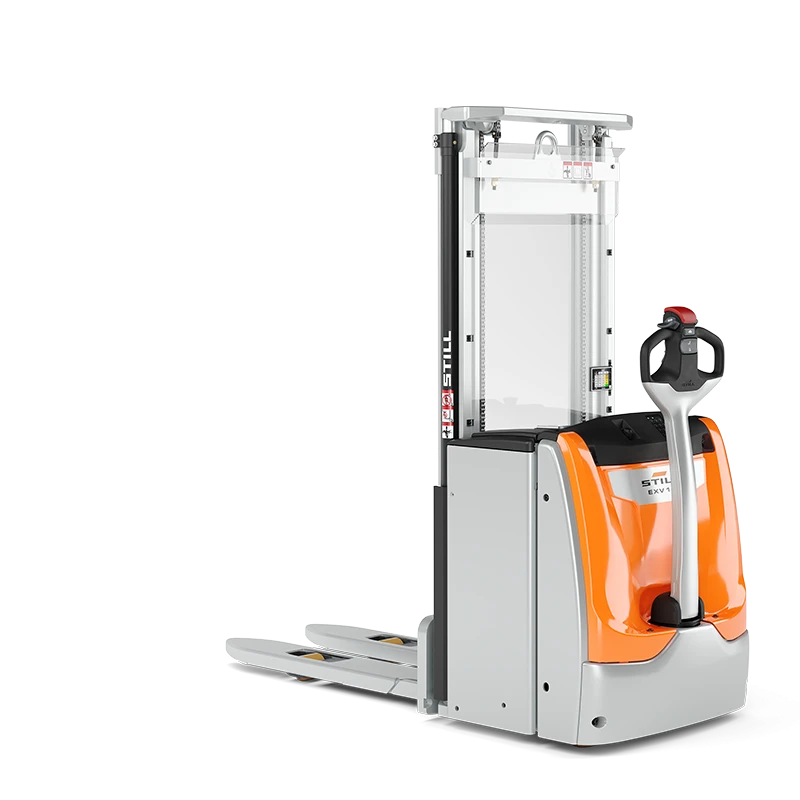
A stacker truck (high lift pallet truck) is a compact electric truck used to lift pallets into racking or stack them on top of each other. For many businesses it is the logical step between a pallet truck that only lifts just off the floor and a large counterbalance forklift. This article explains what a stacker is, the main types available and how to choose the right STILL model for each need.
What is a stacker truck and how does it differ from other trucks?
A stacker consists of a mast, forks, a tiller or operator compartment and a battery. Most stackers have two wheel arms (support legs) that run under the pallet, keeping the truck stable without a heavy rear counterweight. This makes the truck short, light and manoeuvrable in narrow aisles, ideal for small and medium warehouses, production areas, shops and supermarkets.
Compared with an electric pallet truck, a stacker has a mast so it can place goods on racking levels. Compared with a reach truck, a stacker is simpler: it has no mechanism to push the mast forward, usually drives more slowly and lifts lower, and suits moderate throughput. Compared with a counterbalance forklift, a stacker cannot drive on rough outdoor ground but is far more compact and saves aisle space.
Common types of stacker
Pedestrian stacker
The operator walks behind and steers with a tiller. This is the most common type, suitable for short distances and low to medium throughput. STILL tillers feature OptiSpeed, which adjusts speed to the tiller angle for safe slow driving in tight aisles.
Stand-on stacker
A platform lets the operator ride on longer runs, which is less tiring than walking all shift and allows higher travel speed. It is the choice when the distance between goods-in and racking is fairly long.
Seated stacker
Designed for multi-shift operation, long distances and high lifting. The operator sits in a cab with pedals and a joystick, keeping a comfortable posture throughout the shift.
Counterbalanced stacker (cantilever forks)
No support arms under the pallet; the cantilever forks work like a small counterbalance forklift. This type can handle closed-base pallets, single-faced pallets and containers, and accepts attachments. In return, it is longer than a straddle-leg stacker of the same capacity.
Double stacker
Carries one pallet on the wheel arms and another on the forks at the same time, very useful when loading trucks or moving goods internally where more pallets per trip are needed.
STILL stacker comparison table
Figures below are taken from the manufacturer’s model tables; actual lift height depends on the mast selected.
| Model | Type | Max. capacity | Max. lift height | Speed |
|---|---|---|---|---|
| STILL ECV 10 | Pedestrian, light duty | 1,000 kg | 3,227 mm | 4.8 km/h |
| STILL EXV 10C–16C | Compact pedestrian | 1,000–1,600 kg | 4,686–5,466 mm | 6 km/h |
| STILL EXV 14–20 | Pedestrian, high capacity | 1,400–2,000 kg | 6,066 mm (14/16 versions) | 6 km/h |
| STILL EXV-SF 14–20 | Stand-on | 1,400–2,000 kg | 6,066 mm (14/16 versions) | 10 km/h |
| STILL FXV 14–16 | Seated | 1,400–1,600 kg | 6,216 mm | 12 km/h |
| STILL EXV-CB 06–16 | Counterbalanced, pedestrian | 600–1,600 kg | 3,516–4,224 mm | 6 km/h |
| STILL EXD 18C–20C | Double stacker | 1,800–2,000 kg | Low-level stacking | 6 km/h |
Key features of each STILL stacker range
STILL ECV 10 is an entry-level stacker for light, occasional stacking. It uses two 12 V batteries with 125 Ah capacity and an integrated charger, so it can be charged from any standard socket; speed is automatically reduced according to lift height.
STILL EXV 10C–16C is a compact pedestrian stacker with a one-hand OptiSpeed tiller for left- and right-handed operators, an LED display and lowering damping to protect goods. It suits warehouses that need to store goods close together in tight aisles.
STILL EXV 14–20 lifts more and higher. Its extra-long tiller keeps a safe distance between the operator’s feet and the truck, and Curve Speed Control slows the truck in bends. Batteries up to 375 Ah or Li-Ion allow long working times; the optional load display and Dynamic Load Control show the maximum lift height for the load being carried.
STILL EXV-SF 14–20 has an extended stand-on platform, lateral protective arms and a top speed of 10 km/h. The air-cushioned platform adjusts to the driver’s weight, and the colour display uses language-independent symbols. It suits warehouses with longer runs from the staging area to the racking.
STILL FXV 14–16 is a seated stacker lifting over 6.2 m, with speeds up to 12 km/h and batteries up to 625 Ah or optional Li-Ion. It automatically reduces speed according to steering angle and lift height, making it ideal for multi-shift, high-throughput warehouses.
STILL EXV-CB 06–16 is a counterbalanced stacker with cantilever forks, a tilting mast, electric steering and proportional valves for precise lifting and lowering. It handles many types of pallets, containers and attachments; optional FleetManager controls who may use the truck and records impacts.
STILL EXD 18C–20C is a double stacker: it carries up to 1,000 kg on the wheel arms plus 800 to 1,000 kg on the forks. Its slim chassis and small turning radius suit truck loading and confined areas.
Choosing a stacker: 5 questions
- How heavy is the pallet and where is the load centre? Rated capacity drops at higher lift heights or when the load centre is further out than standard. See how to choose forklift capacity.
- How high is the top racking level? Choose a mast whose lift height exceeds the top beam, and check the lowered mast height against doors, ceilings and pipes.
- What type of pallet? Closed-base pallets, single-faced pallets or containers that the support arms cannot pass under need a counterbalanced stacker such as the EXV-CB. Standard pallets work with straddle-leg stackers.
- Distance and frequency? Short and few trips: pedestrian. Long runs, many trips: stand-on. Multiple shifts and constant high lifting: seated. If aisles are very narrow and high lifting is frequent, consider a reach truck or a very narrow aisle truck.
- Floor and energy? Stackers need flat, solid floors. For multi-shift work, consider Li-Ion batteries for opportunity charging; see lithium-ion vs lead-acid batteries.
Frequently asked questions
Can a stacker replace a counterbalance forklift?
In warehouses with flat floors, standard pallets and moderate loads, a stacker is usually sufficient and more compact. For outdoor work, poor floors or heavy loads, a counterbalance forklift remains the better fit.
Pedestrian or stand-on stacker?
If each trip is short and there are few trips, a pedestrian stacker is enough. For long runs and many trips per shift, a stand-on model such as the EXV-SF reduces operator fatigue and raises productivity.
When do I need a counterbalanced stacker?
When handling closed-base pallets, single-faced pallets, containers or when attachments are needed, because the support arms of a standard stacker usually cannot pass under such loads.
Can a stacker work in narrow aisles?
Yes. Its short chassis lets a stacker manoeuvre in narrower aisles than a counterbalance truck. During a site survey, measure the actual aisle width and pallet size to select the right model.
The xenangstill.com team can survey your warehouse, measure racking heights and aisles, and recommend the right STILL stacker truck. Send a request via our quote page or call our hotline 0902 63 79 70.