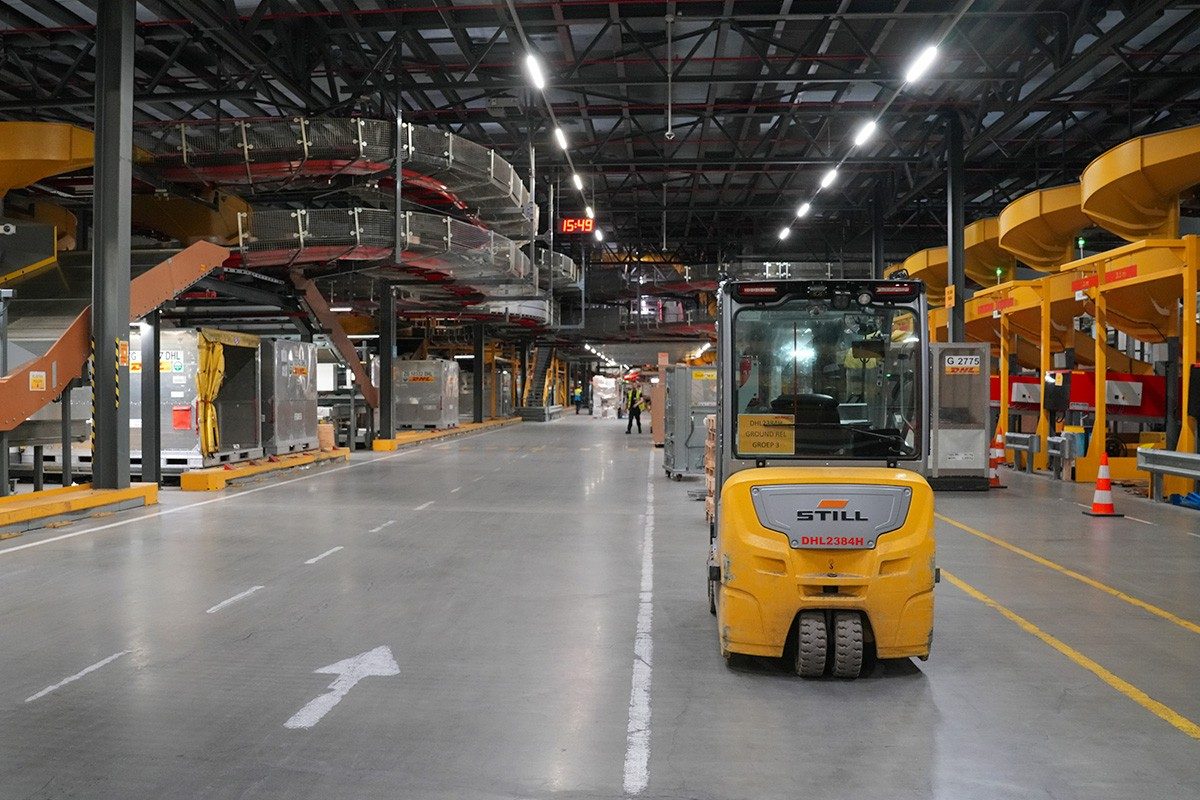
DHL Aviation in Brussels has commissioned a completely new STILL lithium-ion fleet, making it the first of five European DHL Aviation hubs to switch to this technology. Renewing the partnership with STILL fits the logistics provider’s sustainability strategy. To manage energy intelligently, cut peak loads and keep operations running, the partners jointly designed an energy ecosystem in which the STILL Smart Energy Unit plays a key role.
| Industry | Air freight |
|---|---|
| Company | DHL Aviation, Brussels hub (Belgium), part of the DHL Express network |
| Challenge | Build charging infrastructure for a complex logistics centre: decentralised charging, integration with existing energy management, alignment with safety and space goals, intelligent energy control and minimal peak loads |
| Solution | An energy ecosystem built on the STILL Smart Energy Unit and a lithium-ion truck fleet |
| STILL equipment | STILL Smart Energy Unit; 117 new lithium-ion trucks: EXH electric pallet trucks for lorry loading, STILL RX 20 and RX 60 electric forklifts for heavier unit loads |
An express hub running almost 24/7
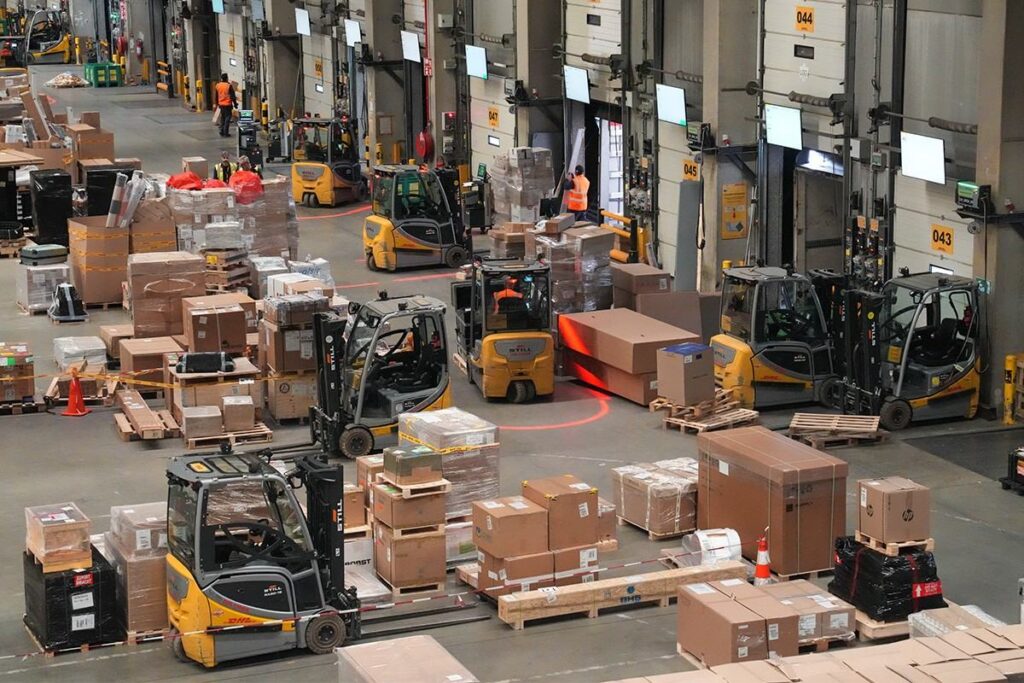
DHL Aviation is part of the global DHL Express network. From Brussels it ships time-sensitive goods, including pharmaceuticals and machine parts, to over 220 countries. “Via our hub, we handle the processing, sorting, and air and road transport of express shipments,” says Marcel De Kelver, Senior Manager Facilities & Equipment at DHL Aviation. “We work in an almost 24/7 environment that is intensive and time-critical. Each operational night, we sort more than 200,000 shipments in our hub. Reliability, safety and sustainability must go hand in hand.”
Key challenges are operational continuity, better safety and the move to sustainable technology. “Recent investments in electric ground support equipment and a new Li-ion-only intralogistics fleet have helped us reduce energy consumption and optimise space,” adds Jelle De Parade, Project Engineer at DHL Aviation responsible for electrical installations.
An opportunity to upgrade
DHL Aviation once again chose STILL for its new fleet. “We have had nothing but good experiences with STILL, both in terms of the trucks as well as their service,” says De Kelver. “We needed more compact and efficient equipment to make better use of the space. The latest generation of RX 20 electric forklift trucks, for example, are highly manoeuvrable and compact, making them ideal for reloading large, non-conveyable loads into unit load devices and for loading and unloading aircraft pallets and containers.”
Although the hub covers 330,000 m², the operation itself is very compact. “Space is particularly valuable here at the airport. Every square metre we save is pure profit,” De Kelver says. That is where the Li-ion trucks help: a central battery charging and changing station is no longer needed, because the batteries can be charged decentrally anywhere in the hub. This reduces internal transport and improves safety.
117 lithium-ion trucks, 16% less energy
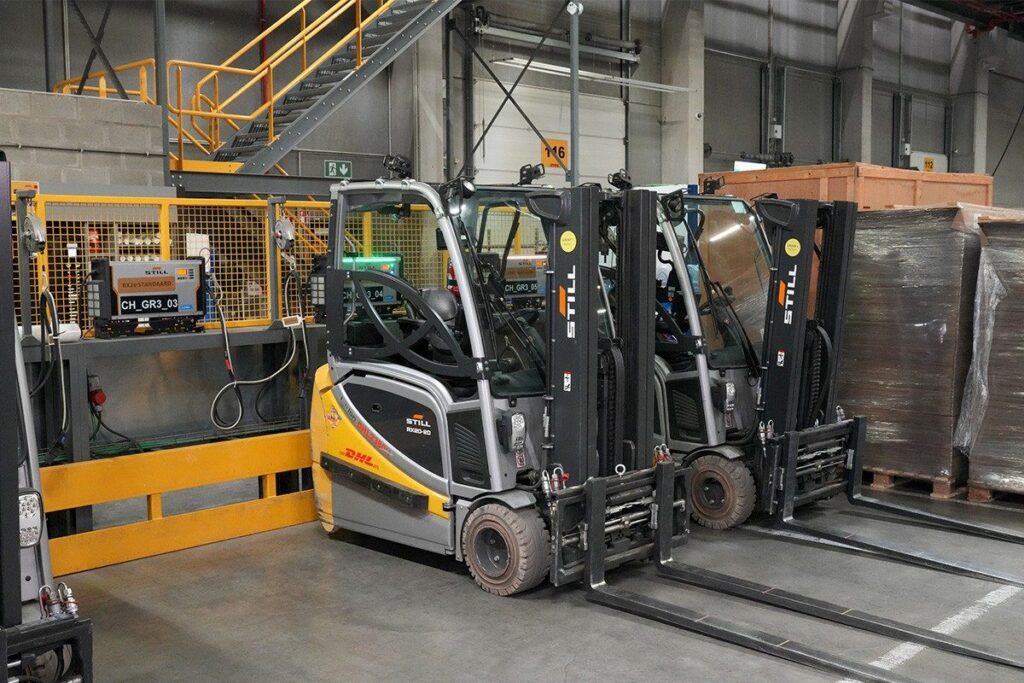
With 117 new STILL trucks, from EXH electric pallet trucks for lorry loading to RX 20 and RX 60 electric forklifts for heavier unit loads, Brussels is one of the major European DHL Aviation hubs to make the switch. “The trucks are even more reliable and ergonomic than before. For example, we can now automatically position the mast vertically, which is important when weighing air freight,” says De Parade.
The biggest gain, he says, is energy. Although the previous fleet was already efficient, DHL Aviation saves 16% on energy with virtually the same truck types and 93 new energy-efficient chargers. Those savings matter because electrification has grown sharply in recent years.
A jointly developed energy ecosystem
“It is precisely this growing electrification that is making further savings increasingly difficult. That is why we wanted more than just new trucks,” De Parade says. DHL Aviation has invested heavily in energy management and control systems that monitor, optimise and forecast consumption in real time, supporting its sustainability goals while managing peak loads and cutting operating costs.
“STILL was open to jointly developing a charging infrastructure tailored to our logistics needs, including decentralised charging, integration with our energy management systems, and alignment with our safety and space optimisation objectives. From the outset, we were able to provide input and engage in productive discussions,” De Kelver says.
The role of the STILL Smart Energy Unit
The STILL Smart Energy Unit, connected to the customer’s energy management system, is central to the solution. At DHL Aviation the hub has to orchestrate several large consumers and sources, such as the many conveyors, e-mobility charging and solar power. “The burden on the electricity grid, or rather the need to relieve it, is becoming more and more important. That is why we need to distribute the available power as efficiently as possible when charging multiple batteries, especially with intermediate charging,” explains Thierry Morreel, Key Account Manager Energy at STILL Benelux.
The chargers are split into ten groups, each with a Smart Energy Unit managing the power drawn by the chargers in that station. The system recognises each battery’s state of charge and power request and can set priorities, for example charging the emptiest batteries first, so every truck stays available with an optimally charged battery.
Results: sustainable and cost-effective
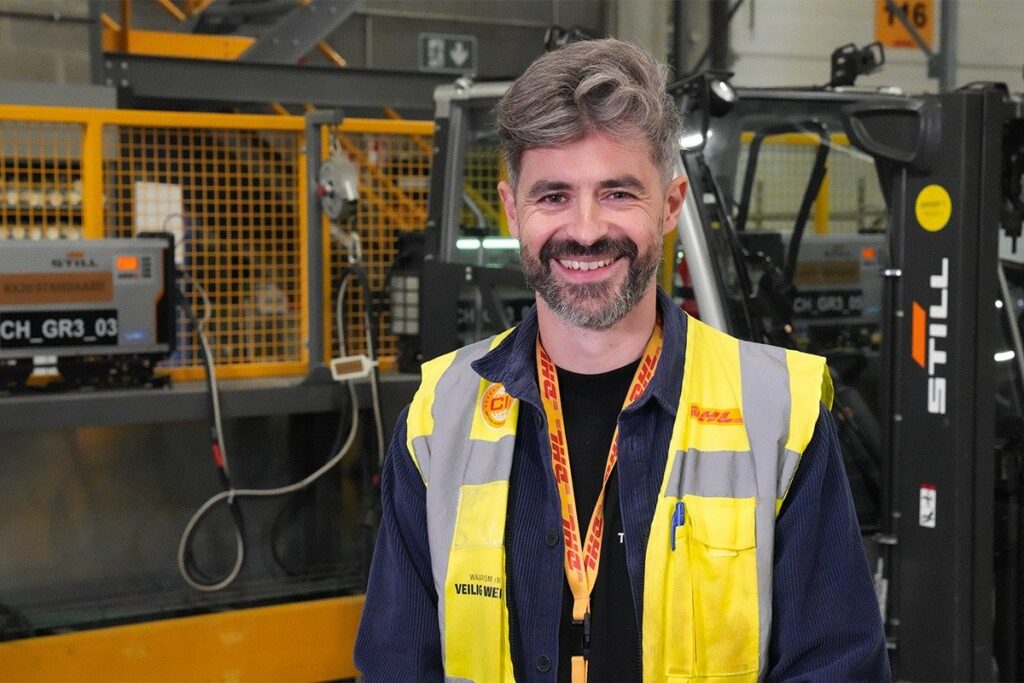
The solution lets DHL Aviation balance energy use across the whole site, reduce it where possible and stay within the limits agreed with its energy supplier. “Every time we consume more energy than agreed with the energy supplier, the energy bill rises sharply,” says De Parade. STILL Smart Portal, the central fleet management platform, gives full insight into charging, energy consumption and the use of forklifts and warehouse equipment.
- 16% lower energy consumption with 117 lithium-ion trucks and 93 new chargers.
- Decentralised charging replaces a central battery room and frees valuable space.
- Better peak-load management, helping both costs and sustainability goals.
- Higher fleet availability and flexibility.
- Improved safety with smart cameras that detect people and intervene, plus contour lighting for visibility.
“All in all, we have improved efficiency, safety and energy management, all of which are crucial for a logistics centre like ours,” De Kelver concludes.
Lessons for companies in Vietnam
Air cargo terminals, express hubs and 3PL warehouses in Vietnam are moving to electric forklifts, which raises questions about charging infrastructure and power bills. From the DHL Aviation project:
- Count floor space when choosing battery technology: lithium-ion trucks charged decentrally remove the battery room and return space to operations.
- Manage peak load as the fleet grows: grouping chargers and setting priorities avoids exceeding the contracted power limit.
- Measure energy with data: track consumption and truck utilisation to see exactly where savings come from.
Learn more about STILL electric forklifts, STILL electric pallet trucks, energy solutions and forklift solutions for logistics & 3PL. Projects delivered in Vietnam are listed on our reference projects page.
Source: STILL GmbH, DHL Aviation takes off with sustainability. Photos: STILL.
Planning a switch to lithium-ion and the charging infrastructure behind it? Send a request via the quote request page or call 0902 63 79 70.