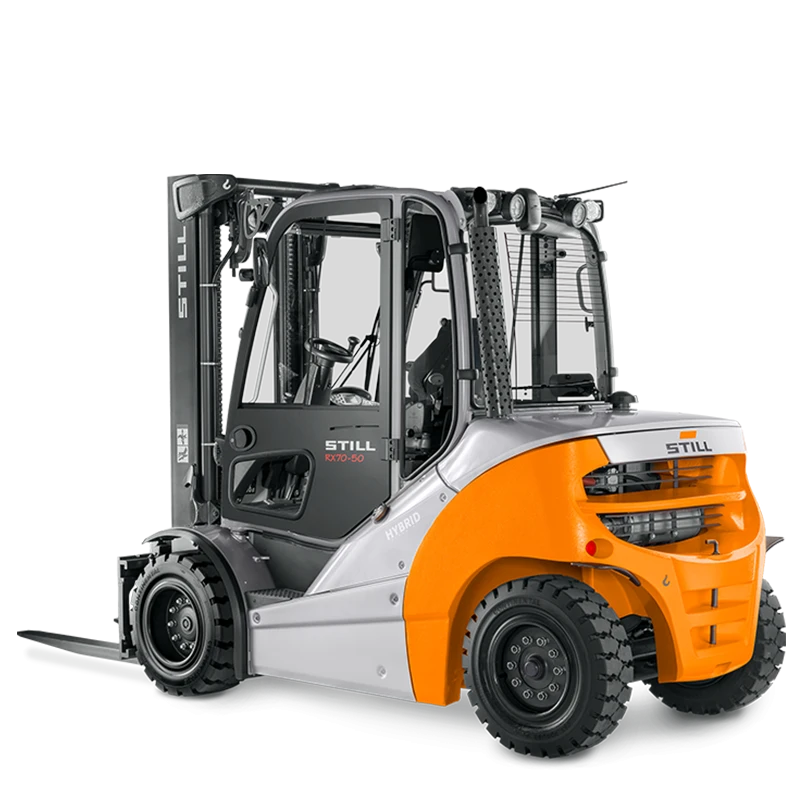
Not every engineering process takes place under a roof. Steel blank yards, die storage areas, welded structure staging and oversize dispatch gates are often outdoors, on uneven ground, with very heavy loads. This is where STILL RX 70 and RCD diesel and LPG forklifts still play the main role in automotive & engineering.
What outdoor areas of an engineering plant demand
Typical goods are steel plate, sections, castings, press dies, welded frames or crated equipment. They are heavy, bulky and sometimes wider than the truck. Trucks run all day between yard and workshop, facing dust, rain and ramps. The key needs are residual capacity, a rigid mast, good visibility and a durable drive train.
If routes are mainly inside enclosed halls with many workers, electric trucks are usually more sensible. Electric vs diesel forklift helps weigh both directions against the real environment.
STILL RX 70: diesel-electric for metalworking
In its product documentation, STILL lists the metalworking industry among the indoor and outdoor applications of the RX 70 4.0 – 5.0 t and RX 70 6.0 – 8.0 t. The distinguishing feature is the diesel-electric drive, which combines the strength of a powerful combustion engine with the precision of an electric drive.
- STILL RX 70 4.0 – 5.0 t: lifts up to five tonnes at a 600 mm load centre, travel speed up to 21 km/h.
- STILL RX 70 6.0 – 8.0 t: capacity up to 8 tonnes, high seat and offset cab for an all-round view.
- All drive components are encapsulated against dust and water; the mast is bend-proof and torsionally rigid.
- Five drive programmes; Blue-Q mode cuts energy consumption by 10% without reducing performance.
For lighter loads, the RX 70 2.0 – 3.5 t comes in diesel and LPG versions. LPG is often considered when trucks enter halls frequently, but ventilation must be assessed under current regulations.
STILL RCD 10 – 18 t: dies, steel coils and very heavy goods
When loads exceed ten tonnes, such as large press dies, machine assemblies or steel structures, the STILL RCD 10 – 18 t is the heavy-duty range. STILL highlights points that fit engineering plants:
- Capacity up to 18 tonnes with a turbo common-rail engine.
- When large loads block the forward view, the entire driver workspace including controls can rotate 180 degrees.
- A wide range of fork carriages and attachments for different goods.
- Sloped counterweight and impact-resistant safety glass roof window for a stable view.
Assignment by process step
| Step | Type / model | Reason |
|---|---|---|
| Receiving plate and blanks from trucks in the yard | STILL RX 70 4.0 – 5.0 t | Drive sealed against dust and water; rigid mast |
| Stacking blanks, medium dies | STILL RX 70 6.0 – 8.0 t | Up to 8 tonnes, view from a high seat |
| Large dies, machine assemblies, welded structures | STILL RCD 10 – 18 t | Up to 18 tonnes, 180-degree rotating workspace |
| Occasional hall access, lighter loads | STILL RX 70 2.0 – 3.5 t (diesel/LPG) | Fuel flexibility, comfortable cab |
What to survey before choosing a combustion truck
Real load and load centre
Dies and blanks are irregular; the centre of gravity may lie further out than the standard load centre. Weigh real loads and check the load chart; with attachments such as long forks or clamps, rated capacity drops.
Yard surface and ramps
Gravel, cracked concrete or steep ramps affect tyre choice and chassis life. Survey the route before fixing the configuration.
Indoor – outdoor boundary
Many plants keep diesel trucks in the yard and assign electric trucks inside, as the automotive & engineering solution set suggests, reducing emissions where people work for long periods.
Maintaining heavy-duty trucks
Diesel trucks in dusty yards need a tight inspection schedule for air filters, cooling, hydraulics and lift chains. Maintenance and repair and genuine parts keep trucks ready when the line is waiting for material. All combustion models are in the diesel & LPG forklifts category.
Frequently asked questions
How does the RX 70 differ from hydrostatic diesel trucks?
The RX 70 uses a diesel-electric drive. According to STILL, this gives high availability, longer service life and lower operating costs, with control as sensitive as an electric truck.
When is an RCD needed instead of an RX 70?
When loads exceed the 8-tonne range of the RX 70 6.0 – 8.0 t, or bulky goods block the view enough to need a rotating workspace. The RCD has models from 10 to 18 tonnes.
Can diesel trucks be used inside an assembly hall?
Technically yes, but ventilation and current occupational safety rules must be assessed. For busy assembly areas, many companies choose electric trucks.
Need a survey of your blank yard and dies, and a recommendation between RX 70 and RCD? Send a request via request a quote or call 0902 63 79 70.