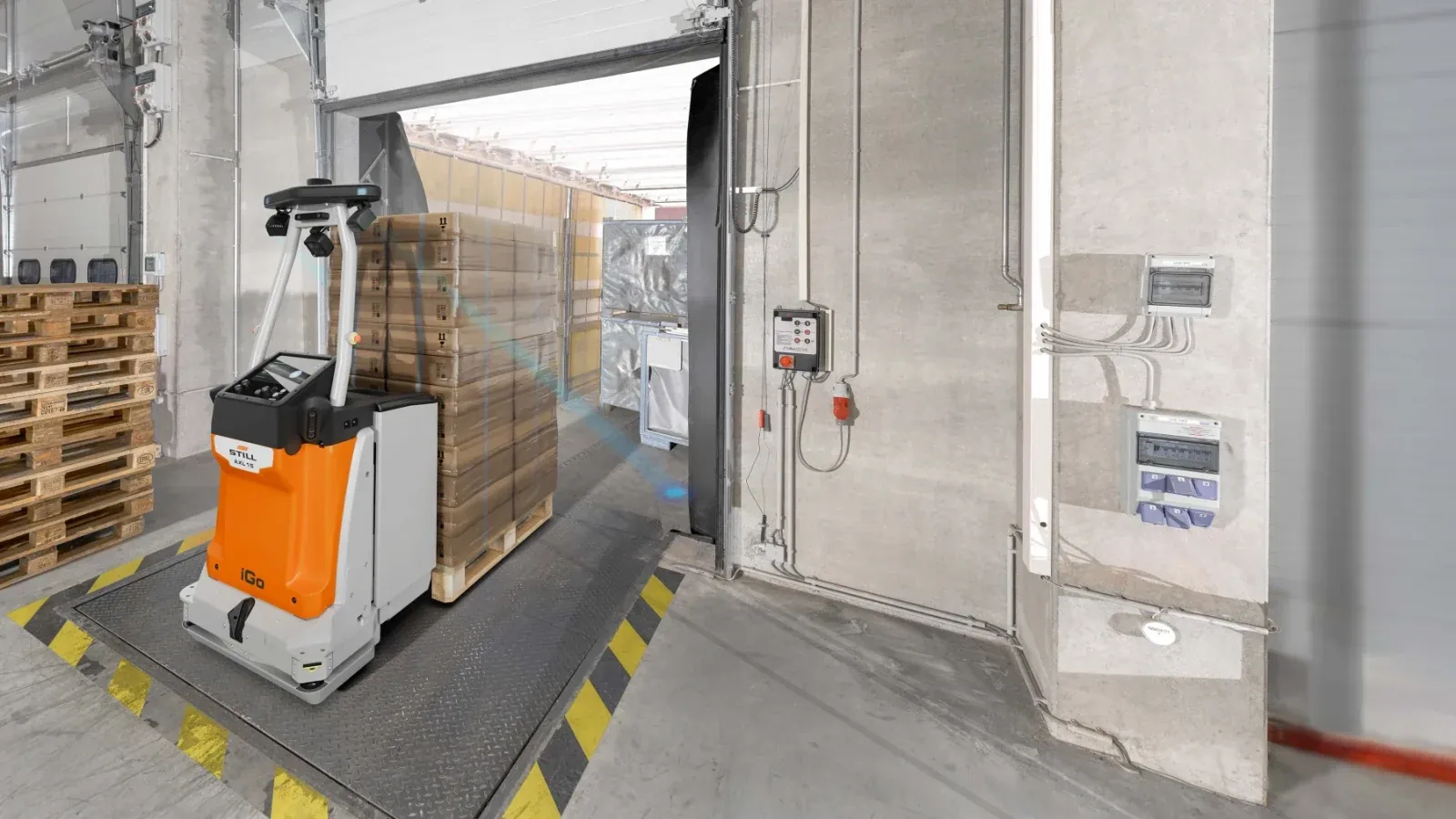
Textile and footwear are labour-intensive. When warehouse staff and forklift drivers are hard to recruit or fluctuate by season, many plants start exploring partial automation. STILL’s iGo automated trucks offer a step-by-step approach: automate repetitive routes first and keep people for tasks that need judgement. This article shows which stages of the textile and footwear chain fit and the matching iGo trucks.
Which stages to automate first?
Not every stage suits automated trucks. Good candidates share three traits: repetitive routes, standard carriers and steady daily volume. In textile and footwear plants, these stages often qualify:
- Fabric pallets from store to cutting: fixed route, standard pallets, many repeats per shift.
- Finished pallets from packing to store: uniform cartons, short routes.
- Loading trucks at the dock: high volumes of standard goods.
- Putting pallets into finished-goods racking: where racking and aisles are well defined.
Cutting rooms and sewing lines with home-made carriers and layouts that change per style are better left manual. An overview of timing is in autonomous forklifts AGV/AMR: when to automate.
iGo trucks by stage
Shipping dock: STILL AXL iGo
The STILL AXL iGo is an autonomous low-lift pallet truck dedicated to loading and unloading trucks. It navigates precisely in the pre-loading zone and inside the trailer, with no need for stationary safety solutions at the dock. It can be integrated into a WMS; according to STILL, two vehicles in parallel can load up to 30 pallets in about 35 minutes. Capacity is up to 1,500 kg. It suits plants shipping finished goods steadily by truck to ports or hubs.
Store to workshop: STILL EXV iGo and AXV iGo
The STILL EXV iGo is an automated stacker with 1,600 kg capacity, 3.744 mm lift height and 7,2 km/h speed (manufacturer data notation). It suits routes moving fabric pallets from store to cutting and placing them on low racking. The STILL AXV 12 iGo handles 1200 kg with 1844 mm lift, suited to supplying stations.
Non-standard carriers: STILL EXV-CB iGo
The STILL EXV-CB iGo uses cantilever forks, with 1400 kg capacity and 3800 mm lift. It helps plants using racks or boxes that are not standard pallets.
High-bay stores: STILL FM-X iGo
The STILL FM-X iGo is an automated reach truck with capacity up to 2330 kg, lift up to 10474 mm and an aisle width of 2950 mm. It is for high-bay finished-goods or fabric stores wanting automated night-shift storage and retrieval.
Guide table: stage – model – reason
| Stage | STILL model | Reason |
|---|---|---|
| Truck loading at the dock | AXL iGo | Drives into trailers, WMS integration |
| Fabric store to cutting | EXV iGo | Fixed route, low racking |
| Supplying stations | AXV 12 iGo | Compact, low lift |
| Non-standard carriers | EXV-CB iGo | Cantilever forks |
| High-bay finished goods | FM-X iGo | Automated reach truck |
Suggested roll-out path
- Pick a pilot route: simple, steady volume, few pedestrian crossings.
- Standardise carriers: pallets and racks must be uniform for reliable detection.
- Check the site: floors, aisles, doors, crossings; clear traffic markings.
- Integrate systems: connect a WMS if present; define who calls trucks and when.
- Train staff working alongside automated trucks, then scale up.
See our warehouse automation solutions, the STILL automated truck range and the textile & footwear solutions page.
Frequently asked questions
Can automated trucks work alongside workers?
iGo trucks use sensors and safety fields to work with people. Even so, each area needs a risk assessment, especially busy line areas.
Can a plant without a WMS use automated trucks?
It can start with simple routes. The level of integration depends on the model and existing systems and needs a survey.
Will automation replace all forklift drivers?
Usually not. Automated trucks take repetitive routes; flexible tasks such as odd receipts and exceptions still need drivers.
Considering automation for a textile or footwear store? Send a quote request with route sketches, carrier types and trips per shift, or call our hotline 0902 63 79 70.