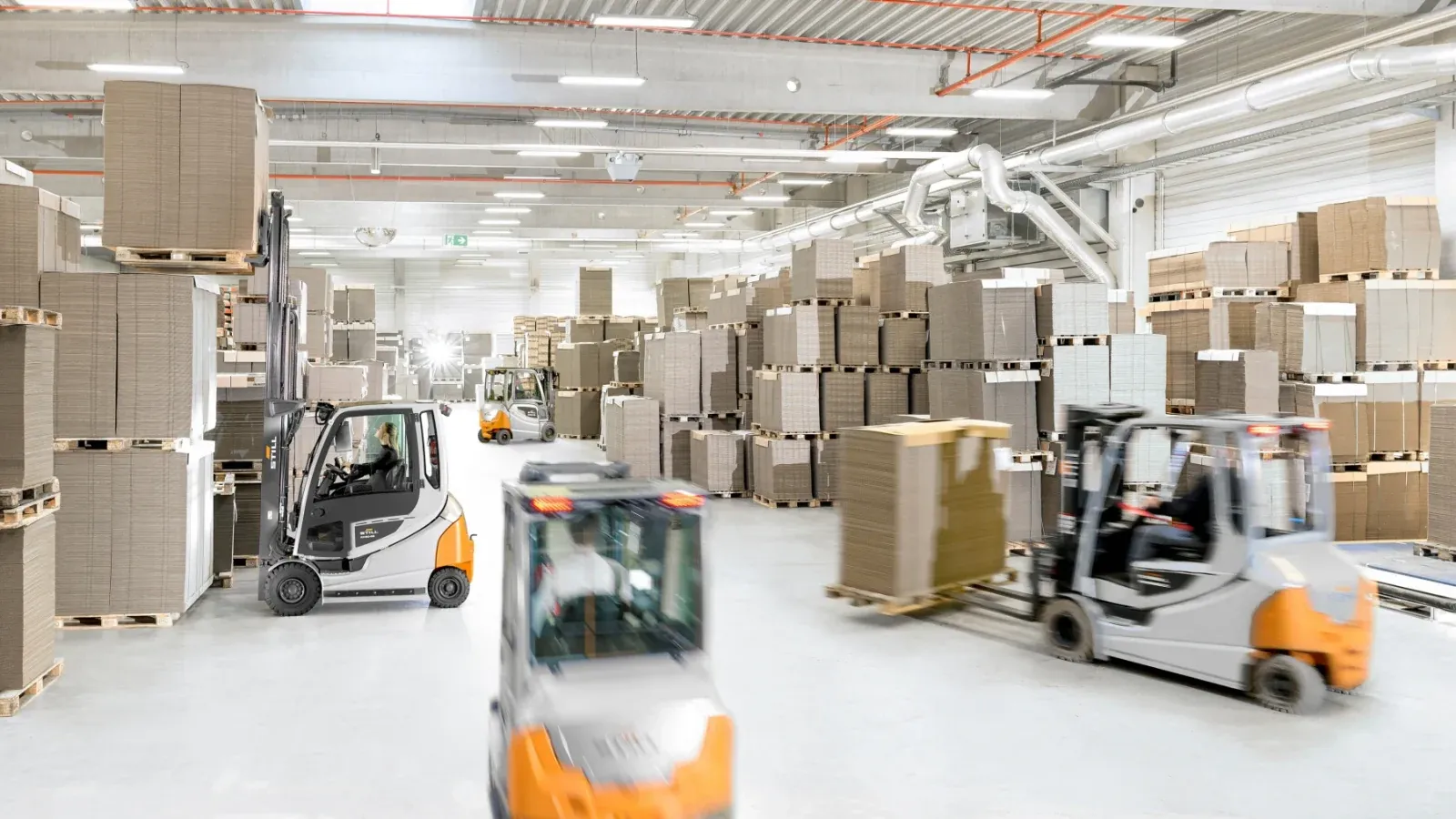
Chemical plants handle demanding loads: steel drums, IBCs, bulk bags, plastic canisters and cartons of bottles. Many goods can leak, corrode or burn, so forklift solutions for the chemical industry are not only about enough capacity but about placing the right truck type in each area: raw material yard, quarantine store, blending, filling, finished goods store and dispatch dock.
Specific operating challenges
- Liquid loads with shifting centres of gravity: full drums and IBCs can slosh under hard braking or cornering; drivers need smooth trucks with good speed control.
- Zoning by chemical properties: oxidisers, acids and solvents are stored by compatibility group, making flows complex.
- Areas with an explosion risk: solvent filling or combustible dust areas may be classified as hazardous, where standard trucks must not enter.
- Many finished goods SKUs: canisters of many sizes and small dealer orders need accurate picking.
A note on areas with an explosion risk
Hazardous area classification must be carried out by the company in line with applicable regulations before any equipment is chosen. In the STILL source documents available to us, only the STILL RX 20 1.4–2.0 t, RX 60 2.5 – 3.5 t and RX 60 3.5 – 5.0 t come with documentation for an explosion-protected version. We do not state any protection level or zone standard; the suitable configuration must be confirmed based on the area assessment. Other ranges should be used in areas confirmed as safe.
Overview: truck type – STILL model – application
| Truck type | STILL model | Application in the chemical industry |
|---|---|---|
| Electric counterbalance forklift | RX 60, RX 20, RCE 25 – 35, RXE 10 – 16C | Unloading drums and IBCs, feeding blending, container loading |
| Diesel and LPG forklift | RX 70, RCD | Outdoor raw material yards, bulk bags, tanks and very heavy loads |
| Reach truck | FM-X, FXR 14C-18C, FM-X SE, FM-4W | High-bay storage of bags, canisters and cases by compatibility group |
| Stacker | EXV 14-20, EXV-CB 06-16, ECV 10, EXD 18C-20C | Additive stores next to blending, sample rooms, packing |
| Electric pallet & hand pallet trucks | EXH 25-30, EXH-S 20-25, FXH 20-25 N, ECH 12C/15C, HPS/HPT | Drums and IBCs to quarantine, discharge stations |
| Electric tow tractor | LTX 20, LTX 50, LTX 70, LXW 20/30, LXT 120/350 | Tugger trains between stores and plant buildings |
| Order picker | OPX 20-25, OPX-L 12, OPX iGo neo, EK-X 10 | Picking loose canisters and cases for dealers |
| iGo automated truck | AXV 12 iGo, EXV iGo, EXV-CB iGo, FM-X iGo, AXL iGo | Repetitive routes: empty packaging to filling, finished goods to storage |
Arranging the fleet along the material flow
Receiving: electric counterbalance or pallet trucks move drums and IBCs to quarantine. Outdoor yards: diesel and LPG trucks for powder bags and heavy items, never in enclosed stores or hazardous areas. Main store: reach trucks, aisles separated by chemical group. Blending and filling: stackers and pallet trucks for short runs; tow tractors link buildings. Finished goods: order pickers assemble orders, counterbalance trucks load containers. Repetitive routes with uniform containers can gradually move to iGo trucks.
Solution articles
- Electric forklifts for chemicals
- Diesel and LPG forklifts for chemicals
- Reach trucks for chemicals
- Stacker trucks for chemicals
- Electric pallet trucks for chemicals
- Electric tow tractors for chemicals
- Order pickers for chemicals
- Automated forklifts for chemicals
Related services
- Maintenance and repair: regular checks in dusty, chemical-laden environments.
- Forklift rental: add trucks for seasonal peaks.
- Fleet management: assign driver access by area.
- Operator training: liquid loads and restricted area rules.
Frequently asked questions
Should a chemical plant favour electric or diesel trucks?
Enclosed stores and production areas should favour electric trucks because they produce no exhaust. Diesel and LPG trucks suit outdoor yards and very heavy loads, with clear boundaries to sensitive areas.
Does STILL offer explosion-protected forklifts?
Our source documents show that the RX 20 1.4–2.0 t, RX 60 2.5 – 3.5 t and RX 60 3.5 – 5.0 t have documentation for an explosion-protected version. Assess the area first, then contact us to confirm the configuration.
Should pallets be standardised first?
Yes, because uniform containers make choosing forks, racking and trucks more precise and are a precondition for automation.
Need a survey and fleet proposal for a chemical plant? Send a request on the quote page or call 0902 63 79 70.