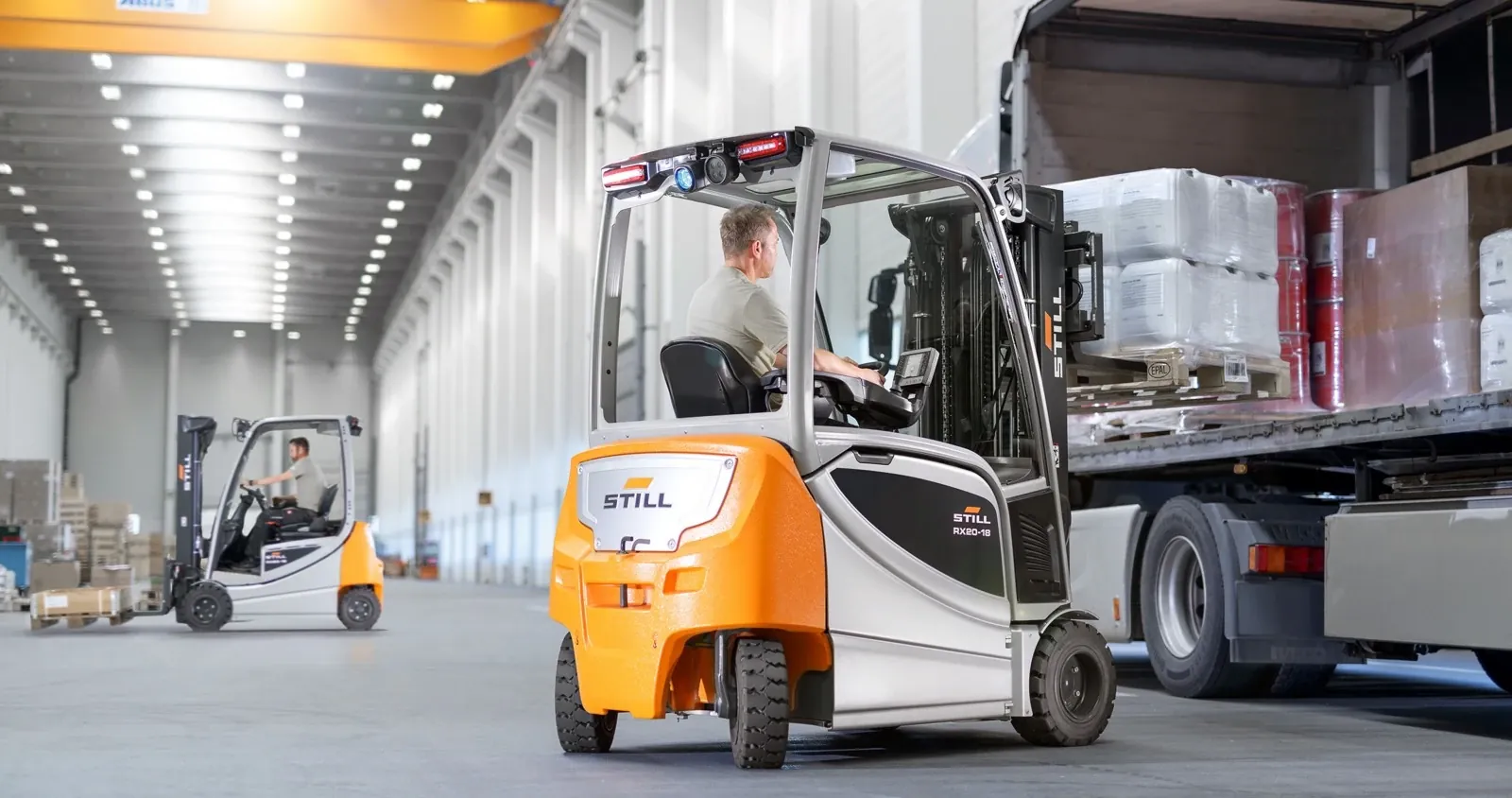
In textile and footwear plants, the electric counterbalance forklift is usually the busiest truck at both ends of the chain: the raw-material receiving door and the finished-goods dock. Fabric rolls, yarn bales, cotton bales and palletised leather hides come in; cartons of garments and shoe boxes go out into containers. This article looks at which stages need an electric forklift, which STILL models fit, and what to watch out for with textile goods.
Why textile and footwear plants favour electric forklifts
Textile goods have their own characteristics: fabric, yarn and leather absorb odours, soil easily and get their value from clean surfaces and consistent colour. Combustion-engine trucks working in enclosed areas can leave exhaust and soot on the goods, especially in greige fabric stores, leather stores and packed finished-goods areas. Electric forklifts produce no local emissions and run quietly, which suits workshops where many operators work close to the truck aisles.
Garment plant layouts are also fragmented: cutting, sewing, pressing and packing areas, with narrow aisles between lines. A compact, agile counterbalance truck reduces collisions with cutting tables, work-in-progress trolleys and building columns. For an overall comparison of the two energy sources, see electric vs diesel forklift.
Main applications in the textile and footwear chain
Receiving raw materials: fabric rolls, yarn, leather
Textile raw materials are often light for their volume but bulky. Long fabric rolls, tightly pressed cotton bales and stacked pallets of leather have a high centre of gravity and can shift under hard braking. Operators need a good view through the mast and a truck that can be controlled precisely at low speed. For fabric rolls not placed on pallets, plants should assess dedicated clamps or carrying poles; fitting an attachment changes the truck’s permitted capacity, so the load chart must be re-read as explained in how to choose forklift capacity.
Feeding materials and trims to the workshop
From the store, inspected fabric pallets and trims (thread, zips, buttons, soles, adhesives) go to the cutting room or line-preparation area. Routes are short with many stops, and trucks share space with pedestrians.
Loading finished goods into containers
Finished garments and footwear are mainly packed in cartons, either palletised or floor-loaded into containers. The truck must work inside containers and truck bodies and manoeuvre in tight space without crushing cartons.
Suitable STILL electric forklifts
The STILL RX 20 suits plants running two or three shifts. It covers the 1.4 to 2 tonne range with a top speed of 20 km/h, and the STILL Easy Control centre lets the driver choose performance functions to suit the application. The Li-Ion version supports opportunity charging: according to the manufacturer, just 30 minutes of charging can extend operating time by several hours, which fits the shift rhythm of a garment plant.
The STILL RXE 10 – 16C is a compact three-wheel counterbalance truck for loads from 1.0 to 1.6 tonnes. STILL highlights its ability to work in trucks, containers and narrow aisles, with Curve Speed Control reducing speed when cornering. It is a strong candidate for shipping docks handling shoe boxes and garment cartons.
The STILL RCE 15 – 20 suits occasional transport and stacking tasks in production workshops, indoors or outdoors, with a convenient side fast-charging port on the Li-Ion version. The STILL SXV-CB 10 lifts up to 1,000 kg on cantilever forks and has a small turning radius, suiting cramped areas between lines. For heavier items such as machinery or large yarn bales, the STILL RX 60 2.5 – 3.5 t range can be considered.
Guide table: stage – truck – reason
| Stage | STILL model | Reason |
|---|---|---|
| Receiving fabric rolls, yarn, leather pallets | RX 20 | Multi-shift use, good visibility, Li-Ion opportunity charging |
| Loading finished cartons into containers | RXE 10 – 16C | Compact, works inside containers and trucks |
| Occasional workshop supply | RCE 15 – 20 | Simple, for indoor and outdoor use |
| Cramped areas between sewing lines | SXV-CB 10 | Cantilever forks, small turning radius |
| Heavy items, machinery | RX 60 2.5 – 3.5 t | Higher capacity while staying electric |
Operating in environments with fibre dust
Weaving mills, sewing rooms and leather cutting areas generate fibre dust and scraps. Dust can collect in the motor compartment, cooling components, battery openings and wheels. Plants should add blowing out, checking cooling fans and electrical connectors to their regular maintenance and repair schedule, at a frequency based on actual dust levels. Textile materials are flammable, so battery charging areas should be separated from fabric stores, well ventilated and compliant with current fire regulations. Information on energy options and charging infrastructure is on the energy solutions page.
The full range is on the STILL electric forklifts page. The complete picture for the sector is on the forklift solutions for textile & footwear page.
Frequently asked questions
Can an electric forklift handle fabric rolls that are not on pallets?
Yes, but it needs a dedicated attachment matched to roll diameter and length. Attachments change the permitted capacity, so a technician should assess real sample loads before the configuration is finalised.
Does a single-shift garment plant need a Li-Ion battery?
Not necessarily. For one shift and short routes, a lead-acid battery may be enough. Li-Ion pays off with multiple shifts or when opportunity charging during breaks is needed. See the comparison in lithium-ion vs lead-acid forklift battery.
Should we buy extra trucks for peak order seasons?
If demand only rises seasonally, short-term rental is usually more flexible. See our forklift rental service to top up the fleet during peaks.
Need advice on electric forklifts for a textile or footwear plant? Send a quote request with your load types, package dimensions and number of shifts, or call our hotline 0902 63 79 70 to arrange a site survey.