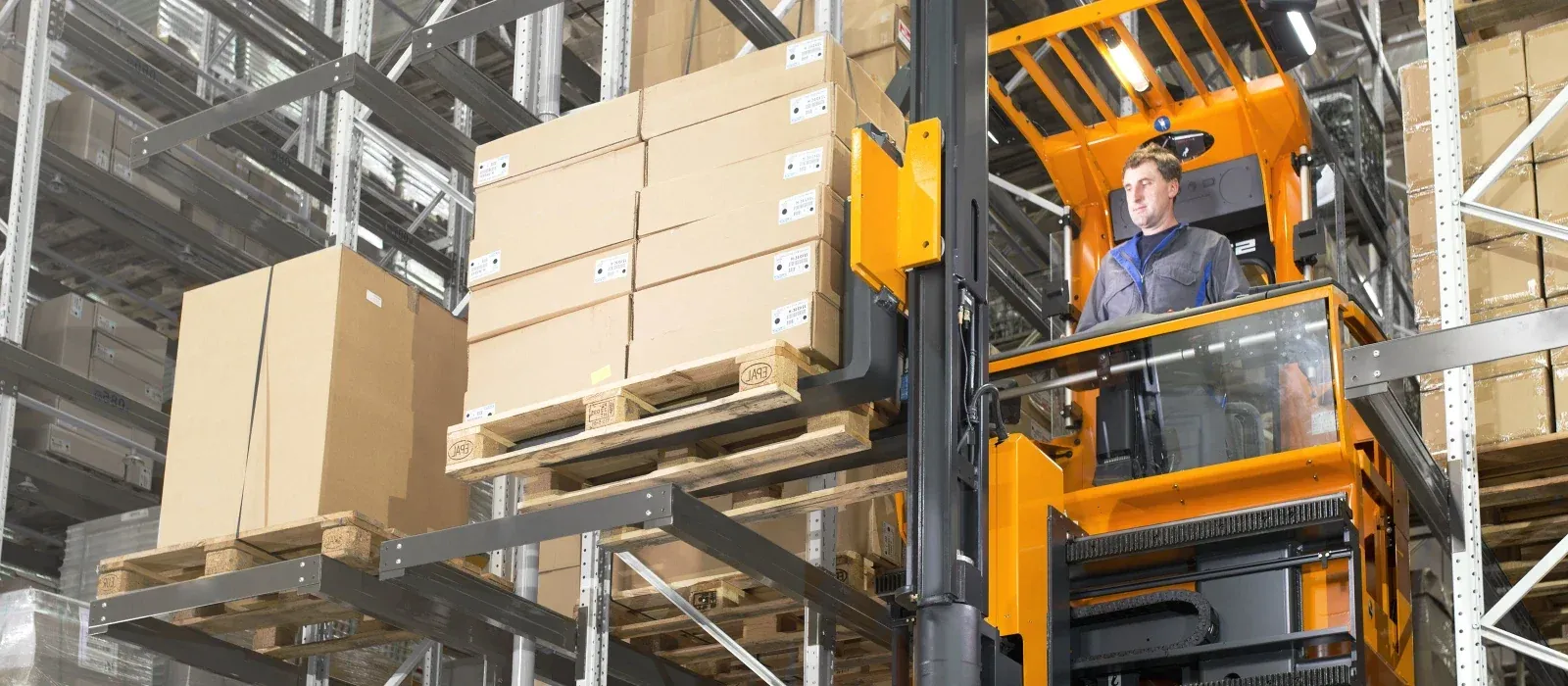
When designing or refitting a warehouse, many businesses lay out the racking first and choose forklifts afterwards. This reversed approach easily leads to aisles too narrow for existing trucks, or too wide and wasteful of space. In practice, warehouse aisle width and forklift type are two decisions that must be made together from the start.
What is working aisle width (Ast)?
Working aisle width (often written Ast in technical documents) is the minimum distance between two racks or rows of goods that allows a loaded truck to turn in and store or retrieve a pallet safely. It depends not only on truck width but also on:
- Truck length and turning radius.
- Pallet size and pick-up direction (long or short side).
- Safety clearances recommended by the manufacturer.
- Truck type: whether it must turn 90° in the aisle, or only retract its mast or handle loads on both sides without turning.
Always use the working aisle width from the data sheet of the exact model and pallet configuration when laying out racking, rather than estimating from experience.
Four aisle categories and matching forklift types
| Aisle category | Suitable truck | Advantages | Considerations |
|---|---|---|---|
| Wide aisle | Electric or diesel/LPG counterbalance forklift | Versatile: truck loading, outdoor work, racking | Uses the most aisle space |
| Narrow aisle | Reach truck | High racking, much narrower aisles than counterbalance trucks | Mainly indoor, needs good floors |
| Narrow aisle, small warehouse | Stacker | Compact, sensible investment, easy to operate | Lower lift height and speed than a reach truck |
| Very narrow aisle | VNA truck | Highest storage density, very tall racking | Requires aisle guidance, very flat floors, transfer stations at aisle ends |
Wide aisles: counterbalance forklifts
Counterbalance forklifts such as the STILL RX 20, STILL RX 60 or STILL RCE carry a counterweight at the rear to balance the load. Because the whole truck must turn 90° to face the rack, they need the widest aisles of all groups. In return, they are the most versatile: unloading containers, running between buildings and stacking at moderate heights. The STILL RX 20 offers lift heights of up to 7,930 mm depending on version.
Warehouses with only a few rack rows, trucks that must do many jobs, or frequent yard work should favour this group. See STILL electric counterbalance forklifts.
Narrow aisles: reach trucks
A reach truck’s mast moves back and forth between two base arms, so the load sits within the truck’s footprint while travelling and only reaches out for storing. This allows a much narrower working aisle than a counterbalance truck, while stacking height is greater. The STILL FM-X reaches lift heights of up to 14,000 mm; the STILL FXR 14C–18C up to 10,970 mm, with a compact cab and reduced working aisle width that suit small warehouses too. For long goods such as steel, pipes or timber, the four-way STILL FM-4W carries long loads through narrow aisles.
Learn more in what is a reach truck and the reach trucks category.
Small warehouses, narrow aisles: stackers
Stackers (electric high lift trucks) are an economical choice for small warehouses, retail and production sites with low to medium racking. They are compact and highly manoeuvrable. Examples: the STILL EXV 14–20 lifts up to 6,066 mm; the STILL EXV-CB is a counterbalanced version without base arms that can handle closed-bottom pallets. For longer travel distances or multi-shift work, consider a ride-on version or move up to a reach truck. See the stackers category.
For low lift pallet trucks, width matters too: the STILL EXH-SF 20–25 has an overall width of 720 mm, narrower than a Euro pallet; the STILL FXH 20–25 N is available in truck widths of 770 mm, 820 mm or 970 mm.
Very narrow aisles (VNA): maximum storage density
VNA trucks do not turn in the aisle; they travel straight along a guidance system (inductive or mechanical guidance) and handle loads on both sides. The aisle is therefore only slightly wider than the truck, allowing more rack rows on the same floor area. The STILL MX-X is a man-up VNA truck with a maximum lift height of 18,110 mm according to its data sheet.
In return, a VNA warehouse requires coordinated investment: very flat floors, aisle guidance, pallet transfer zones at aisle ends and dedicated safety systems such as the PPS personal protection system, predictive braking and automatic speed reduction at aisle ends. See the STILL MX-X and the very narrow aisle trucks category.
Autonomous trucks and aisle width
If you plan to automate in the future, keep aisles wide enough for autonomous trucks. STILL specifies a working aisle width of 2,480 mm for the AXV 12 iGo, 2,875 mm for the EXV iGo and 2,950 mm for the FM-X iGo automated reach truck. A little extra width today can save relocating racks later.
How to choose aisle width and forklift
- Determine the number of pallet locations needed and the clear ceiling height.
- Define throughput: long-term storage (slow-moving) or fast-moving warehouse.
- Check the floor: flatness, load-bearing capacity, gradients.
- Draw two or three racking layouts for different truck groups and compare pallet locations, throughput and total investment.
- Confirm the truck model first, then finalise the racking system drawings.
Frequently asked questions
Are narrower aisles always better?
No. Narrow aisles increase storage locations but limit which trucks can be used, often reducing flexibility and demanding better floors and infrastructure. Fast-moving warehouses are sometimes more efficient with wider aisles.
Can I use a counterbalance truck in a warehouse designed for reach trucks?
Usually this is not safe, because counterbalance trucks need wider aisles to turn into the rack. Check the working aisle width of the specific model.
Which figure should I use for aisle width?
The data sheet value for the specific model and actual pallet size, plus the recommended safety clearance.
Can an existing warehouse be converted to VNA?
It is possible, but floor condition, ceiling height and racking refit costs must be assessed before deciding.
Designing or refitting a warehouse? Send us your floor plan for advice and a quote, or call our hotline 0902 63 79 70 and T&C will propose the right aisle layout and STILL trucks.