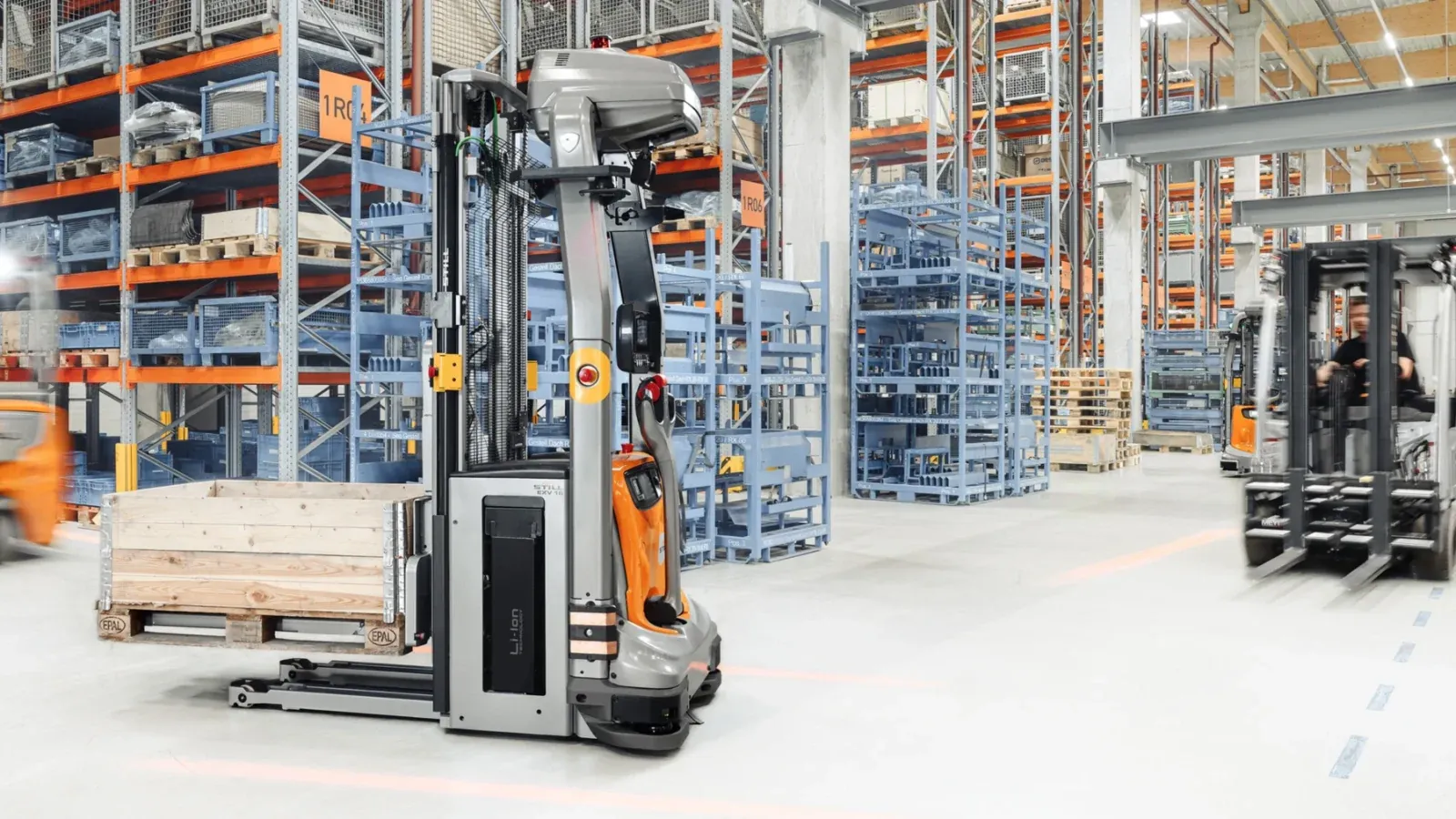
Food and beverage plants have many identical, repeated moves: a pallet leaves the stretch wrapper and travels a fixed path to storage; a packaging pallet goes from the store to the same spot beside the machine. These moves run across three shifts, holidays included. That makes them a sensible starting point for an automated forklift in a food plant.
Why food plants suit automated transport
- Standardised loads: same pallet type, same height, same wrapping, exactly what automated trucks handle well.
- Repeated routes: fixed pick-up and drop-off points with few exceptions.
- Continuous operation: plants run several shifts, so driver costs on nights and holidays are significant.
- Traceability: when automated trucks connect to the warehouse system, every pallet move is recorded.
Autonomous forklifts AGV/AMR: when to automate sets out general evaluation criteria.
STILL iGo solutions by stage
End of line: STILL AXV 12 iGo and EXV iGo
STILL presents the STILL AXV 12 iGo as an entry product for supplying and removing production materials, with 1200 kg capacity and 1780 mm stacking height. A working aisle width of only 2480 mm allows use where previously only manual trucks fitted. For more capacity and height, the STILL EXV iGo lifts up to 1,600 kg to 3.8 metres at a top speed of 7.2 km/h, suiting end-of-line collection to staging or block storage. Both use 360-degree safety laser scanners and a redundant safety system to ISO 3691-4.
High-bay finished goods: STILL FM-X iGo
The STILL FM-X iGo lifts up to 2,300 kg to a storage height of up to 10 metres with a working aisle under 3 metres. It uses a lithium-ion battery and a multi-level safety system with laser scanners. In food stores running night shifts, it can put away the day’s production while few people are around.
Truck loading: STILL AXL iGo
The dispatch dock is a familiar bottleneck in beverage plants. STILL lists food among the applications of the STILL AXL iGo, which automatically loads and unloads standardised goods up to 1,500 kg on trucks. According to STILL, two units working in parallel can load up to 30 pallets in around 35 minutes; 3D Visual SLAM enables navigation without changes to infrastructure, and the solution integrates with warehouse management systems.
The full range is in the automated trucks category; software and integration are covered under warehouse automation.
Automated truck selection table
| Stage | Type/model | Reason |
|---|---|---|
| Packaging supply, end-of-line pallets | STILL AXV 12 iGo | 2480 mm aisle, easy entry point |
| Collection to staging, block storage | STILL EXV iGo | 1,600 kg, lifts to 3.8 m |
| High-bay put-away at night | STILL FM-X iGo | Lifts 2,300 kg to 10 m |
| Truck loading at the dock | STILL AXL iGo | 30 pallets in around 35 minutes with two units |
A practical roll-out path
- Pick a pilot route: usually end of line to storage, where the route is short and pallets uniform.
- Standardise pallets and positions: damaged pallets and skewed wrapping are common reasons automated trucks stop; control outgoing pallet quality.
- Mixed operation: automated and manual trucks share space, so set clear priority rules and zones.
- Expand step by step: once the first route is stable, extend to packaging supply, high-bay storage and the dock.
Manual truck groups for the remaining stages are on food & beverage solutions.
Frequently asked questions
Can automated trucks work in plants with many staff?
iGo models use 360-degree safety laser scanners and safety systems to ISO 3691-4 to operate alongside people. Pedestrian flows still need on-site assessment.
Which stage should be automated first?
Usually end of line to the finished goods store, as the route is fixed, pallets are uniform and work runs across shifts.
Do we need to change our warehouse system?
iGo trucks can run stand-alone for simple tasks or integrate into existing IT systems. The level of integration depends on each plant’s processes.
Want to assess which route in your plant to automate first? Book a survey via the quote page or call 0902 63 79 70.