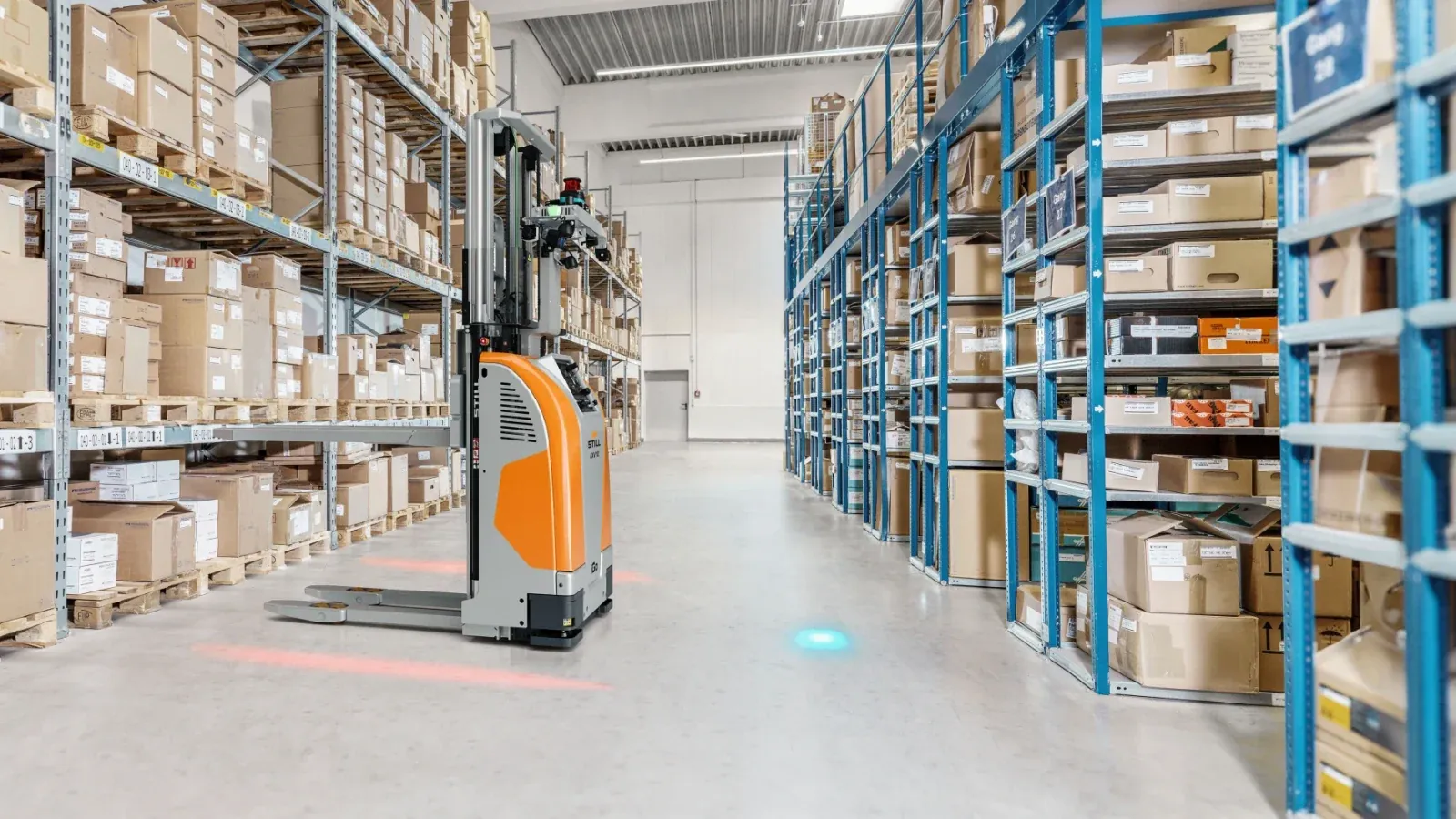
In automotive and engineering plants, some transport trips repeat hundreds of times a day on the same route: from buffer store to line, empties back, finished goods to the warehouse. These tasks suit automated trucks. The STILL iGo range includes several automated truck types, each suited to a specific step in production.
When an engineering plant should automate transport
Good candidates are routes with fixed pick-up and drop-off points, uniform containers and steady frequency across shifts. Steps with constantly changing goods, off-centre loads or frequently blocked areas should keep manned trucks. Many plants start with one pilot route before expanding.
Autonomous forklift AGV/AMR: when to automate sets out general evaluation criteria.
STILL AXV 12 iGo: supplying and removing production materials
STILL describes the STILL AXV 12 iGo as a reliable partner for simple horizontal transport tasks such as supplying and removing materials for production or goods-in and goods-out areas. It stores 1,200 kg at a height of 1,780 mm, travels at 7.2 km/h and is compact enough for the tightest spaces. A multi-level safety system protects people, truck and goods in mixed operation with workers and manual trucks. iGo easy enables plug-and-play commissioning, stand-alone operation or connection to a warehouse management system (WMS).
STILL EXV-CB iGo: special load carriers
Automotive components often sit in dedicated racks rather than standard pallets. The STILL EXV-CB iGo is an automated counterbalanced stacker that handles both standard pallets and special load carriers, with a capacity of 1,400 kg and storage height up to 3.8 metres. It has a redundant safety system in line with ISO 3691-4 and 360-degree laser scanners creating configurable warning and protection fields around the truck.
STILL EXV iGo and FM-X iGo: buffer stores and high racking
STILL names production logistics and staging areas as particular strengths of the STILL EXV iGo: 1,600 kg capacity, lift height up to 3.8 metres, top speed 7.2 km/h and quick switching between automated and manual mode. For high-rack component stores, the STILL FM-X iGo is an automated reach truck lifting up to 2,300 kg on cantilever forks to storage heights up to 10 metres, using the PPS pallet positioning system and serving conveyors and flow racking.
STILL AXL iGo: automated truck loading
In the shipping area of a component plant, the STILL AXL iGo loads and unloads pallets on trucks automatically without fixed safety infrastructure at the dock. According to STILL, two trucks working in parallel can load up to 30 pallets in about 35 minutes, for standardised goods weighing up to 1,500 kg, including in industry.
Automated truck selection by process step
| Step | Type / model | Reason |
|---|---|---|
| Supplying and removing line materials | STILL AXV 12 iGo | STILL names production use; compact, 1,200 kg |
| Non-standard component racks | STILL EXV-CB iGo | Handles special load carriers, lifts to 3.8 m |
| Staging areas, block storage | STILL EXV iGo | Production logistics, quick switch to manual |
| High-rack component store, conveyors | STILL FM-X iGo | Storage up to 10 m, PPS pallet positioning |
| Loading finished goods onto trucks | STILL AXL iGo | 30 pallets in about 35 minutes with two trucks |
Preparing for deployment
Standardise pick-up and drop-off points
Automated trucks need clear transfer points and containers placed correctly. Floor marking, fixed stands and defined places for empties keep the process stable.
Floors and aisles
Floors with metal chips, oil or temporary obstacles affect operation. Aisles must be kept clear as planned.
People and safety
Workers need instruction on working alongside automated trucks. See also warehouse automation and warehouse safety.
The automated trucks category lists every iGo model. Manned trucks for the same chain are on automotive & engineering solutions.
Frequently asked questions
Can automated trucks work alongside workers and manual forklifts?
Yes. STILL equips iGo models with multi-level safety systems with laser scanners and sensors for mixed operation; a risk assessment of the actual layout is still required.
Is a warehouse management system (WMS) required?
No. According to STILL, iGo easy supports both stand-alone operation and connection to a WMS.
Where should automation start?
Usually with repetitive material supply and removal routes between buffer store and line, where pick-up and drop-off points are fixed.
Need to assess which plant routes to automate? Send a request via request a quote or call 0902 63 79 70.