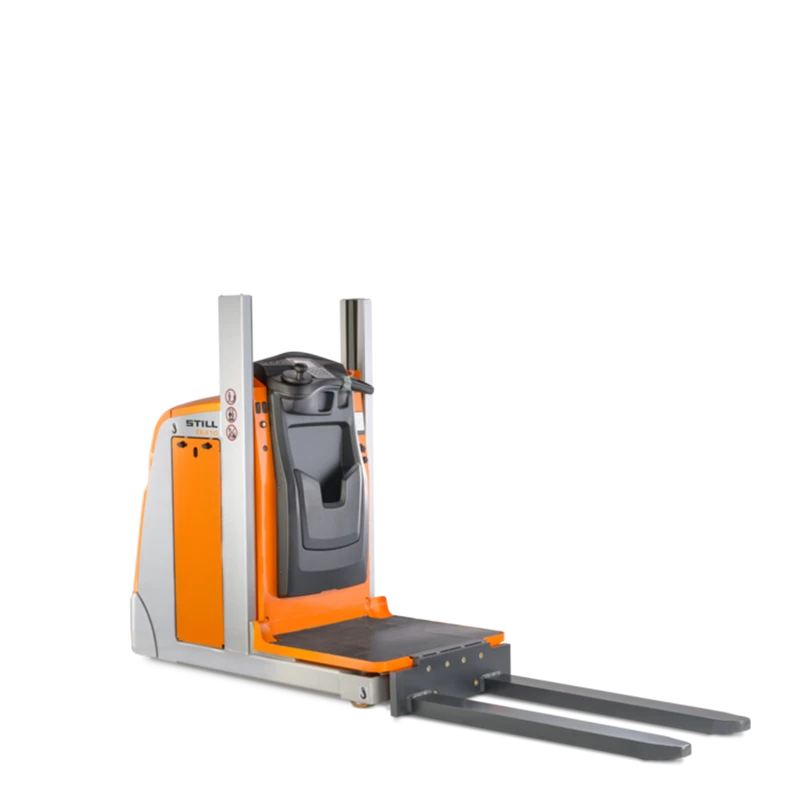
Electronic components rarely go to the line as full pallets: each production order needs a kit of many SKUs, a few reels or trays each. Building kits, plus picking spare parts and warranty components, is the job of an order picker for the electronics industry, where accuracy matters as much as speed.
Where does picking happen in an electronics plant?
- Kitting per production order: the picker walks the component store, collects every SKU for a batch and places it on a pallet or trolley for the line.
- Spare parts store: many small SKUs in single orders for service centres or dealers.
- Finished goods by carton: mixed orders of several models for distributors.
Component kits have many order lines with small quantities, and one wrong SKU can stop a line. Picking aisles therefore need trucks that let the picker focus on the right location instead of constantly getting on and off.
Low-level picking: STILL OPX-L 12 and OPX iGo neo
When components sit at floor and first rack level, a low-level order picker is the common choice. The STILL OPX-L 12 has a mast that lifts picked goods weighing up to 1,200 kg to a working height of up to 786 mm, so pickers place component cartons without bending deeply. It travels at up to 12 km/h and can stack pallets vertically. A folding step and raisable operator platform speed up picking at the first rack level.
For very high-frequency kitting, the STILL OPX 20-25 iGo neo drives, steers, accelerates and brakes on its own, following the operator. The manufacturer says this eliminates up to 75% of getting on and off; hybrid tracking recognises the operator even during Z-picking between two rack rows. An automation interface allows integration into customer processes.
High-level picking: STILL EK-X 10
Many component stores use tall racks to save space, with slow-moving SKUs on upper levels. The STILL EK-X 10 lifts the picker and cab together, handling up to 1,000 kg to a height of 6.3 metres. Tilting side barriers shorten the distance between picker and rack for ergonomic picking even from deep locations.
The key for component stores is connectivity: STILL iGo pilot navigation guides the truck and offers semi-automatic rack approach, linked to the warehouse management system (WMS) via the iGo pilot interface. The truck goes to the right location for the pick order, reducing the risk of picking the wrong SKU. Lithium-ion versions offer opportunity charging.
Recommendation table: process – model – reason
| Process | Suggested model | Reason |
|---|---|---|
| Low-level kitting | STILL OPX-L 12 | Lifts picked goods to 786 mm, stacks pallets |
| High-frequency kitting | STILL OPX 20-25 iGo neo | Up to 75% fewer get-offs, hybrid tracking |
| High-rack component store | STILL EK-X 10 | Up to 6.3 metres, tilting barriers |
| Spare parts store with WMS | STILL EK-X 10 | iGo pilot navigation, WMS interface |
Designing a component kitting area
- Analyse the pick frequency of each SKU and place fast movers at the easiest levels.
- Standardise component bins and trays so they stack stably on kit pallets.
- If the store includes electrostatic protected areas, define the rules for pickers and vehicles; STILL’s published specifications do not state anti-static features for order pickers, so discuss this during the survey.
See also order picker guide: low-level or high-level, the STILL order pickers category and forklift solutions for electronics.
Frequently asked questions
Should component kitting use low-level or high-level pickers?
It depends on rack height. If the SKUs sit at floor and first level, choose the OPX; if they are stored high, choose the EK-X 10.
Can the EK-X 10 connect to the plant’s WMS?
The source states the EK-X 10 connects to a WMS via the STILL iGo pilot interface. The exact integration needs assessing against your current system.
Is iGo neo a fully autonomous truck?
No. iGo neo is an autonomous driver-assist mode: the truck follows the picker, who still picks and directs the work.
Need to design a component kitting area? Send a request on the quote page or call 0902 63 79 70.