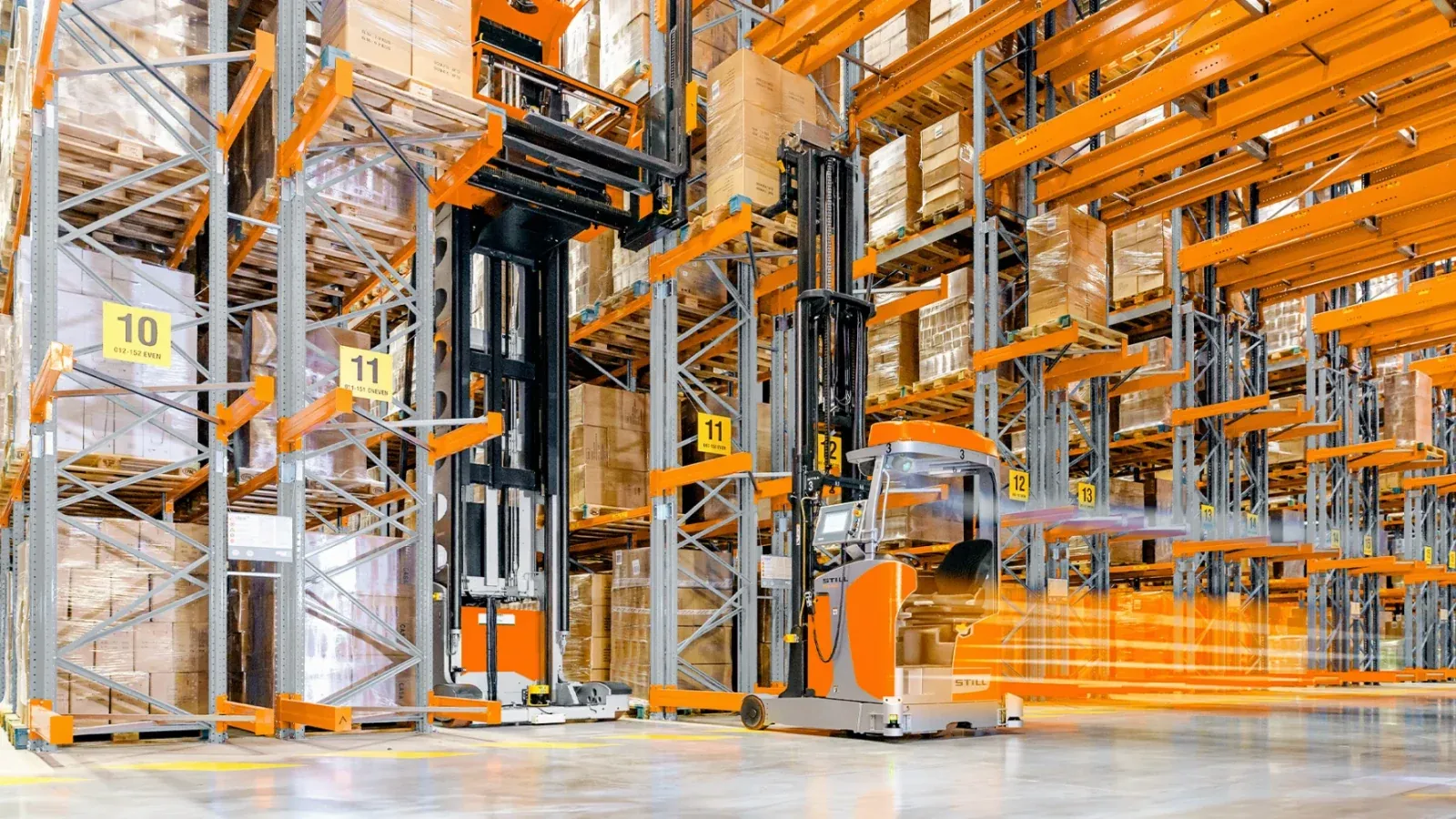
Autonomous forklifts (AGVs and AMRs) are no longer reserved for large distribution centres. With the STILL iGo range, a business can start with one simple transport route and expand step by step. The key question is not “should we automate?” but which process to automate, when, and with which truck.
AGV vs AMR: what is the difference?
An AGV (Automated Guided Vehicle) follows predefined routes; an AMR (Autonomous Mobile Robot) perceives its environment more flexibly. The line between the two is increasingly blurred: STILL iGo trucks use laser navigation for precise positioning and 360° safety laser scanners that create a protective zone around the truck, allowing them to work in mixed operation alongside people and manual forklifts.
Compared with fixed conveyors, autonomous trucks are more flexible: routes, pick-up and drop-off points are changed in software rather than by rebuilding the facility. That is why many warehouses choose autonomous trucks as the first step on their warehouse automation journey.
Signs your warehouse is ready to automate
Not every warehouse needs autonomous trucks right away. Consider it seriously when several of the following apply at once:
- Repetitive goods flows: pallets move along the same A–B route many times per shift, for example from the end of a production line to a staging area, or from goods-in into storage.
- Multi-shift operation: the more shifts, the clearer the value of a truck that can run continuously and consistently.
- Difficulty hiring and retaining drivers for monotonous tasks.
- Collisions and damaged goods at intersections, loading docks and narrow aisles.
- Standardised load carriers: pallets, cages or containers of consistent size allow reliable automated handling.
- A WMS is in place: connecting autonomous trucks to receive transport orders becomes much easier.
If floors are in poor condition, layouts change constantly or transport volumes are low, improve processes and the site first.
The STILL iGo range: choosing a truck by task
The table below summarises each model based on published specifications.
| Model | Truck type | Key specifications | Typical tasks |
|---|---|---|---|
| STILL AXL iGo | Autonomous low lift pallet truck | Capacity 1,500 kg, speed 7.2 km/h | Automated truck loading and unloading |
| STILL AXV 12 iGo | Automated stacker | Capacity 1,200 kg, working aisle 2,480 mm | Horizontal transport, supplying and removing production material |
| STILL EXV iGo | Versatile automated truck | Capacity 1,600 kg, lift 3,744 mm, aisle 2,875 mm | Wide-aisle and block storage, transfer stations |
| STILL EXV-CB iGo | Automated counterbalance stacker | Capacity 1,400 kg, lift 3,800 mm | Conveyor transfer, closed-bottom pallets, special load carriers |
| STILL FM-X iGo | Automated reach truck | Storage height up to 10 m, working aisle 2,950 mm | High racking, flow racking, VNA transfer stations |
| STILL OPX iGo neo | Low-level order picker with autonomous assistance | Capacity up to 2,500 kg | Order picking with the operator on foot |
Loading dock: STILL AXL iGo
Truck loading has long been a “blind spot” in intralogistics. The STILL AXL iGo navigates precisely in both the pre-loading zone and inside the trailer, with no need for stationary safety solutions at the dock. According to the manufacturer, two AXL iGo trucks working in double play can load up to 30 pallets in approximately 35 minutes. The fleet is managed via the browser-based MAS fleet manager.
Horizontal transport and material supply: AXV 12 iGo, EXV iGo, EXV-CB iGo
This is the group best suited for getting started. The STILL AXV 12 iGo is compact and comes in pre-configured best-fit packages that make selection easy. The STILL EXV iGo is more powerful and suits wide-aisle and block storage. The STILL EXV-CB iGo uses cantilever forks (no base arms), so it can pick up closed-bottom pallets from the floor and transfer loads directly to and from conveyors.
High racking: STILL FM-X iGo
When putaway into racking also needs automating, the STILL FM-X iGo is the automated version of the FM-X reach truck. Its Pallet Positioning System (PPS) ensures precise storage and retrieval of a wide variety of load carriers. If you are new to this truck type, see what is a reach truck.
Order picking: STILL OPX iGo neo
Not all automation replaces people. The STILL OPX iGo neo follows the picker, moving on its own and avoiding or stopping at obstacles. The manufacturer states it eliminates up to 75% of getting on and off the truck during picking. For safety, it only crosses intersections autonomously after the operator gives approval, and it can be switched to manual driving at any time.
Safety in mixed operation with people
The biggest concern when introducing autonomous trucks into a live warehouse is pedestrian safety. The AXV 12 iGo, EXV iGo, EXV-CB iGo and FM-X iGo feature a redundant safety system that meets the requirements of ISO 3691-4. 360° laser scanners create warning and protective fields around the truck; dynamic safety fields adapt to the route and curve radius. The optional STILL Warning Zone Light and STILL Safety Light make the truck easier to see.
You still need to separate traffic, mark routes and train staff to work alongside autonomous trucks.
Roll-out roadmap for autonomous forklifts
- Analyse goods flows: record routes, frequencies, load carrier types, floor condition and intersections.
- Pick a pilot route: choose a repetitive route with few exceptions and clearly measurable results.
- Choose the level of integration: the plug-and-play STILL iGo easy solution allows stand-alone operation or WMS connection; material flow management systems can be connected via MMS.
- Train staff to work with autonomous trucks.
- Measure and scale: the STILL iGo insights analytics tool tracks utilisation and performance, helping you decide when to add trucks or processes.
See all models in the STILL automated trucks category.
Frequently asked questions
Can a small warehouse use autonomous forklifts?
Yes. The STILL AXV 12 iGo is designed to be compact for tight spaces, with a working aisle width of 2,480 mm. What matters is that goods flows are repetitive enough and the floor is suitable.
Is a WMS required?
No. STILL iGo easy allows stand-alone operation for simple tasks, with WMS connection added once the business is ready.
Do autonomous trucks completely replace drivers?
Usually not. Autonomous trucks handle repetitive routes while operators focus on tasks that need judgement. The EXV iGo and FM-X iGo can still be driven manually when needed.
How much does an autonomous forklift cost?
Cost depends on the number of trucks, level of integration and site conditions; a site survey is needed before quoting.
Considering warehouse automation? Request a quote or call our hotline 0902 63 79 70 and T&C will analyse your goods flows and recommend the right STILL iGo configuration.