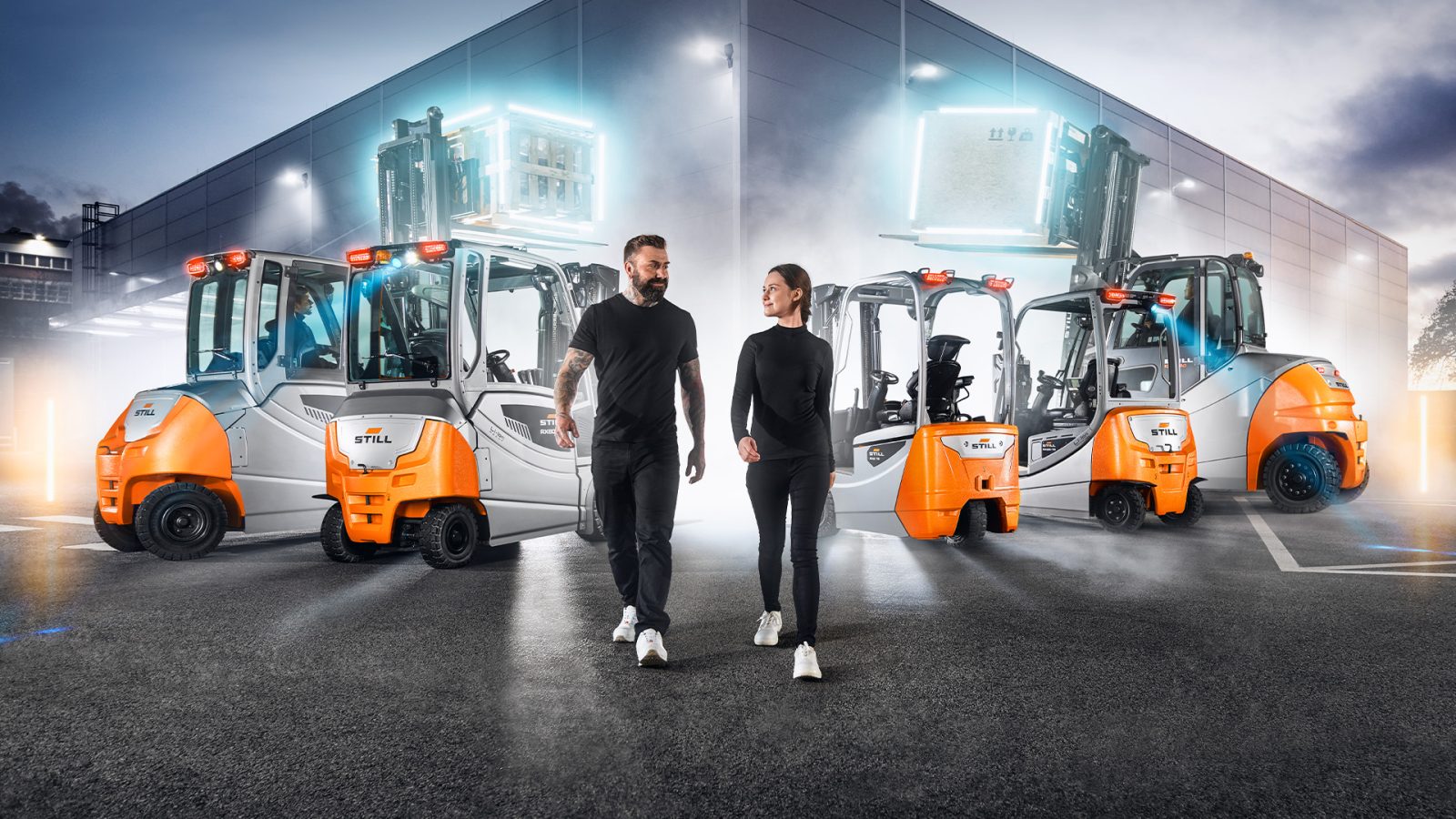
When investing in a new forklift, almost every business faces the same question: should we choose an electric or a diesel forklift? There is no answer that fits every warehouse. The choice depends on where the truck operates, how many shifts it runs, the loads it handles and how you calculate costs over several years. This article helps you compare the two types quickly using the most practical criteria.
1. Working environment: indoors or outdoors?
Electric forklifts produce no local emissions and run quietly, which makes them practically mandatory for enclosed warehouses, food and pharmaceutical plants, cold stores and areas where people work close to the trucks. Modern electric counterbalance trucks such as the STILL RX 20 or the RX 60 also perform well in covered yards with even surfaces.
Diesel and LPG forklifts suit outdoor yards, construction sites, building-materials depots and ports – places with rough surfaces, many ramps and trucks running all day. The STILL RX 70 series uses a diesel-electric drive, so it is more fuel-efficient than a conventional diesel truck.
2. Number of shifts and refuelling/charging time
- 1–2 shifts per day: overnight charging is enough for an electric forklift, even with a lead-acid battery.
- 3 continuous shifts: an electric truck can still cope if it uses a lithium-ion battery with opportunity charging during breaks, or a lead-acid battery with a battery-change system. A diesel truck only needs a few minutes to refuel.
- Irregular overtime and hard-to-plan charging times: diesel/LPG trucks are more flexible.
See also: Lithium-ion or lead-acid battery for electric forklifts?
3. Investment cost and operating cost
The purchase price of an electric forklift (including battery and charger) is usually higher than a diesel truck of the same capacity. In return, an electric truck has a significantly lower energy cost per hour and fewer maintenance items: no engine oil changes, fuel filters, spark plugs or exhaust system. The right comparison is therefore the total cost of ownership (TCO) over the whole service life, not just the purchase price.
| Criterion | Electric forklift | Diesel / LPG forklift |
|---|---|---|
| Local emissions | None | Yes |
| Noise level | Low | Higher |
| Initial purchase price | Higher | Lower |
| Energy cost per hour | Low | Higher |
| Scheduled maintenance | Few items | Many items (engine, filters, oil) |
| Best suited to | Enclosed warehouses, food, pharma, cold stores, manufacturing | Outdoor yards, construction, building materials, ports |
4. Load capacity
STILL electric counterbalance forklifts currently cover capacities from about 1 tonne (RXE 10–16C) up to 8 tonnes (RX 60 6.0–8.0 t). For heavier goods such as steel coils, concrete elements or timber blocks, the heavy-duty diesel RCD 10–18 t remains a popular choice.
5. Quick recommendations by application
- Distribution warehouses, supermarkets, FMCG: RX 20 (1.4–2.0 t), or RCE 15–20 if you need a standard configuration at a reasonable cost.
- Manufacturing plants and indoor warehouses with a loading yard: RX 60 2.5–3.5 t – a direct replacement for a diesel truck of the same capacity.
- Materials yards and outdoor sites with many ramps: RX 70 2.0–3.5 t diesel/LPG.
- Loads above 8 tonnes: RCD 10–18 t.
6. Common mistakes when choosing a truck type
- Comparing purchase price only: this ignores fuel, maintenance and downtime costs over many years of operation. Ask your supplier to compare both options using the same assumptions about daily operating hours.
- Underestimating outdoor running time: a truck that mainly works indoors but regularly goes out onto unpaved yards or rough ramps needs different tyres and a different protection rating – or a diesel/LPG truck may be the better choice.
- Forgetting the charging infrastructure: switching to electric requires a power supply with sufficient capacity and a sensible charger location. Lead-acid batteries also need a well-ventilated charging area.
- Ignoring the operators: electric and diesel trucks feel different to drive, accelerate and brake differently. Operators should be re-briefed before the trucks go into regular shifts.
Electric technology has significantly narrowed the availability gap. For example, with the STILL RX 20 Li-Ion, just 30 minutes of charging can extend the usage time by several operating hours. On the other side, the STILL RX 70 uses a hybrid diesel-electric drive that makes the diesel truck run more smoothly and efficiently. The final decision should therefore be based on real operating data from your own warehouse.
Frequently asked questions
Can an electric forklift work outdoors in the rain?
Yes, if the truck is configured with a suitable protection rating and tyres. During the site survey, our engineers will ask about the share of outdoor running time, ramp gradients and surface conditions to choose the right configuration.
What do we need to prepare when switching from diesel to electric?
You need to plan the power supply and charger location, choose the battery type based on the number of shifts and retrain your operators. Learn more about our energy solutions for electric forklifts.
Can we rent a truck before buying?
Yes. Our forklift rental service lets you test a truck under real conditions before making an investment decision.
Need advice on a specific configuration? Send a quote request with your load capacity, lift height and number of shifts, or call our hotline 0902 63 79 70 – our technical team will survey your site and compare costs for each option.