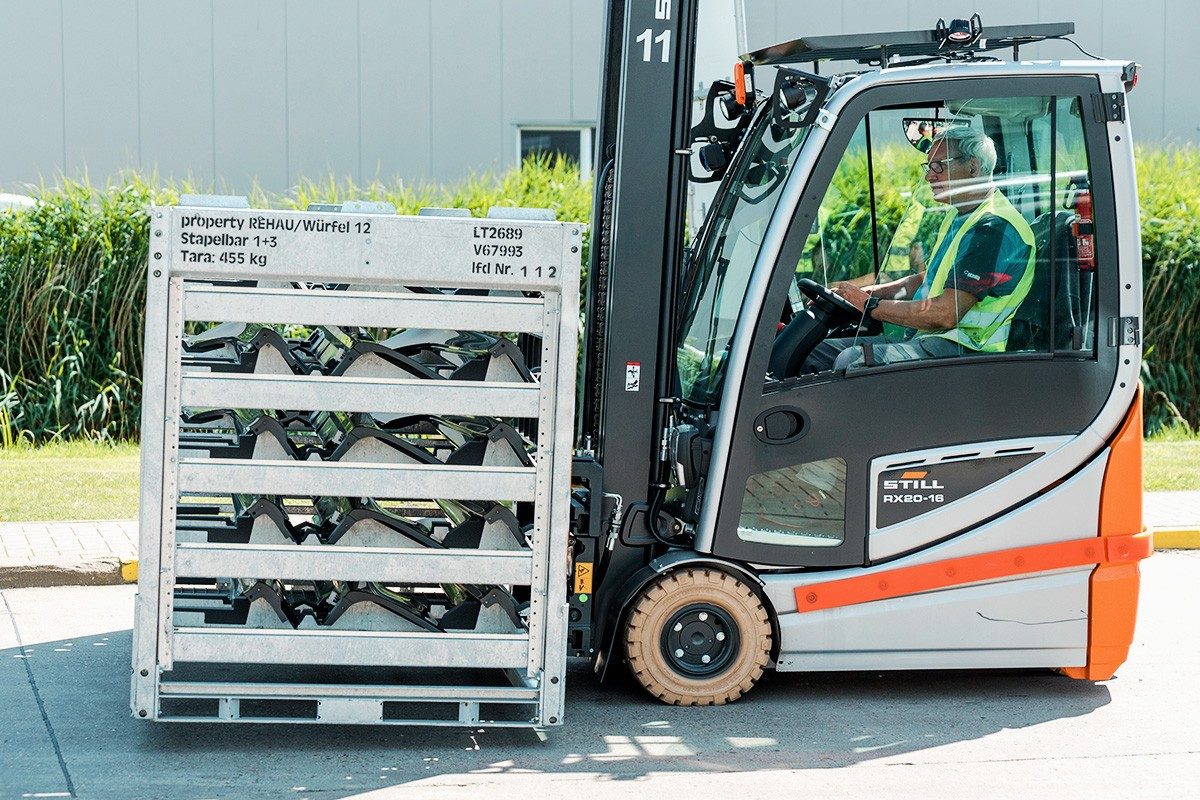
At automotive supplier REHAU Automotive‘s plant in Brake on the Lower Weser, Germany, production and dispatch are mainly handled by forklift trucks. As production processes grew more complex and dynamic with a large number of items, the entire safety concept for internal transport had to be reorganised. Together with STILL, REHAU implemented a pioneering plant traffic safety system based on smart driver assistance, AI-assisted cameras and projected warning signs for pedestrians, intended to become the benchmark for other production sites.
| Industry | Automotive – polymer bodywork attachments |
|---|---|
| Company | REHAU Automotive: over 1,000 employees, part of the Rehau Group (approx. 20,000 employees, more than 190 locations) |
| Challenge | Ensuring the highest safety standards for around 180 trucks a day and up to 6,000 internal driving instructions |
| Solution | Reorganising internal transport and using smart driver assistance and safety systems to reduce accident risk |
| STILL equipment | Wireless collision avoidance, wireless zone detection (automatic zone-dependent speed reduction), AI camera systems for person detection, Safety Lighting projectors |
REHAU Automotive: a polymer specialist for over 70 years
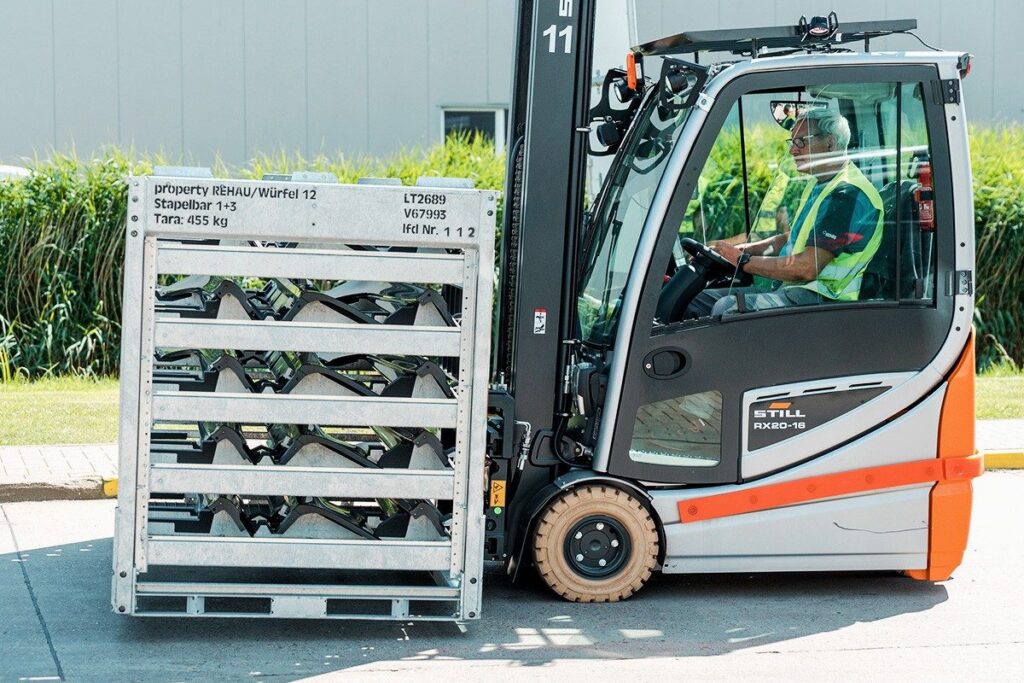
The REHAU plant in Brake was established on 6 September 1964 on 2,750 m2 with 15 employees. Starting with piping, REHAU Automotive went on to specialise in injection moulding, painting and assembling polymer systems for the bodywork attachments of cars from famous manufacturers. “Every day, around 180 trucks either arrive in incoming goods or take our bumper systems and external attachments out for delivery. This means we issue up to 6,000 driving instructions per day for internal transport, processed by the 91 trucks of the STILL electric forklift fleet,” explains Matthias Blum, Supervisor Production Logistics.
After constant expansion, the plant now employs more than 1,000 people in 80,000 m2 of halls on a 234,000 m2 site. REHAU Automotive is one of five companies in the Rehau Group, which generated revenue of more than EUR 4.5 billion in 2023 with approx. 20,000 employees at 190 locations worldwide.
The challenge: complex workflows put safety at risk
The large product range made production logistics workflows increasingly complex, and faulty processes in production supply put plant traffic safety at risk. “To achieve optimum safety standards, we got together with STILL, taking advantage of its vast experience to reorganise our transportation,” says Blum. Michael Dänekas, STILL Regional Service Manager Safety & Energy Solutions, adds: “Our Safety Assist functions support forklift drivers with sophisticated warning systems and automated intervention, reducing accident and injury risks to a minimum.”
Wireless zone detection protects the hall doors
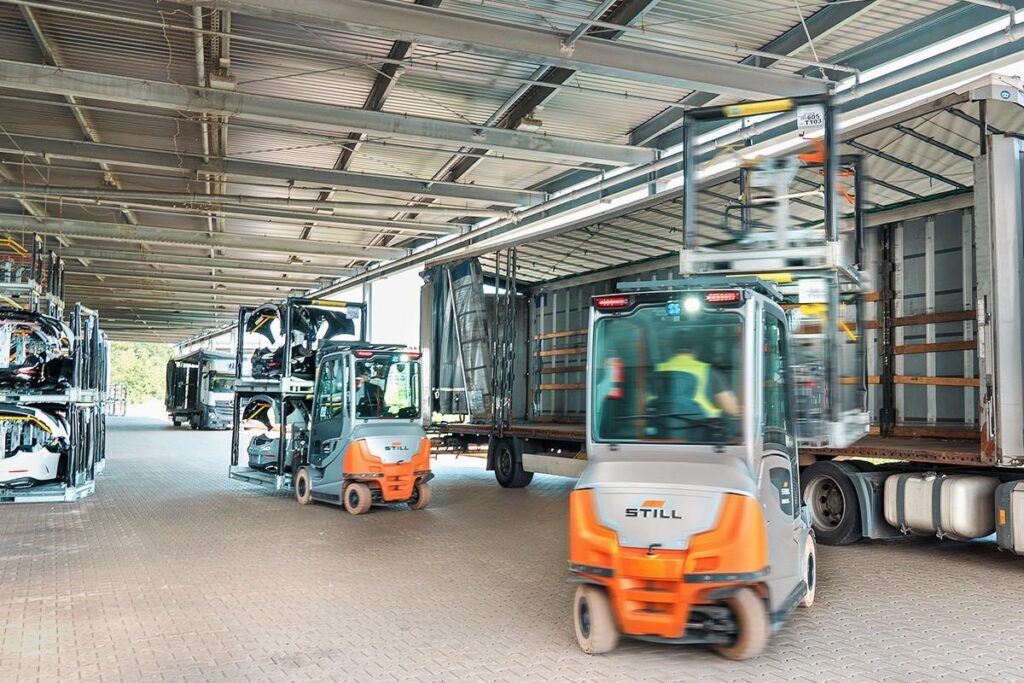
The hall doors in Brake are controlled by motion detectors. Higher traffic meant trucks sometimes stopped in the middle of the door area, causing accidents and collision damage. Speed reduction was therefore the most important requirement. Door zones, driving speeds and mast heights were analysed with STILL and parametrised in Safety Assist. 36 trucks were fitted with radio antennas connected to the truck control system, and receiving sensors were mounted at 26 hall doors.
When a truck enters the danger zone of a door, it sends a wireless signal to two door modules mounted parallel to the roadway, activating predefined safety functions such as reduced speed and warning lights for pedestrians. Zoning Assist manages truck performance in real time, and continuous wireless triangulation between the truck and both modules opens the door at the right moment and keeps it open until the truck has left the danger zone. Top speed can only be reactivated by pressing the accelerator again. “As it stands, there is hardly any collision damage at the hall doors,” confirms Blum.
Precise UWB radio at lower cost
The system uses short-range digital ultra-wideband (UWB) radio, which is less fault-prone in industrial environments and locates objects to within ten centimetres. “The UWB signal is precise and stable, so only one active antenna is needed on each truck roof. The hall doors and the projector lighting are controlled by the same signal. Acquisition costs are lower than for other technologies, and you only invest in the plant infrastructure once,” explains Dänekas. If a hazard point moves, the projector with its integrated radio module is simply repositioned.
Speed limits and AI person detection
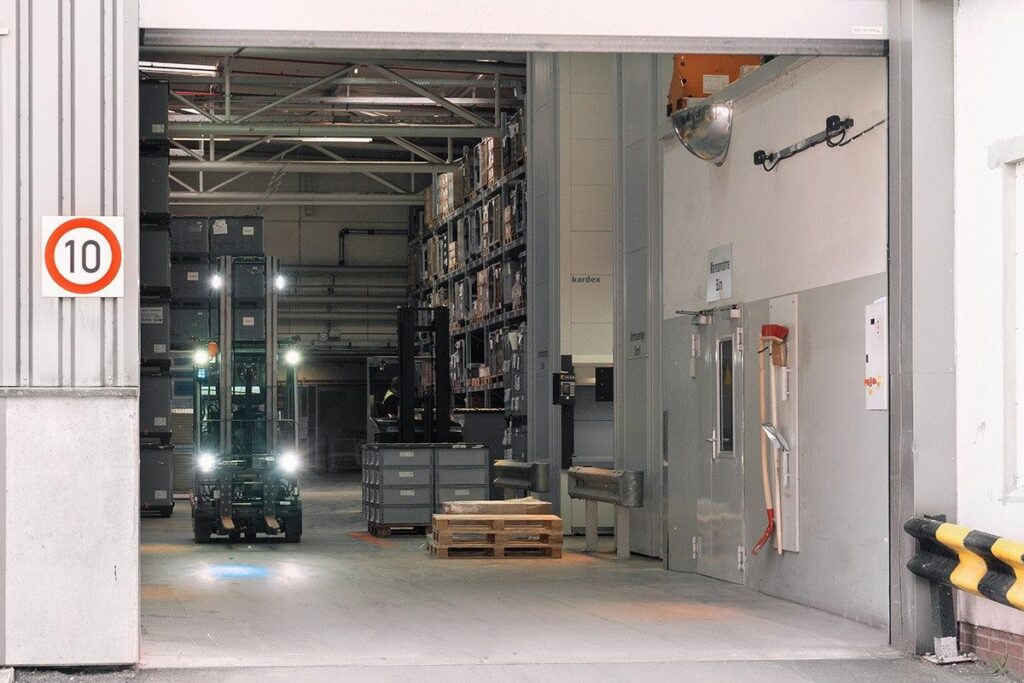
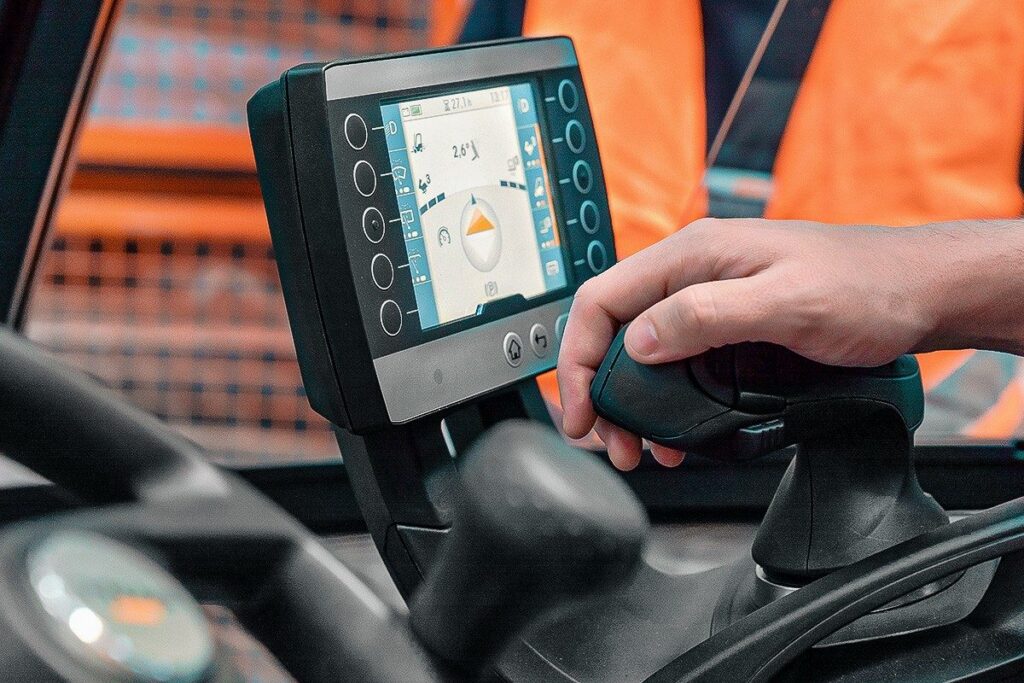
Maximum speeds are also limited by zone: 10 km/h in the halls because of heavy pedestrian traffic and 16 km/h outdoors where routes are long and pedestrians fewer, without cutting productivity or adding staff. All functions are monitored on the STILL Easy Control display, and an extra red LED in the cockpit shows when the speed limit is active.
The new AI-assisted STILL camera detects people and person-like objects in real time. Its integrated AI processor needs no extra hardware, it works from -40 °C to +85 °C and it can be mounted at the rear, front or sides. Drivers are warned in two stages: in the detection zone the person is framed in yellow with an acoustic signal and the truck can slow down; in the warning zone the frame turns red, a continuous alarm sounds and the optional STOP function halts the truck. “On average, we add at least double the value for every euro we spend on preventive measures,” says Thomas Köhle, Plant Director in Brake.
Projected warnings and results
Several LED projectors of the STILL Safety Lighting system on driving routes and walkways project a STOP sign onto the floor as soon as a truck approaches; unlike paint, the projection never wears. On the trucks, STILL Warning Zone Light Plus projects two light strips at the sides and a semi-circle at the rear to warn people nearby.
- The risk of accidents in plant traffic has been virtually eliminated.
- Hardly any collision damage at the hall doors.
- Lower energy costs, as faulty doors are no longer left open for long periods.
- Easier work for drivers handling 6,000 instructions a day; higher staff productivity and satisfaction.
“The smart Safety Assist functions are milestones for safety in plant traffic. Our internal transport system is the benchmark for other production sites and a flagship project for our entire company,” says Blum.
Lessons for companies in Vietnam
- Start with the hot spots: hall doors, pedestrian crossings and entrances are where warehouse safety measures such as zone-based speed limits pay off first.
- Measure before you configure: analyse speeds, mast heights and traffic flows first, and use fleet management to track the effect.
- Automotive suppliers: a fleet of STILL electric forklifts with safety assistants suits our automotive and engineering solutions.
See also our operator training and other STILL reference projects.
Source: STILL GmbH, Greater safety in plant traffic thanks to smart forklift trucks. Photos: STILL.
Need advice on safety systems for your forklift fleet? Send your request via the quote request page or call 0902 63 79 70.