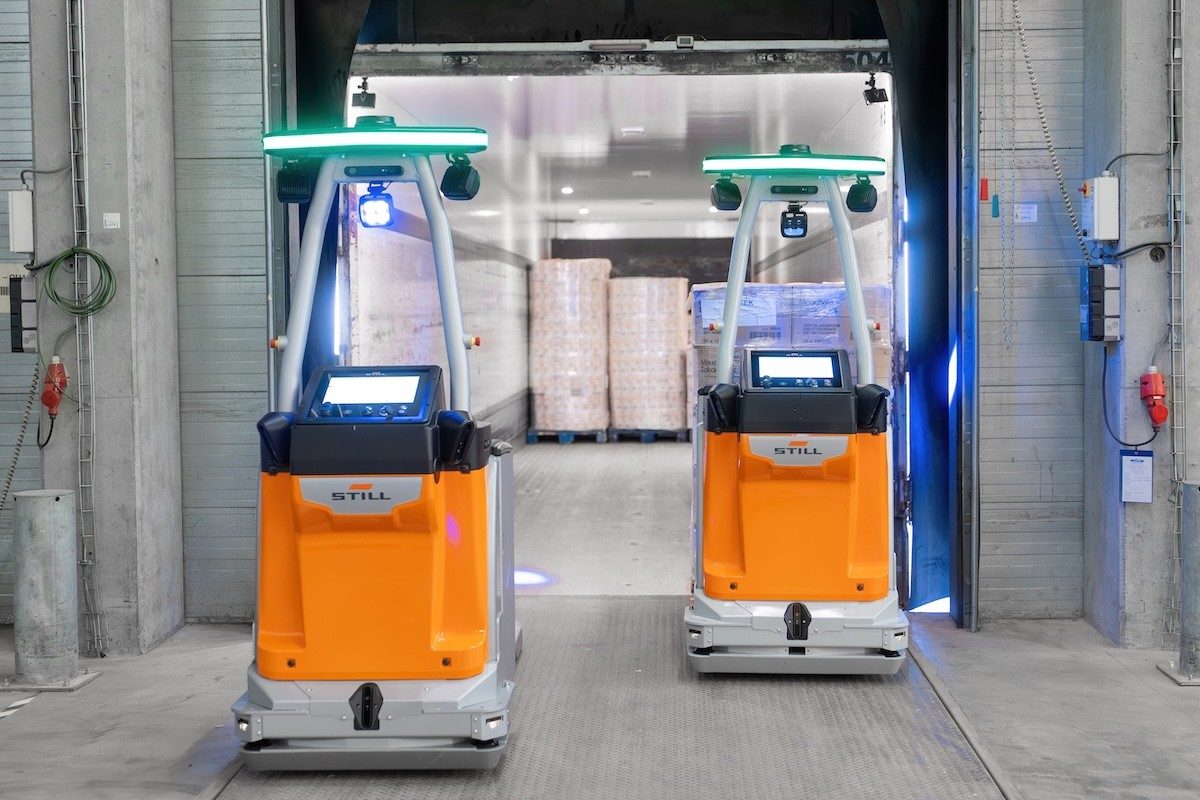
Retail logistics runs under constant pressure: high volumes, tight delivery windows and a growing shortage of labour. For Colruyt Group, one of Europe’s leading food retailers, this is everyday reality. Supplying more than 700 stores from a handful of large distribution centres requires tightly synchronised processes and reliable material flows. Loading and unloading lorries at the dock is critical to that system, yet it remains physically demanding and hard to automate. Together with STILL, Colruyt is now exploring a new approach: autonomous lorry loading and unloading.
| Industry | Food retailing |
|---|---|
| Company | Colruyt Group, over 700 stores in Belgium and Luxembourg, three distribution centres of around 100,000 m² each |
| Challenge | Automate lorry loading and unloading in high-throughput distribution centres with scarce staff and many manual tasks, while meeting strict safety requirements in mixed traffic and on ramps |
| Solution | A proof of concept for autonomous lorry loading, integrated step by step into existing operations |
| STILL equipment | STILL AXL iGo automated low lift pallet truck |
Retail logistics at scale
Colruyt Group runs three major distribution centres of roughly 100,000 square metres each. From these hubs, food and non-food goods go out daily to stores across Belgium and Luxembourg. The group also operates its own transport fleet and selected production lines such as meat and bakery. As an everyday low-price retailer, Colruyt puts a strong focus on process efficiency and cost control.
“We have been investing in innovation and R&D for many years to enable us to control our costs,” says Koen De Vos, Director Supply Chain at Colruyt Group. Yet retail logistics remains highly labour intensive, which makes recruitment and workforce planning harder every year. “One of the main challenges I see for the future is the availability of labour capacity,” he adds. Automation here is not about replacing people, but about supporting employees and stabilising operations.
The dock as a bottleneck
Unlike other warehouse processes, dock operations are highly dynamic: trailer types vary, pallets are not always perfectly placed and operators work close together. Stationary automation for this area has existed for years, but most of it relies on fixed installations such as conveyors or permanently installed loading devices.
“For us, these technologies were innovative but not necessarily adapted to our dense and variable supply chain environment,” De Vos explains. Extra fixed infrastructure clashed with Colruyt’s need for flexibility, so manually driven forklifts stayed the standard at the docks: reliable, but dependent on labour and limited by ergonomics and safety.
A step-by-step automation strategy
Colruyt takes a pragmatic, incremental approach. Instead of redesigning whole sites, it looks for solutions that fit existing layouts and processes. “Colruyt Group and STILL have a long-standing relationship, with STILL serving for years as a preferred supplier of traditional forklift trucks,” says De Vos. About four years ago the partners extended their cooperation to automation, starting with autonomous horizontal transport in the warehouse. The long-term goal was always to automate lorry loading as well, and that goal has now taken shape in the AXL iGo.
STILL AXL iGo: built for trailer loading
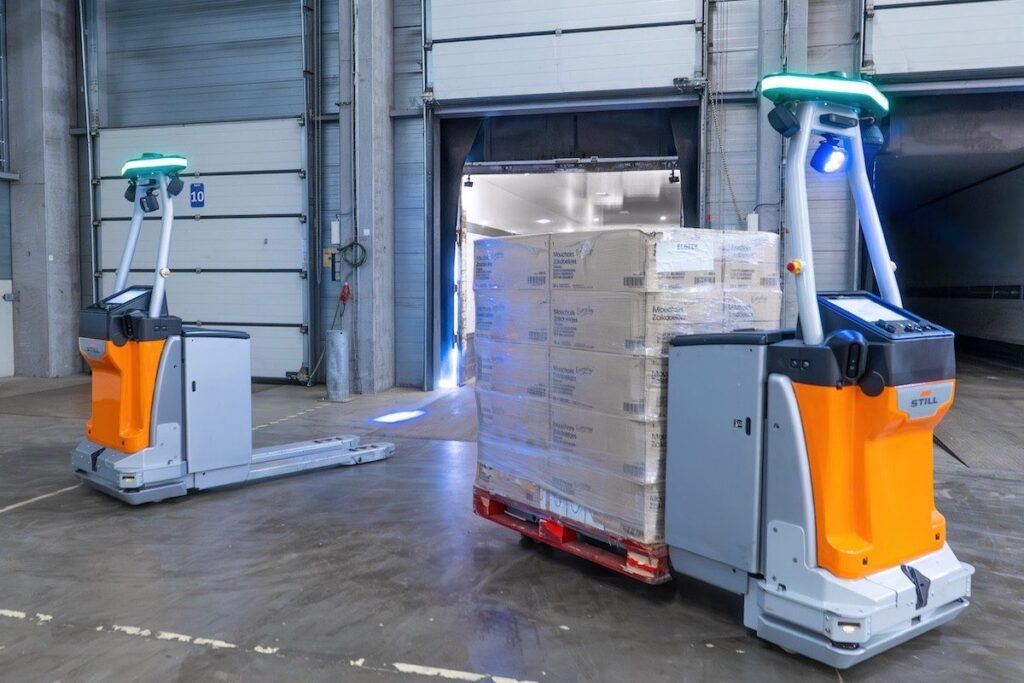
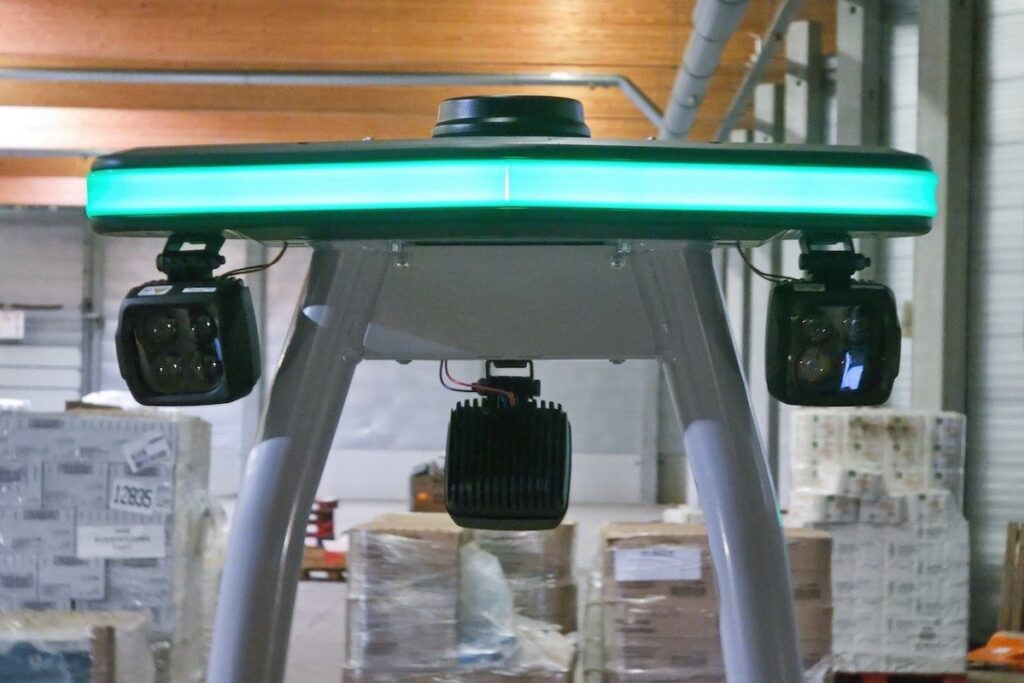
The STILL AXL iGo is an autonomous low lift pallet truck designed specifically for loading and unloading trailers. Unlike traditional automated loading systems, it needs no fixed safety installations such as cameras or dedicated loading infrastructure. It navigates with a combination of 3D Visual SLAM, cameras and LiDAR scanners, which lets it work safely inside trailers and in mixed traffic at the dock.
- Load capacity of 1,500 kg and a travel speed of up to 2 m/s (7.2 km/h).
- In a typical scenario, two trucks load 30 pallets into a trailer in around 35 minutes.
- Precise pallet detection handles off-centre loads and varying pallet quality, both common in retail logistics.
“AXL iGo was developed to mimic the actions of an experienced forklift truck operator, but with consistent performance across all shifts,” says Jasper Van Gool, Project Lead Automated and Integrated Solutions at STILL. “Because it works without fixed infrastructure, customers can introduce automation exactly where it creates value.”
Working safely in dense environments
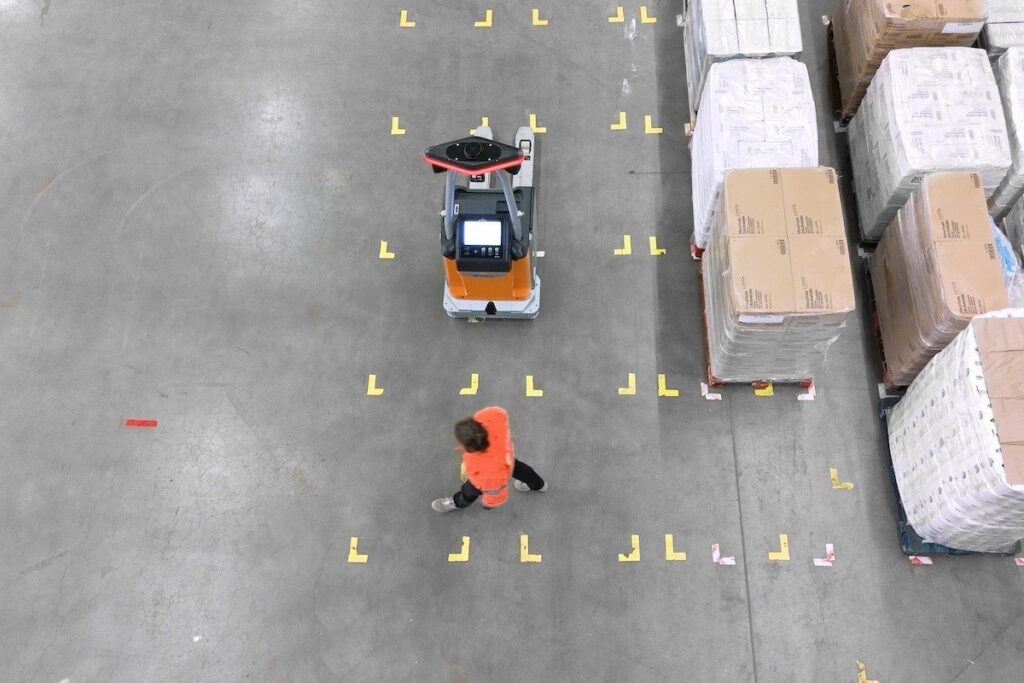
Safety is usually the biggest concern when automating the dock, where traffic density is high and people, manual trucks and vehicles constantly interact. The AXL iGo uses a 360-degree safety concept with scanners, cameras, visual and acoustic warnings and emergency stop functions. “Working safely alongside operators is very important to us,” De Vos stresses.
During the proof of concept, the autonomous trucks worked next to employees without disrupting established workflows. Manual operation remains possible at any time, which raises acceptance and operational resilience. “Our goal is not to isolate automation, but to integrate it into real logistics environments,” says Van Gool.
One machine, many tasks, easy to scale
Another deciding factor for Colruyt was the multifunctional nature of the AXL iGo. “With just one machine, you can perform horizontal movements as well as loading and unloading,” De Vos explains. That fits Colruyt’s cost-efficient approach and reduces the need for specialised equipment. To scale up, additional vehicles are added to the fleet management system through a browser-based interface without major infrastructure changes.
Proof of concept results
The trial shows that autonomous lorry loading works in a dense, high-throughput retail environment. For Colruyt it meets several strategic goals at once:
- Supporting the workforce as labour becomes scarce.
- Improving safety at docks with mixed traffic.
- Stabilising processes with consistent performance across shifts.
- Keeping flexibility and growing step by step without a large upfront investment.
“First of all, it works efficiently and reliably in dense operations,” De Vos sums up. “Secondly, it is scalable and can grow alongside our activities, without a significant initial investment.”
Lessons for companies in Vietnam
Retail distribution centres, supermarket chains and 3PL warehouses in Vietnam face rising labour costs and a shortage of forklift drivers too. From the Colruyt project:
- Start with the heaviest task: the outbound dock is often where automation pays off most in labour and safety.
- Pilot before scaling: run a proof of concept with one or two trucks in real operations, measure throughput, then decide on fleet size.
- Prefer solutions without fixed infrastructure: keep your existing layout and expand easily as volumes grow.
Learn more about STILL automated trucks, warehouse automation and forklift solutions for retail & wholesale. Projects delivered in Vietnam are listed on our reference projects page.
Source: STILL GmbH, Colruyt plans to optimise dock operations. Photos: STILL.
Want to assess automation for your own dock? Send a request via the quote request page or call 0902 63 79 70.